Saint Zephyrinus
Died 217
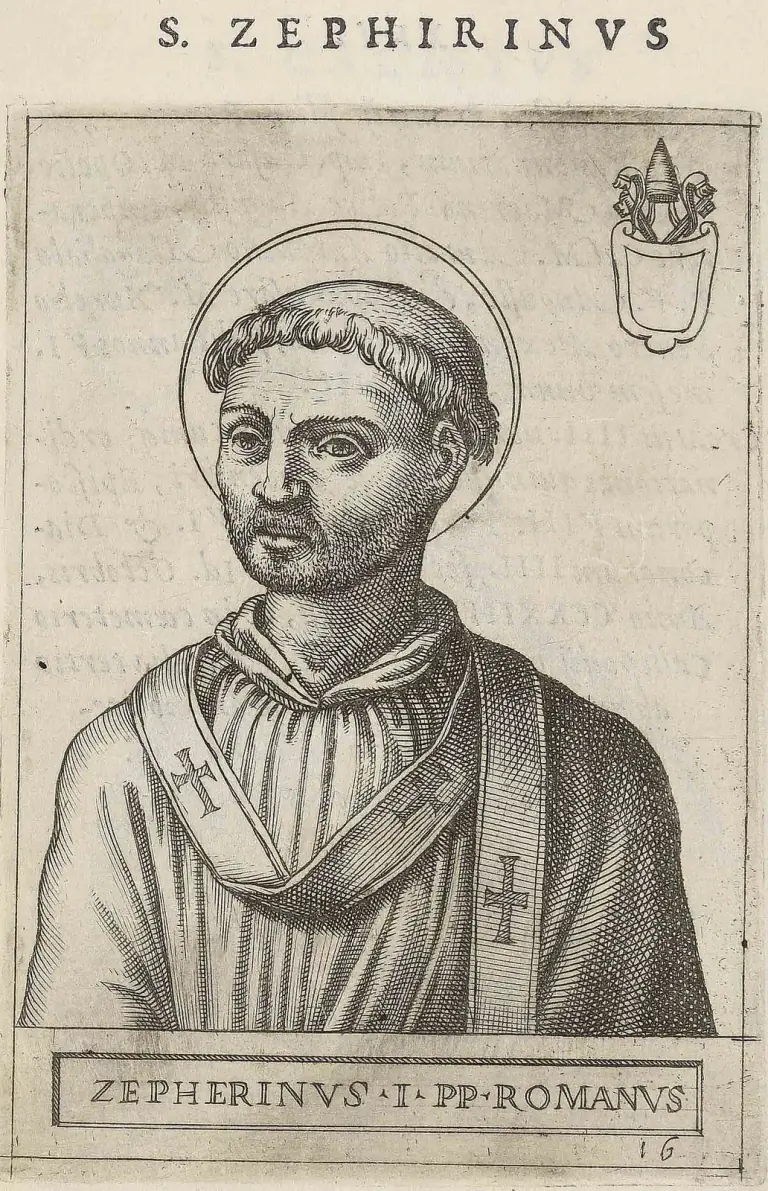
- Known for
- Putting the deacon Callistus in charge of the Church's cemetery on the Appian Way; the quarrel with Hippolytus over the Trinity 12
Saint Zephyrinus was bishop of Rome for eighteen years, from the end of the second century to 217, and the pope who put the deacon Callistus in charge of the Church's cemetery on the Appian Way, the catacomb that still bears Callistus's name. 147 Most of what is known about him comes from an enemy, the Roman theologian Hippolytus, who called him ignorant and corrupt because he would not condemn one side of a dispute about the Trinity. 12 His feast is December 20. 7
Victor's successor
The Liber Pontificalis, the early book of papal lives, says that Zephyrinus was "by nationality a Roman, son of Habundius." 5 J.P. Kirsch, in the Catholic Encyclopedia, has him elected on the death of Pope Victor in 198. 1 Eusebius puts the succession "about the ninth year of the reign of Severus," and says he held the office eighteen years. 34
Kirsch reads Hippolytus's description of him as "a simple man without education" and takes it to mean that Zephyrinus "had not taken the higher studies and had devoted himself to the practical administration of the Church and not to theological learning." 1 The Norwegian bishops' saints database (katolsk.no) is harsher: a weak man, wholly dependent on his capable archdeacon Callistus. 6
Callistus and the cemetery
One of the first things Zephyrinus did was to bring back Callistus, the former convict whom Victor had sent to live at Antium on a pension. 12 Hippolytus says that Zephyrinus made Callistus "a fellow-worker in the management of his clergy," and "transferring this person from Antium, appointed him over the cemetery." 2
Kirsch explains what that cemetery was. Shortly before, under Victor, the Roman Christian community had come to own "a common place of burial on the Via Appia," and Zephyrinus placed Callistus over it; the cemetery took his name. 1 Kirsch adds that Zephyrinus "undoubtedly" made Callistus a deacon, and that he became "the confidential counsellor of the pope, whom he succeeded." 1 The current Roman Martyrology remembers Zephyrinus for exactly this, as the pope who gave his deacon Saint Callistus the charge of building the cemetery of the Church of Rome on the Appian Way. 7
The penitent Natalius
Eusebius preserves one story about Zephyrinus from an anonymous work written in his time. 3 The followers of Theodotus, a teacher whom Victor had excommunicated for saying that Christ was "a mere man," persuaded a Roman confessor named Natalius, who had suffered for the faith, to become their bishop "with a salary, to be paid by them, of one hundred and fifty denarii a month." 3 katolsk.no gives the same sum; Kirsch, retelling it, has 170. 16
Natalius was warned in visions and ignored them, until one night, the story goes, "he was scourged by holy angels." 3 In the morning "he put on sackcloth and covered himself with ashes, and with great haste and tears he fell down before Zephyrinus, the bishop, rolling at the feet not only of the clergy, but also of the laity." 3 He showed the welts. "Yet scarcely was he taken back into communion." 3 Kirsch says only that readmission "was finally granted him." 1
Hippolytus and the quarrel over the Trinity
The great argument of Zephyrinus's years was over how to speak of the Father and the Son. Kirsch describes two schools in Rome. Hippolytus, "the most important theologian among the Roman presbyters of this era," taught a doctrine of the Logos that set the Son apart from the Father in ways that "offered many difficulties as regards the tradition of the Church." 1 Against him, Cleomenes and Sabellius stressed the oneness of God so far that the Son became a mode of the Father, and they were later called Modalists or Patripassians. 12
Zephyrinus would not rule between them. In Kirsch's account he "said simply that he acknowledged only one God, and this was the Lord Jesus Christ, but it was the Son, not the Father, Who had died," which Kirsch calls "the doctrine of the tradition of the Church." 1 Hippolytus preserves the same two sayings: "I know that there is one God, Jesus Christ," and "The Father did not die, but the Son." 2
Hippolytus wanted a ruling, and when none came he blamed the pope and his adviser. He calls Zephyrinus "an uninformed and shamefully corrupt man," "an ignorant and illiterate individual, and one unskilled in ecclesiastical definitions," and says Callistus moved him with presents because he "was accessible to bribes, and covetous." 2 He accuses him of drifting into the Modalist error himself. 2 katolsk.no answers that a profession of faith Zephyrinus issued shows he was no Modalist; he held both to Christ's divinity and to his distinction from the Father, but lacked the terms to say it, since the pope was no philosopher. 6
The rupture came only after his death. When Callistus was elected to succeed him, Kirsch writes, Hippolytus "withdrew from the Church with his scholars, caused a schism, and made himself a rival bishop." 1
Rome in his time
The peace that the Church had enjoyed under Victor did not last. Kirsch says the position of Christians "grew constantly worse," and that in 202 or 203 an edict of Septimius Severus "forbade conversion to Christianity under the severest penalties," though nothing is known of how it was carried out in Rome. 1 katolsk.no mentions the same decree. 6
Rome was full of argument. A learned Roman named Caius held a dialogue against the Montanist Proclus "at Rome under Zephyrinus," Eusebius says, and Kirsch notes that in it Caius points to the graves of Saint Peter on the Vatican and Saint Paul on the Ostian Way. 14 Origen, still a young teacher from Alexandria, came to Rome while Zephyrinus was bishop, "desiring, as he himself somewhere says, to see the most ancient church of Rome." 4
The Liber Pontificalis credits Zephyrinus with decrees on the ordination of clergy and on glass vessels at Mass. 5 Kirsch says they were ascribed to him "arbitrarily and without historical basis." 1
Death and burial
Eusebius says that Zephyrinus died in the first year of the emperor he calls Antoninus, "having held his office for eighteen years," and that Callistus received the episcopate. 4 Kirsch gives the date as December 20, 217. 1 The Liber Pontificalis says he "was buried in his own cemetery near the cemetery of Calistus on the Via Appia, August 25"; katolsk.no gives August 26 for the burial. 56 Kirsch places the grave "in a separate sepulchral chamber over the cemetery of Calistus." 1
He was later honored as a martyr. The 1897 English edition of the Roman Martyrology enters "St. Zephirinus, pope and martyr" at Rome. 8 katolsk.no says that tradition has no support in early sources and is regarded as unlikely, though the burial near Callistus can be believed. 6
What is Saint Zephyrinus the patron saint of?
Saint Zephyrinus's feast day
Saint Zephyrinus's feast day is December 20 in the current Roman Martyrology. 7 The Martyrology, in the text published by the Italian bishops, enters on that day at Rome, beside the cemetery of Callistus on the Appian Way, the burial of Saint Zephyrinus, pope, who governed the Church of Rome for eighteen years. 7 December 20 is also the day Kirsch gives for his death. 1
The older calendar kept him on August 26. The 1897 Martyrology has him there, and katolsk.no gives August 26 as his memorial day. 68
Praying with Saint Zephyrinus
Zephyrinus is a saint who comes down to us mostly through the words of someone who despised him. 2 Hippolytus was the leading theologian among the Roman priests, by Kirsch's reckoning, and his portrait of the pope is cruel. 12 Kirsch reads the same evidence and finds a pastor who refused to make a dogma out of one school's theology. 1
What Zephyrinus actually said was short. One God, and the Son, not the Father, died. 12 He held to that and would not be pushed further by either side, and whether that was wisdom or simplicity his own century could not agree.
The story Eusebius kept is of a confessor who had sold himself to a sect and came back in sackcloth, and of a Church that took him back with difficulty. 3 It was Zephyrinus at whose feet he fell. 3 The cemetery he gave to Callistus became the burial place of the Roman Church, and the Martyrology still remembers him by it. 17
Saint Zephyrinus, pray for us.
Sources
- 1.J.P. Kirsch, "Pope St. Zephyrinus," The Catholic Encyclopedia, Vol. 15 (New York: Robert Appleton Company, 1912).
- 2.Hippolytus, Refutation of All Heresies, Book IX, chapters 2, 6 and 7, translated by J.H. MacMahon, Ante-Nicene Fathers, Vol. 5 (Buffalo: Christian Literature Publishing Co., 1886), as hosted by New Advent.
- 3.Eusebius, Church History, Book V, chapter 28, translated by Arthur Cushman McGiffert, Nicene and Post-Nicene Fathers, Second Series, Vol. 1 (Buffalo: Christian Literature Publishing Co., 1890), as hosted by New Advent.
- 4.Eusebius, Church History, Book VI, chapters 14, 20 and 21, translated by Arthur Cushman McGiffert, Nicene and Post-Nicene Fathers, Second Series, Vol. 1 (Buffalo: Christian Literature Publishing Co., 1890), as hosted by New Advent.
- 5.The Book of the Popes (Liber Pontificalis), Vol. 1, "XVI. Zephyrinus," translated by Louise Ropes Loomis (New York: Columbia University Press, 1916).
- 6."Den hellige pave Zefyrinus ( - 217)," Den katolske kirke (katolsk.no), Catholic Diocese of Oslo (in Norwegian).
- 7.Roman Martyrology, entry for December 20, "San Zefirino, papa," as printed in "Santo del giorno," Conferenza Episcopale Italiana (in Italian).
- 8.The Roman Martyrology, August 26 (Baltimore: John Murphy Company, 1897).
Saints to turn to next
Others in this collection who are turned to for some of the same things.
- Saint Agnes of Montepulcianoc. 1268 - April 1317Work and vocationDiscernment
- Saint Albert ChmielowskiAugust 20, 1845 - December 25, 1916DiscernmentWork and vocation
- Saint Andrew Avellino1521 - November 10, 1608DiscernmentWork and vocation
- Saint Angela MericiMarch 21, 1474 - January 27, 1540Work and vocationDiscernment