Saint Angela Merici
March 21, 1474 - January 27, 1540
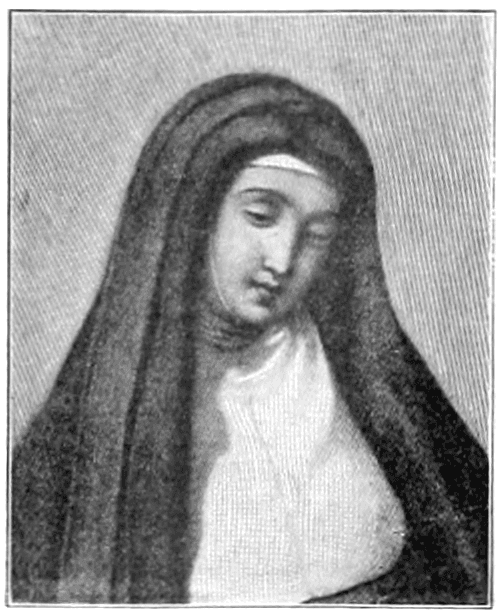
- Feast day
- January 27, the day she died. The 1907 encyclopedia gives May 31 1
- Born
- At Desenzano on Lake Garda, March 21, 1474 1
- Which was
- Not a religious order: no community life, no habit, no vows 2
Saint Angela Merici invented something the Church did not have a word for: women consecrated to Christ who went on living in their own houses, in ordinary clothes, without vows. 2 Franciscan Media credits her with founding both "the first of what are now called 'secular institutes' and the first teaching order of women in the Church." 2 She began by turning her own house into a school for the girls of her town. 1 Seventy years after she died, the thing she made was reorganized into a conventional religious order. 2
A sister who died without the sacraments
She was orphaned young - at ten according to Ott, in her teens according to Franciscan Media - and went with her elder sister to an uncle's house. 12 Then the sister died suddenly, and Ott specifies the circumstance that tormented her: "without being able to receive the last sacraments." 1
What she did about it is precise and slightly heartbreaking. She became a Franciscan tertiary and "greatly increased her prayers and mortifications for the repose of her sister's soul." 1 And then: "In her anguish and pious simplicity she prayed God to reveal to her the condition of her deceased sister." 1 She asked to be told where her sister was.
Ott reports the answer with the hedge intact: "It is said that by a vision she was satisfied her sister was in the company of the saints in heaven." 1
At twenty her uncle also died and she went home. 1
Her own house, as a school
Her diagnosis of what was wrong was specific. Ott: "Convinced that the great need of her times was a better instruction of young girls in the rudiments of the Christian religion, she converted her home into a school where at stated intervals she daily gathered all the little girls of Desenzano and taught them the elements of Christianity." 1
No foundation, no permission, no building - she used the house she had inherited and taught the children of the town in it. The order came out of the school, not the other way round.
It worked well enough that Brescia asked her to do the same there. 1 Franciscan Media has her going as a live-in companion to a widow and becoming "the spiritual advisor of a group of men and women with ideals of spiritual renewal and service to those in need." 2
Blind on Crete
On pilgrimage to the Holy Land in 1524 "she became suddenly blind when she was on the island of Crete." 1
She went on anyway. Ott: she "continued her journey to the Holy Places". 1 Franciscan Media puts what that means: "She proceeded to visit the sacred shrines, seeing them with her spirit." 2 She completed a pilgrimage whose entire purpose is to see things, without sight.
And then the detail that makes the story: she was cured on the return journey "while praying before a crucifix at the same place where she was struck with blindness a few weeks before." 1 The same spot, going the other way.
The following year she was in Rome for the jubilee and Clement VII, having heard of her, "invited her to remain in Rome; but Angela, who shunned publicity, returned to Brescia." 1 She turned down the pope and went home to the school.
A company, not an order
On November 25, 1535, she "chose twelve virgins and laid the foundation" of what became the Ursulines, in a small house near the church of St. Afra. 1 She was sixty. 2
What she actually established is where the two sources diverge, and it matters. Ott calls it "the order of the Ursulines" and calls her "Foundress of the Ursulines". 1 Franciscan Media describes something else: "This constituted a new way of life: single women consecrated to Christ and living in the world rather than in a monastery. With Angela as their 'mother and mistress,' Company members did not live in community, wore no special clothing, and made no formal vows." 2
No convent, no habit, no vows. Women who stayed where they were, kept their own clothes, and belonged to each other by agreement. Franciscan Media says this is "the first of what are now called 'secular institutes'" - a category that would not have a name for another four hundred years. 2
The name was chosen deliberately: Ursula, "a patroness of medieval universities and venerated as a leader of women." 2
She was superior for five years and died at Brescia on January 27, 1540, and was buried, Franciscan Media notes, "clothed in the habit of a Franciscan tertiary" - the one she had taken as a grieving girl. 12 The Rule she wrote was approved four years after her death. 2
What happened to it afterward
Franciscan Media records the change in a single sentence that deserves more weight than its length: "In the early 1600s, Companies that had expanded into France were re-organized into the religious Order of St. Ursula, to teach girls." 2
Seventy years after she died, the thing that was not a religious order became one - enclosed, habited, vowed. That is how the Ursulines are known, and it is how Ott's 1907 article describes the original foundation, with the distinction gone. 1
Both survived. "Angela's words continue to inspire the Ursuline nuns' mission of education, a mission that spread worldwide. The Company of St. Ursula also continued to exist and is federated worldwide today with members in 30 countries." 2 The order she did not found and the company she did are both still going.
She was beatified in 1768 and canonized in 1807 by Pius VII. 12
What is Saint Angela Merici the patron saint of?
Neither source cited here gives her a patronage. 12 Ott's article ends with her burial and canonization; Franciscan Media's with the spread of the Company. Neither names a cause she is invoked for, and this page does not supply one.
What she is credited with is a category rather than a cause: the first secular institute, and the first teaching order of women. 2
Saint Angela Merici's feast day
The feast of Saint Angela Merici is January 27, the day she died in 1540.
The 1907 encyclopedia gives a different date and then corrects itself. The article ends "Her feast is celebrated 31 May", and a note added to the text by New Advent's editors follows: "After this article was written, her feast was moved to 27 January." 1
Both are printed rather than one being quietly replaced. A reader who meets May 31 in an older book has not found a mistake.
Praying with Saint Angela Merici
She is the saint for doing the thing in front of you with what you already have. She did not found a school; she taught in her own front room, and gathered the local girls at set times, because she had decided that was what was most needed. 1 Everything afterward - Brescia, the Company, the Rule, an educational mission on every continent - grew out of a house and a decision.
The invention is the remarkable part and it is easy to miss because it looks like nothing. Women who wanted to belong to God entirely, without leaving home, wearing what they already wore, bound by no vow. 2 In 1535 there was no such thing, and there was no word for it until the twentieth century. She built a form of life the Church had to catch up with.
And then it was changed. Seventy years after she died the Companies in France were reorganized into a conventional order - enclosed, habited, vowed - which is how the Ursulines are known and how her own encyclopedia describes her foundation four centuries later. 12 She is in good company here: the Visitation was forced into enclosure too. Founders rarely get to keep the shape of what they made.
The blindness on Crete is the image to hold. She had crossed the Mediterranean to look at the holy places and lost her sight before she got there, and she went and saw them anyway. 12 What she came for had not depended on her eyes.
Saint Angela Merici, pray for us.
Sources
Saints to turn to next
Others in this collection who are turned to for some of the same things.
- Saint Gregory the Greatc. 540 - March 12, 604Work and vocationDiscernmentStudy and teaching
- Saint Albert the Greatc. 1206 - November 15, 1280Study and teachingWork and vocation
- Saint Augustine of CanterburyBirth unknown - 604 or 605Work and vocationDiscernment
- Saint Augustine of HippoNovember 13, 354 - August 28, 430Study and teachingDiscernment