Saint Augustine of Canterbury
Birth unknown - 604 or 605
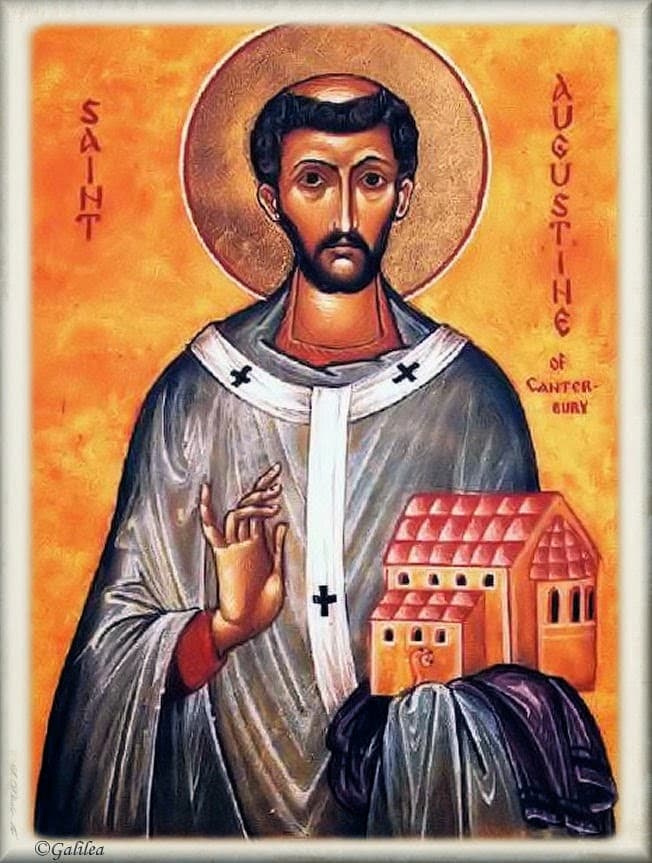
- Feast day
- May 27 2
- Was
- Prior of Gregory the Great's own monastery on the Caelian Hill in Rome 1
- Baptized
- King Ethelbert of Kent on Pentecost Sunday, 597, within a year of landing 2
- Failed at
- Reconciling the Anglo-Saxon Christians with the Britons - "dismal failure" 2
Saint Augustine of Canterbury was a Roman prior sent to convert the English, and he got as far as Gaul before the stories about the people he was going to frightened his party into wanting to go home. 12 He went back to Rome himself to explain why the mission should be dropped. Gregory the Great sent him straight out again. 1 He landed in Kent, baptized its king within a year, founded the see of Canterbury, and failed completely at the one task that needed diplomacy rather than nerve. 2
What the mission replaced
Gregory's first idea was not a mission at all. Clifford states it without comment: "The first plan which seems to have occurred to the pontiff was to take measures for the purchase of English captive boys of seventeen years of age and upwards. These he would have brought up in the Catholic Faith with idea of ordaining them and sending them back in due time as apostles to their own people." 1 He wrote to a presbyter administering Church land in Gaul to set aside the revenues for the purchases. 1
What came instead was about forty monks from Gregory's own monastery - the house of St. Andrew on the Caelian Hill, which he had built out of his own family property and ruled himself before becoming pope. 1 Augustine was its prior, and Gregory "designated Augustine... to be their representative and spokesman." 1
Clifford is sharp about why it had to come from Rome at all. The king of Kent, Aethelberht, had married a Christian Frankish princess, Bertha, on the express condition that she could practice her religion, and she had brought a bishop with her; a ruined Roman-British church outside the walls at Canterbury had been set aside for her use. 1 And nothing had happened. "Neither Bertha's piety, nor Luidhard's preaching, nor Aethelberht's toleration, nor the supposedly robust faith of British or Gaulish neighbouring peoples was found adequate to so obvious an opportunity until a Roman pontiff, distracted with the cares of a world supposed to be hastening to its eclipse, first exhorted forty Benedictines of Italian blood to the enterprise." 1
A Christian queen with her own bishop had been living in Canterbury for perhaps twenty years, and the nearest Christian bishops had not crossed the Channel. 1
They turned back
They left in June 596 with letters to the bishops and princes on the route, and instructions to pick up Frankish interpreters before crossing. 1 They did not get far.
"Discouragement, however, appears early to have overtaken them on their way. Tales of the uncouth islanders to whom they were going chilled their enthusiasm, and some of their number actually proposed that they should draw back." 1 Franciscan Media has the same: "Hardly had he and his men reached Gaul when they heard stories of the ferocity of the Anglo-Saxons and of the treacherous waters of the English Channel." 2
Augustine did not overrule them. "Augustine so far compromised with the waverers that he agreed to return in person to Pope Gregory and lay before him plainly the difficulties which they might be compelled to encounter." 1 He went back to Rome to argue their case, and the rest of the party waited near Aix-en-Provence. 1
Gregory did not accept it. He "raised the drooping spirits of Augustine and sent him back without delay to his faint-hearted brethren, armed with more precise, and as it appeared, more convincing authority." 1 Franciscan Media's version is one line: he was "assured by him that their fears were groundless." 2 Gregory also made him abbot of the party, which settled the question of who was in charge. 1 The letter of encouragement is dated July 23, 596, and Augustine was back at Aix by August. 1
"Whatever may have been the real source of the passing discouragement no more delays are recorded." 1 They went up the Rhone, through Arles and Vienne and Autun to Paris, wintered there, picked up interpreters, and sailed in the spring. 1
Kent
They landed on the Isle of Thanet and waited, as ordered, until the king would see them. 1 Clifford notes that four separate places claim to be the exact spot and declines to choose between them - "The Boarded Groin, Stonar, Ebbsfleet, and Richborough... each has its defenders." 1 The king came the dozen miles from Canterbury himself, and the meeting was held outdoors, "sub divo". 1
It went well. Franciscan Media: "Ethelbert received them kindly, set up a residence for them in Canterbury and within the year, on Pentecost Sunday 597, was himself baptized." 2 Augustine was consecrated bishop in France and came back to found his see, building a church and monastery near the site where the present cathedral, begun in 1070, now stands. 2 Sees followed at London and Rochester. 2
The method was Gregory's and Franciscan Media calls it "quite enlightened for the times": "purify rather than destroy pagan temples and customs; let pagan rites and festivals be transformed into Christian feasts; retain local customs as far as possible." 2 It is the opposite of the instinct that levels a shrine, and it is the reason a good deal of pre-Christian England survives inside the Christian calendar.
The thing he could not do
There were already Christians in Britain - the Britons, driven west by the same Anglo-Saxon invasions that had produced the kingdom Augustine was now evangelizing. Reconciling the two was the task he failed at, and Franciscan Media does not soften the verdict: the attempts "ended in dismal failure." 2
The reasons it names are two, and only one of them was about religion. "Augustine failed to convince the Britons to give up certain Celtic customs at variance with Rome and to forget their bitterness, helping him evangelize their Anglo-Saxon conquerors." 2 He was asking a defeated people to change their practices and to go and preach to the people who had defeated them, on behalf of a foreigner who had arrived after the conquest and was working from the conquerors' court.
It did not happen. Clifford's article describes a later conference at which only seven British bishops came and the result "was, if anything, more discouraging than before", with accusations of unworthy motives freely made. 1
What is Saint Augustine of Canterbury the patron saint of?
Neither source cited here gives him a patronage. 12 Clifford lists his symbols instead - "cope, pallium, and mitre as Bishop of Canterbury, and pastoral staff and gospels as missionary" - and the title both sources give him is a description of what he did: Apostle of the English. 12
This page leaves the patronage question open rather than filling it in.
Saint Augustine of Canterbury's feast day
The feast of Saint Augustine of Canterbury is May 27.
He died on May 26, and the two sources disagree about the year. Clifford's article opens with "d. 26 May, 604"; Franciscan Media says his death came in 605, "a short eight years after his arrival." 12 Neither explains the gap between the death date and the feast, and this page does not guess at one.
Praying with Saint Augustine of Canterbury
He is the saint for having already said yes and then wanting out. He was a prior in a Roman monastery, sent by a pope who knew him personally, and somewhere in Gaul the reports about the Channel and the Anglo-Saxons got to his people and to him. 12 He did not desert. He did something more ordinary and more recognizable: he went back to the person who sent him and made the case, honestly, for not going.
Gregory told him the fears were groundless and sent him out again, and that was that. 12 Clifford's sentence is worth keeping for how little it makes of the episode: "Whatever may have been the real source of the passing discouragement no more delays are recorded." 1 The man who nearly quit converted a kingdom within a year of landing.
His failure is as instructive as his success. He could face a pagan king in an open field and he could not get a bitter, defeated Christian community to work with him, because that needed something other than nerve - it needed him to be the wrong nationality at the right moment, and he was not. 2 Some things fail because the person attempting them is unsuited, not unwilling.
And the alternative plan is worth remembering, because it says what the stakes were. If the forty monks had not gone, Gregory was preparing to buy English boys out of slavery and train them up as missionaries to their own people. 1 The mission existed because there were English children for sale in Rome.
Saint Augustine of Canterbury, pray for us.
Sources
Saints to turn to next
Others in this collection who are turned to for some of the same things.
- Saint FabianBirth unknown - January 20, 250CourageDiscernmentWork and vocation
- Saint Fidelis of Sigmaringen1577 - April 24, 1622CourageWork and vocationDiscernment
- Saint Gregory VIIAbout 1020 - May 25, 1085CourageWork and vocationDiscernment
- Saint Angela MericiMarch 21, 1474 - January 27, 1540Work and vocationDiscernment