Saint Gregory VII
About 1020 - May 25, 1085
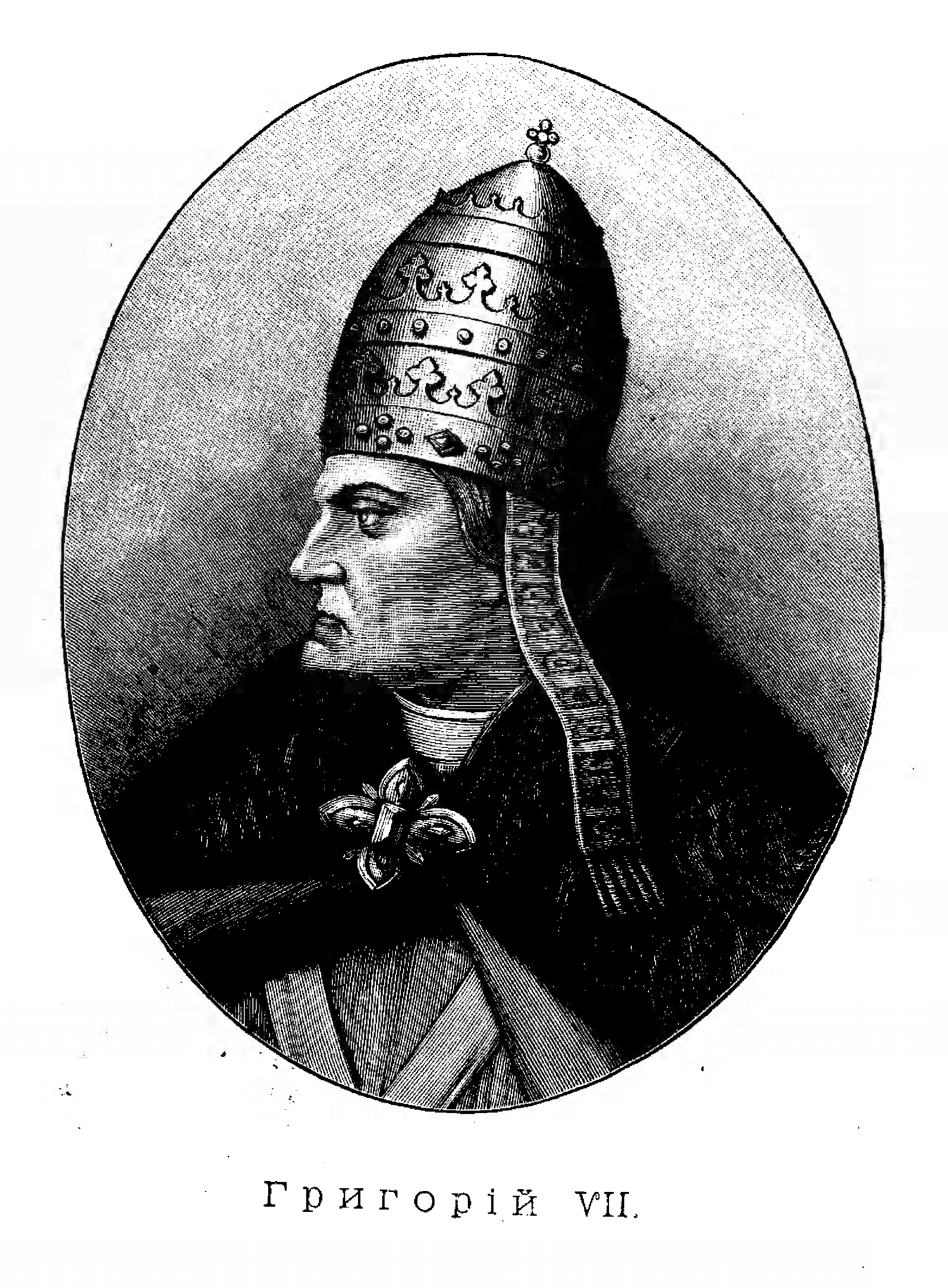
- Born
- Hildebrand, in Tuscany, "vir de plebe" - of the common people. His mother's name is unrecorded 1
- Fought
- Simony, clerical marriage, and lay investiture - kings appointing bishops 2
- Made Henry IV
- Wait three days barefoot in the snow at Canossa, January 1077 1
- Died
- In exile at Salerno, driven from Rome by the excesses of his own allies 1
Saint Gregory VII was born Hildebrand, a name his encyclopedia says meant "a bright flame" to the people who loved him and "a brand of hell" to those who did not. 1 He spent twenty years making other men pope before the crowd at his predecessor's funeral shouted him into the office himself. 1 He held an emperor standing barefoot in the snow for three days, and died driven out of Rome by the excesses of the army that had come to rescue him. 1 "I have loved justice and hated iniquity, therefore I die in exile." 12
A carpenter's son, or a peasant's
Oestereich is candid that the record is thin. "The early years of his life are involved in considerable obscurity." His father Bonizo "is said by some chroniclers to have been a carpenter, by others a peasant, the evidence in either case being very slender; the name of his mother is unrecorded." 1 What is not in doubt is the class: "That he was of humble origin - vir de plebe, as he is styled in the letter of a contemporary abbot - can scarcely be doubted." 1
He was sent young to a monastery on the Aventine where his mother's brother was abbot, and Oestereich points to what he would have absorbed there: "The austere spirit of Cluny pervaded this Roman cloister, and it is not unlikely that here the youthful Hildebrand first imbibed those lofty principles of Church reform of which he was afterwards to become the most fearless exponent." 1
Franciscan Media sets out what needed reforming, and why it was not a matter of taste. "The 10th century and the first half of the 11th were dark days for the Church, partly because the papacy was the pawn of various Roman families." 2 Three specific abuses: "simony - the buying and selling of sacred offices and things; the unlawful marriage of the clergy; and lay investiture - kings and nobles controlling the appointment of Church officials." 2
Twenty years making other men pope
He followed his first patron into exile at Cologne, and after that pope died went to Cluny for a year. 1 In January 1049 at Besançon he met the newly chosen Leo IX and came back to Rome with him - but not, Oestereich notes, before Leo, "who had been nominated merely by the emperor, had expressed the intention of submitting to the formal choice of the Roman clergy and people." 1 The whole quarrel of his life is already in that clause.
As administrator of the papal patrimony he turned out to have an unusual talent. Church property "which latterly had been diverted into the hands of the Roman nobility and the Normans, was largely recovered, and the revenues of the Holy See, whose treasury had been depleted, speedily augmented." 1
The state of the abbey of St. Paul outside the Walls, which he was sent to fix, is worth quoting for what the period actually looked like: "Monastic discipline was so impaired that the monks were attended in their refectory by women; and the sacred edifices were so neglected that the sheep and cattle freely roamed in and out through the broken doors." 1 He restored it, and kept a lifelong attachment to the place.
When Leo IX died the Romans wanted Hildebrand and he refused, going to Germany instead to get an imperial nomination for somebody else. 1 He did it again after that, and again. The two great acts of Nicholas II's reign - the decree vesting papal elections in the college of cardinals, and the alliance with the Normans - "were in large measure the achievement of Hildebrand, whose power and influence had now become supreme in Rome." 1 He wrote the rule that took the choice of popes away from emperors and Roman families, while declining the office himself.
"Let Hildebrand be pope!"
Alexander II died on April 21, 1073. "On the day following the death of Alexander II, as the obsequies of the deceased pontiff were being performed in the Lateran basilica, there arose, of a sudden, a loud outcry from the whole multitude of clergy and people: 'Let Hildebrand be pope!' 'Blessed Peter has chosen Hildebrand the Archdeacon!'" 1 His objections went nowhere. He had been the most important man in the Church for twenty years and everybody in the building knew it.
Franciscan Media summarizes the program of the pontificate in a sentence: "Gregory VII's papal letters stress the role of the bishop of Rome as the vicar of Christ and the visible center of unity in the Church." 2
He was not only fighting kings. At a synod in 1075 he excommunicated Robert Guiscard, the Norman leader, "for his sacrilegious invasion of the territory of the Holy See." 1 And he was trying to organize an expedition east to relieve the Christians under Seljuk pressure, and to reunite the Eastern and Western Churches, twenty years before the First Crusade. 1
Canossa
The dispute with the Emperor Henry IV was over who appointed bishops and abbots, and Franciscan Media states Gregory's position without qualification: he "fiercely resisted any attack on the liberty of the Church." 2
It came to a head when the German princes declared Henry's crown forfeit unless he was reconciled with the pope within a year. 1 What Henry then did is the most famous journey of the Middle Ages. "Abandoned by his own partisans and fearing for his throne, Henry fled secretly with his wife and child and a single servant to Gregory to tender his submission. He crossed the Alps in the depth of one of the severest winters on record." 1
Italians hostile to the pope met him on the other side and offered him an army. "Henry spurned their offers." 1 Gregory, traveling north and "fearing treachery, retired to the castle of Canossa." 1
And then Gregory made him wait. "The pontiff, mindful of his former faithlessness, treated him with extreme severity. Stripped of his royal robes, and clad as a penitent, Henry had to come barefooted mid ice and snow, and crave for admission to the presence of the pope. All day he remained at the door of the citadel, fasting and exposed to the inclemency of the wintry weather, but was refused admission. A second and a third day he thus humiliated and disciplined himself." 1
On January 28, 1077, he was let in and absolved - "but only on condition that he would appear at the proposed council and submit himself to its decision." 1 Even the absolution came with terms.
Driven out by his own side
It did not hold. Henry eventually took Rome, installed an antipope and had himself crowned emperor by him. 1 Gregory was trapped until his Norman ally Robert Guiscard - the man he had excommunicated eight years earlier - marched on the city and Henry withdrew. 1
And then the rescue destroyed him. "The pontiff was liberated, but, the people becoming incensed by the excesses of his Norman allies, he was compelled to leave Rome." 1 The Romans turned on him over what the army that saved him did to their city. He went to Monte Cassino and then to Salerno, "disappointed and sorrowing", and died there the next year. 1
Three days before the end he did something that is not in the famous quotation. He "withdrew all the censures of excommunication that he had pronounced, except those against the two chief offenders - Henry and Guibert." 1 Everything else lifted; those two left standing.
Then: "I have loved justice and hated iniquity, therefore I die in exile." 12 Franciscan Media records the sequel he did not live to see: "Thirty years later the Church finally won its struggle against lay investiture." 2
He was beatified in 1584 and canonized in 1728, six hundred and forty-three years after his death. 1
What is Saint Gregory VII the patron saint of?
Neither source cited here gives him a patronage. 12 Oestereich ends with his letters and the editions they are printed in; Franciscan Media ends with the feast. Neither names a cause he is invoked for, and this page does not supply one.
The estimate Oestereich opens with is not modest: "One of the greatest of the Roman pontiffs and one of the most remarkable men of all times." 1 It is a 1909 judgment and is quoted as one.
Saint Gregory VII's feast day
The feast of Saint Gregory VII is May 25, the day he died at Salerno in 1085. Franciscan Media states it outright: "The liturgical feast of Saint Gregory VII is celebrated on May 25." 2 The encyclopedia gives the same date as his death in its opening line. 1
This is one of the few entries in this library where the two sources, written eighty years apart, agree on everything about the date without needing to be reconciled.
Praying with Saint Gregory VII
He is the saint for a fight you are right about and lose anyway. The principle he defended - that the Church appoints its own bishops and is not an asset of whoever holds the throne - was won thirty years after he died, by other people, in a compromise he never saw. 2 What he got personally was Canossa, and then Rome sacked by his own allies, and then Salerno.
The three days in the snow are worth thinking about carefully, because they are not obviously admirable. Henry came barefoot, fasting, in the worst winter on record, and Gregory - "mindful of his former faithlessness" - left him outside the gate for three days and then absolved him on conditions. 1 A man who had been proved right about somebody did not let that go. Whether that reads as justice or as something harder is left to the reader; the source calls it "extreme severity" and does not apologize for it.
Which is why the deathbed matters. Three days before he died he lifted every excommunication he had pronounced except two. 1 Not a general amnesty and not none: almost everyone forgiven, and the two men he had actually fought left where they were. It is an exact measure of how far he could go, offered by a dying man with nothing left to gain.
And the name. To the people who loved him, a bright flame; to the people who hated him, a brand of hell. 1 He was the same man to both. Anybody who has been badly needed and badly resented for the same qualities will recognize the arrangement.
Saint Gregory VII, pray for us.
Sources
Saints to turn to next
Others in this collection who are turned to for some of the same things.
- Saint Augustine of CanterburyBirth unknown - 604 or 605CourageWork and vocationDiscernment
- Saint FabianBirth unknown - January 20, 250CourageDiscernmentWork and vocation
- Saint Fidelis of Sigmaringen1577 - April 24, 1622CourageWork and vocationDiscernment
- Saint Angela MericiMarch 21, 1474 - January 27, 1540Work and vocationDiscernment