Saint Fabian
Birth unknown - January 20, 250
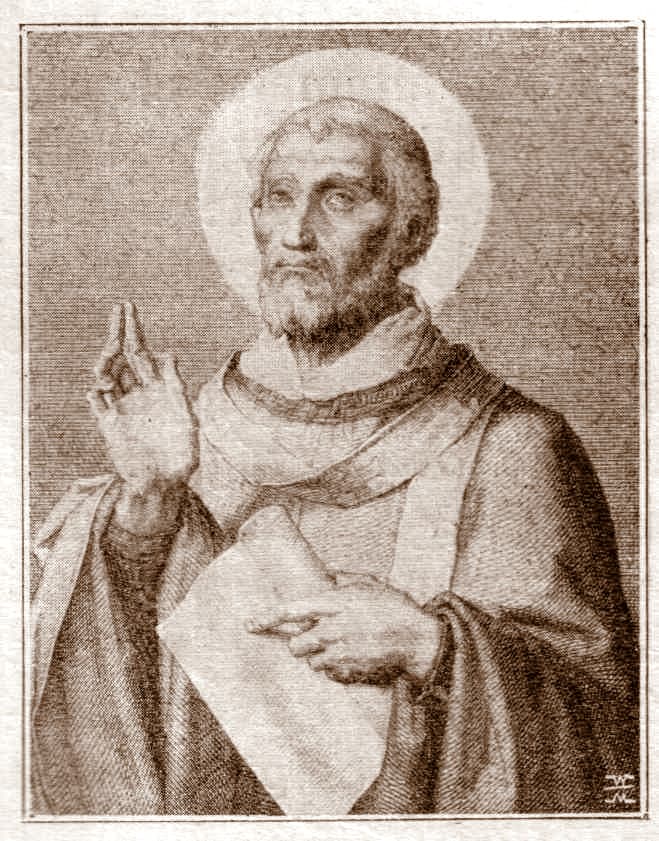
- Feast day
- January 20, shared with Saint Sebastian 2
- Pope
- 236 to 250, fourteen years 1
- Died
- A martyr on January 20, 250, at the start of the Decian persecution 1
- Buried
- The Crypt of the Popes in the catacomb of Saint Callistus. De Rossi found his Greek epitaph there in 1850 1
- Not by him
- The decretals in his name in Pseudo-Isidore, which Meier calls apocryphal 1
Saint Fabian was a farmer with no official standing who walked into Rome on the day the Church there was choosing a new bishop, and walked out as pope. 12 Eusebius says a dove came down and settled on his head, and the assembly elected him on the spot - a man, Meier writes, "of whom no one had even thought." 1 He held the office for fourteen years, and then the emperor Decius began killing bishops and Fabian was the first to die. 1
The dove
The story is not a later legend attached to a famous name. It is in Eusebius, writing within a century, and Meier gives it straight. Fabian "had come to Rome, with some others, from his farm and was in the city when the new election began." 1 Franciscan Media has him arriving "from his farm one day as clergy and people were preparing to elect a new pope" - a bystander at somebody else's decision. 2
What happened next is the part that would be hard to believe if the source were later. "While the names of several illustrious and noble persons were being considered, a dove suddenly descended upon the head of Fabian, of whom no one had even thought." 1 The assembly read it immediately: "To the assembled brethren the sight recalled the Gospel scene of the descent of the Holy Spirit upon the Saviour of mankind, and so, divinely inspired, as it were, they chose Fabian with joyous unanimity and placed him in the Chair of Peter." 1
Franciscan Media records the same unanimity and is plainer about what it overcame: "This sign united the votes of clergy and laity, and he was chosen unanimously." 2 There had been a field of candidates, all of them better known than he was.
Fourteen years, and what survives of them
Meier writes the sentence that this page is built around: "During his reign of fourteen years there was a lull in the storm of persecution. Little is known of his pontificate." 1
What is known is administrative, and the article is careful to say how well each item is attested. The "Liber Pontificalis" says he divided Rome into seven districts, each supervised by a deacon, and appointed seven subdeacons to collect the "acta" of the martyrs - the actual court records of their trials. 1 That is a filing system for other people's deaths, and it is the reason a good deal of what the Church knows about its early martyrs exists at all.
Beyond that the confidence drops by degrees. "There is a tradition that he instituted the four minor orders." 1 Considerable work was done in the catacombs under him, and he had the body of Pope Pontianus brought back from Sardinia, where he had died in the mines, and laid in the catacomb of Saint Callistus. 1 Then: "Later accounts, more or less trustworthy, attribute to him the consecration (245) of seven bishops as missionaries to Gaul, among them St. Denys of Paris." 1
Two things he certainly did are known because somebody else wrote them down. Cyprian mentions that Fabian condemned a bishop named Privatus for heresy. 1 And Origen - the most formidable and most suspected mind of the age - "did not hesitate to defend, before Fabian, the orthodoxy of his teaching." 1 A farmer was hearing the century's hardest theologian explain himself.
The stone
Decius became emperor in 249 and moved against the bishops first. Fabian died on January 20, 250, "at the beginning of the Decian persecution", and was buried in the Crypt of the Popes in the catacomb of Saint Callistus. 1
In 1850 the archaeologist De Rossi found his grave slab there and read the Greek on it. Meier gives the words: "Fabian, bishop and martyr." 1 Franciscan Media adds what the slab looks like: the stone "may still be seen, broken into four pieces, bearing the Greek words." 2
The other surviving verdict is Cyprian's, who was writing to Fabian's successor at the time. Franciscan Media quotes it: Fabian was an "incomparable" man "whose glory in death matched the holiness and purity of his life." 2 Cyprian was not a man who flattered popes - he fought one to a standstill a few years later - which is what gives the word its weight.
What is Saint Fabian the patron saint of?
Neither source cited here gives him a patronage. 12 Meier's article is an administrative record and Franciscan Media's entry ends at the feast day; neither raises the question, and this page leaves it open rather than filling it in.
What he is plainly for is being handed something you did not apply for and are not qualified to hold.
Saint Fabian's feast day
The feast of Saint Fabian is January 20, the day he died. 12 Franciscan Media states it in a form worth keeping: "Saint Fabian shares the celebration of his liturgical feast with Saint Sebastian on January 20." 2
They have nothing to do with each other beyond the date. Sebastian was a soldier, Fabian was a bishop, and the calendar puts them together because both were buried on the Appian Way and both were killed by the same persecution.
Praying with Saint Fabian
He is the saint for a job you did not want, were not in line for, and cannot now decline. Nobody had thought of him. He had come into town on other business. He was, so far as the record goes, a layman with a farm, and the people who were qualified were already being discussed by name when the vote went to him instead. 1
It is worth sitting with how little came of it in the way of story. Fourteen years, and the encyclopedia's own summary is that little is known. 1 He organized the city into districts, he appointed people to write down what happened to the martyrs, he heard Origen out, he fetched a dead pope home from Sardinia. 1 None of that is the kind of thing anybody sets out to be remembered for, and all of it was the work in front of him.
Then the lull ended. The record does not suggest he saw it coming or prepared for it; it says he was the first bishop of Rome that Decius killed. 1 What Cyprian noticed afterward was not the courage on its own but the fit between the death and the life - the glory of the one matching the holiness of the other. 2 The dove had been right.
The stone is the detail to keep. It is still there, cracked in four, with four words on it in Greek. A man was chosen by accident, did ordinary work for fourteen years, was killed for it, and somebody carved his name.
Saint Fabian, pray for us.
Sources
Saints to turn to next
Others in this collection who are turned to for some of the same things.
- Saint Augustine of CanterburyBirth unknown - 604 or 605CourageWork and vocationDiscernment
- Saint Fidelis of Sigmaringen1577 - April 24, 1622CourageWork and vocationDiscernment
- Saint Gregory VIIAbout 1020 - May 25, 1085CourageWork and vocationDiscernment
- Saint Angela MericiMarch 21, 1474 - January 27, 1540Work and vocationDiscernment