Saint Fidelis of Sigmaringen
1577 - April 24, 1622
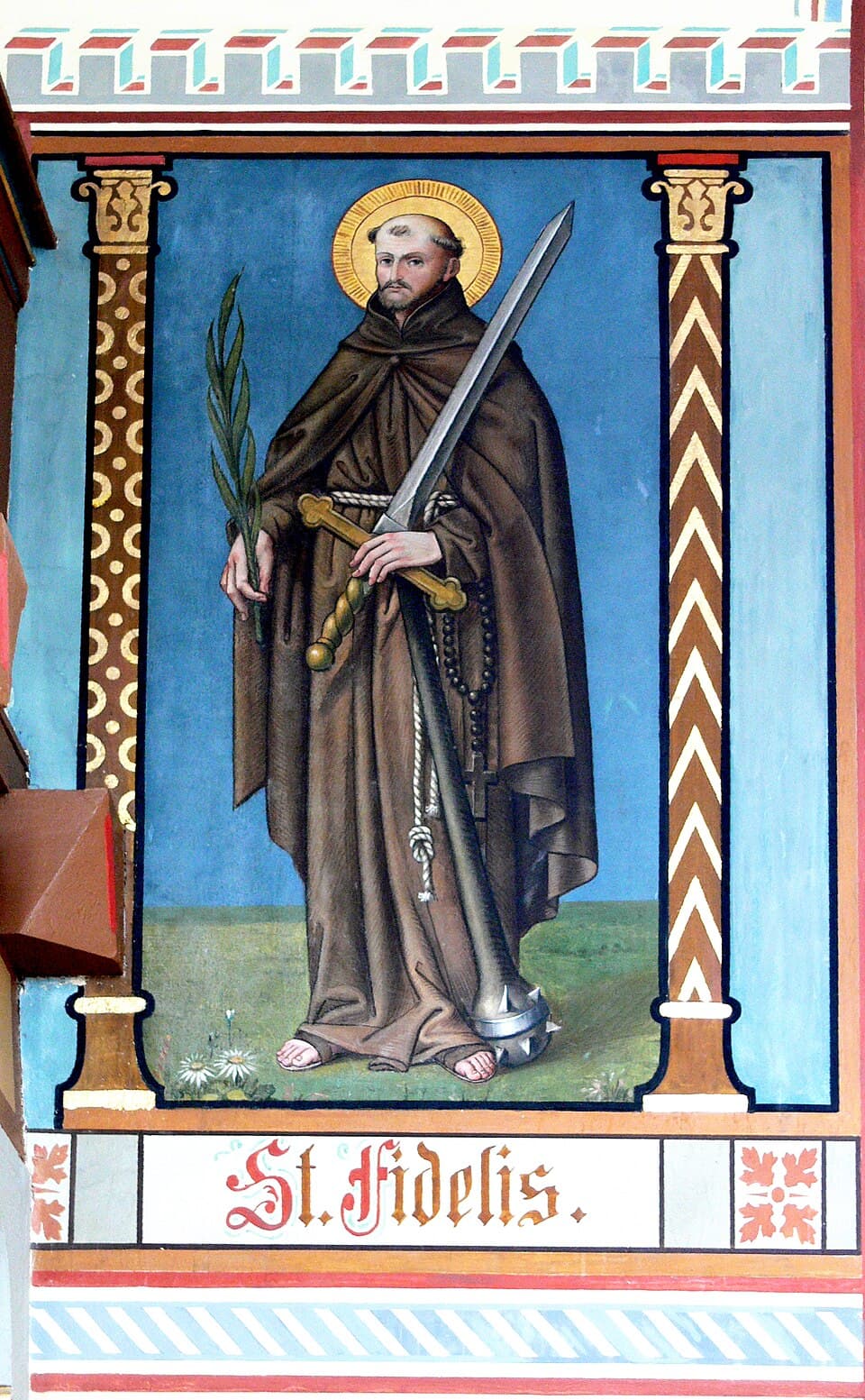
- Feast day
- April 24, the day he was killed. Hess states it outright 1
- Before the habit
- Doctor of canon and civil law at Freiburg, 1611, and an advocate known as the poor man's lawyer 12
- Why he quit the law
- Hess: "the open corruption which found place in the law courts" 1
- Died
- Seewis in the Grisons, 24 April 1622, the first martyr of the Congregation of Propaganda 1
Saint Fidelis of Sigmaringen was a doctor of law who walked out of the profession because he could not stand what he saw in the courts. 1 He became a Capuchin, and for twelve years prayed for two things: never to commit a mortal sin, and to die for the faith. 1 In April 1622 a crowd in a Swiss valley offered to spare him if he would renounce it. He said no, and they killed him. 12
The poor man's lawyer
He was born Mark Rey at Sigmaringen in 1577, son of the town's burgomaster, of Flemish descent on his father's side. 12 He studied at the University of Freiburg, and in 1604 became tutor to a young nobleman, Wilhelm von Stotzingen, traveling with him in France and Italy. 1 Hess adds a detail that only emerged later: at the canonization process, von Stotzingen himself "bore witness to the severe mortifications his tutor practised on these journeys." 1 The pupil had noticed and said nothing for forty years.
In 1611 he returned to Freiburg, took the doctorate in canon and civil law, and began to practice as an advocate. 1 Franciscan Media describes the practice he built: he "constantly upheld the causes of the poor and oppressed people" and was nicknamed "the poor man's lawyer." 2
It did not last. Hess gives the reason in a phrase: "the open corruption which found place in the law courts determined him to relinquish that profession and to enter the Church." 1 Franciscan Media says he "grew disgusted with the corruption and injustice he saw among his colleagues." 2 Not a crisis of faith, not a vision. He looked at his colleagues and left.
He was ordained the following year and immediately entered the Capuchins at Freiburg, taking the name Fidelis - the faithful one. 1 His brother George was already a Capuchin. 2 His money went to needy seminarians and to the poor. 2 Franciscan Media opens its whole account with the habit that outlived the money: "If a poor man needed some clothing, Fidelis would often give the man the clothes right off his back." 2
He left one thing behind from his novitiate: a book of spiritual exercises written for himself, which Hess calls "an interesting memorial of his novitiate and of his spiritual development at that time." 1 It was rediscovered and republished at Stuttgart in 1893. 1
Preaching, and the two prayers
He finished theology at Constance and was made guardian of the Capuchin communities at Rheinfelden, then Freiburg, then Feldkirch. 1 As a preacher, Hess says, "his burning zeal earned for him a great reputation." 1 He wrote pamphlets against Calvinism and Zwinglianism as well, though "he would never put his name to his writings" - and, Hess notes with evident regret, "these publications have long been lost." 1
During an epidemic in the town where he was guardian, he nursed sick soldiers. 2
In 1621 he was sent into the Grisons, in what is now eastern Switzerland, to work for the return of a Calvinist region to the Catholic faith. Hess is candid about why it had gone: "The people there had almost all gone over to Calvinism, owing partly to the ignorance of the priests and their lack of zeal." 1 The Church had lost the valley by neglecting it.
It is here that Hess records the two prayers. "Since he first entered the order he had constantly prayed, as he confided to a fellow-friar, for two favours: one, that he might never fall into mortal sin; the other, that he might die for the Faith. In this Spirit he now set out, ready to give his life in preaching the Faith." 1
He took with him a crucifix, a Bible, a breviary, and the book of his order's rule. "For the rest, he went in absolute poverty, trusting to Divine Providence for his daily sustenance." 1
A winter in the Grisons
He arrived at Mayenfeld in time for Advent and started at once, "often preaching in several places the same day." 1 The reception was hostile from the beginning: "His coming aroused strong opposition and he was frequently threatened and insulted." 1
He did not confine himself to Catholic churches. He preached in the public streets and "occasionally in the conventicles of the heretics" - which is to say he walked into Calvinist meeting-houses and argued. 1 At Zizers he held conferences with the magistrates and leading townsmen "often far into the night", and converted the most influential man in the town, Rudolph de Salis, whose public recantation brought others with him. 1
Franciscan Media records what observers thought was actually doing the work: "Those who observed the mission felt that success was more attributable to the prayer of Fidelis during the night than to his sermons and instructions." 2
The success is what killed him. Hess: the local preachers "were seriously alarmed and set themselves to inflame the people against him by representing that his mission was political rather than religious and that he was preparing the way for the subjugation of the country by the Austrians." 1 Franciscan Media states the charge from the other side: "He was accused of opposing the peasants' national aspirations for independence from Austria." 2
The charge was not absurd on its face. He was a foreign friar working in a region resisting Austrian control, and Austrian soldiers guarded the doors when he preached. 1 To the people who killed him he was not only a missionary.
Seewis
At Easter 1622 he went back to Feldkirch for a chapter of his order. The newly founded Congregation of Propaganda in Rome formally made him superior of the mission in the Grisons. 1 And Hess records that "he had, however, a presentiment that his labors would shortly be brought to a close by a martyr's death. Preaching a farewell sermon at Feldkirch he said as much." 1
He went back. "On re-entering the country of the Grisons he was met everywhere with the cry: 'Death to the Capuchins!'" 1
On 24 April he was at Grusch. He made his confession, said Mass, preached, and set out for Seewis. "On the way his companions noticed that he was particularly cheerful." 1
He began to preach in the church at Seewis and was interrupted by a tumult inside and outside it. Several of the Austrian soldiers guarding the doors were killed, and Fidelis was struck. 1 Franciscan Media's version differs here: a gun was fired at him while he preached and he was unhurt. 2
Both sources agree on what happened next. Someone on the other side - Hess says a Calvinist, Franciscan Media says a Protestant - offered to take him somewhere safe. He thanked the man and refused, saying his life was in the hands of God. 12
Outside the church a crowd surrounded him, led by the preachers, and offered to spare him if he would apostatize. Hess gives his answer: "I came to extirpate heresy, not to embrace it." 1 They struck him down. Franciscan Media places the killing on the road back. 2
He was the first martyr of the Congregation of Propaganda. 1 His body was taken to Feldkirch and buried in his order's church, except the head and left arm, which went to the cathedral at Chur. 1 He was beatified in 1729 and canonized in 1745 - Franciscan Media gives 1746. 12
What is Saint Fidelis of Sigmaringen the patron saint of?
Neither Hess nor Franciscan Media assigns Saint Fidelis a patronage. 12 In practice he is claimed by lawyers, which is fitting in an awkward way: he is the patron of the profession he abandoned because he could not practice it honestly. 12 A lawyer asking his prayers is asking the intercession of a man who concluded that the courts of his day could not be worked in.
He is also invoked against the temptation to soften what one believes in order to be safe. That is the shape of his last conversation, and there is no separating him from it. 1
In art, Hess says, he is shown "with a crucifix and with a wound in the head; his emblem is a bludgeon." 1 A club is an unusual attribute even among martyrs, and it is exactly what it looks like.
Saint Fidelis of Sigmaringen's feast day
The feast of Saint Fidelis of Sigmaringen is April 24, the day he was killed at Seewis in 1622. Hess states it plainly - "His feast is kept on 24 April" - and Franciscan Media presents him on the same day. 12
The one date the sources do not agree on is the canonization: Hess gives 1745 and Franciscan Media 1746. 12 Franciscan Media adds a further claim that Hess does not - "Fifteen years later he was recognized as a martyr" - which would place the formal recognition of the martyrdom after the canonization rather than before it. 2 It is recorded here and not resolved.
Praying with Saint Fidelis
Start with the law career, because it is the part of him most people can use. He was good at it, he was known for taking the cases of the poor, and he left because the courts were corrupt and he would not work in them. 12 That is a decision with no consolation attached: no vision told him to go, and walking away cost him a profession he had spent years qualifying for. Hess gives the whole of his reasoning in one clause about what he saw in the courtrooms. 1
Then the two prayers, which are harder. He asked never to sin mortally and to die for the faith, and he asked for both every day for twelve years. 1 It is not a prayer to imitate lightly. What is worth taking from it is that when the moment came he was not surprised by it - he had told his brothers at Feldkirch he expected it, and his companions noticed on the last morning that he was unusually cheerful. 1 He had been getting ready for a long time.
The refusal of shelter is the detail that carries the most. A man on the other side of the argument, who owed him nothing, offered to hide him, and he said no. 12 That was not bravado; there was no audience worth impressing and no advantage in it. He had decided in advance what he would do and he did it.
And the last thing he said was not a prayer or a blessing. It was an argument: "I came to extirpate heresy, not to embrace it." 1 He died mid-dispute, in the manner of a man who had spent his whole life in disputes and thought they mattered. Whether his particular quarrel with the Calvinists of the Grisons looks the same to a reader four hundred years later is beside the point of his courage, though it is worth being honest that the people who killed him thought they were resisting an occupation. 12 Two things can be true. He kept his word and they did not spare him.
Saint Fidelis of Sigmaringen, pray for us.
Sources
Saints to turn to next
Others in this collection who are turned to for some of the same things.
- Saint Augustine of CanterburyBirth unknown - 604 or 605CourageWork and vocationDiscernment
- Saint FabianBirth unknown - January 20, 250CourageDiscernmentWork and vocation
- Saint Gregory VIIAbout 1020 - May 25, 1085CourageWork and vocationDiscernment
- Saint Francis BorgiaOctober 28, 1510 - September 30, 1572DiscernmentWork and vocation