Saint Francis Borgia
October 28, 1510 - September 30, 1572
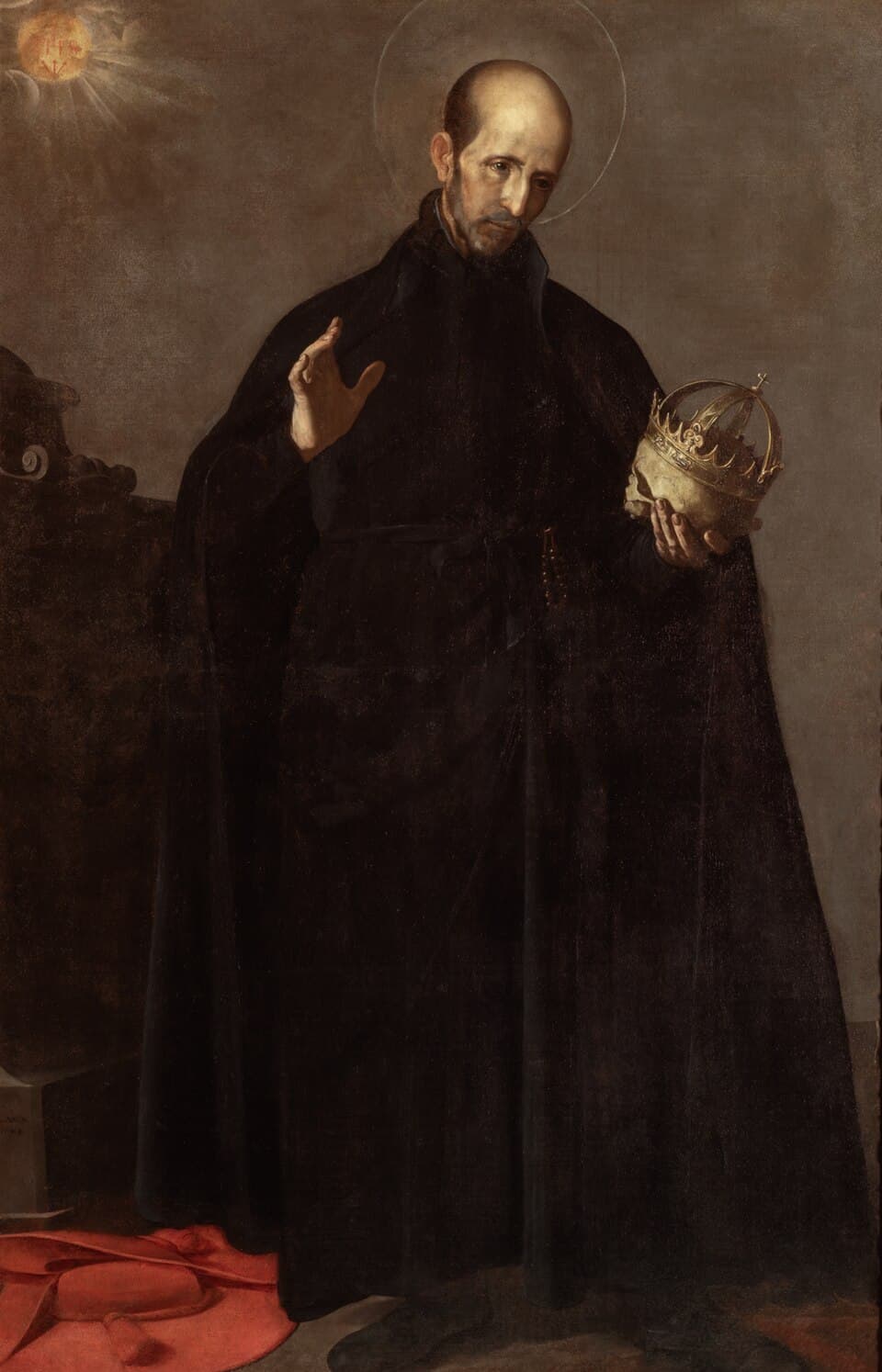
- Patron saint of
- Invoked against earthquakes, per Franciscan Media 2
- Born
- 28 October 1510, heir to the Duchy of Gandia. Great-grandson of Pope Alexander VI 1
- Before the Society
- Marquess of Lombay, equerry to the Empress, Viceroy of Catalonia, fourth Duke of Gandia 1
- Also
- A composer. Suau calls him one of the chief restorers of sacred music before Palestrina 1
- Refused
- A cardinalate, twice. Ignatius talked the pope out of it the first time 1
- Elected
- Third Superior General of the Jesuits at fifty-five; often called their second founder 2
Saint Francis Borgia was the great-grandson of Pope Alexander VI, a Marquess at nineteen, Viceroy of Catalonia at twenty-eight, and Duke of Gandia at thirty-three. 1 He gave all of it away, walked out of his estates at forty to "see them no more", and ended as the third head of the Jesuits, remembered as the order's second founder. 12 The first time he ever saw Ignatius of Loyola, Ignatius was being taken to prison by the Inquisition and Francis was riding past with an escort. 1
The name
Suau does not ease into it: "The future saint was unhappy in his ancestry." 1 Francis was the great-grandson, on his father's side, of Rodrigo Borgia, who was elected pope in 1492 as Alexander VI and had eight children. 1 His own grandfather, Juan Borgia, was "assassinated in Rome on 14 June, 1497, by an unknown hand, which his family always believed to be that of Caesar Borgia." 1 On his mother's side he was great-grandson of Ferdinand of Aragon, who "had procured the appointment of his natural son, Alfonso, to the Archbishopric of Saragossa at the age of nine years." 1
That is the family. Suau then points at where the change started, and it was not with Francis. Juan's widow, Maria Enriquez, withdrew to the duchy and raised her two children; her daughter Isabel entered the Poor Clares at Gandia, and the mother followed her in. "It was through these two women that sanctity entered the Borgia family, and in the House of Gandia was begun the work of reparation which Francis Borgia was to crown." 1 Two women, a generation ahead of him, in a convent.
He lost his own mother at ten. 1 At eleven a popular rising put his life in danger, and he was sent to Saragossa to be educated at the court of his uncle the archbishop - "an ostentatious prelate who had never been consecrated nor even ordained priest." 1 Suau adds a detail most accounts would suppress: Francis "could not disguise from himself the relation in which his grandmother stood to the dead archbishop, although he was much indebted to her for his early religious training." 1 He grew up knowing exactly what his family was.
At twelve he was sent as a page to the Infanta Catarina at Tordesillas, "the youngest child and companion in solitude of the unfortunate queen, Juana the Mad." 1 A boy of twelve, attending on a woman kept in confinement.
A glance in the street at Alcala
In 1528 the court of Charles V opened to him "and the most brilliant future awaited him." 1 On the road to Valladolid something happened that neither man could have understood at the time.
"On the way to Valladolid, while passing, brilliantly escorted, through Alcala de Henares, Francis encountered a poor man whom the servants of the Inquisition were leading to prison. It was Ignatius of Loyola. The young nobleman exchanged a glance of emotion with the prisoner, little dreaming that one day they should be united by the closest ties." 1
He was seventeen, Suau says, "endowed with every charm" and, after the emperor himself, the most gallant presence at court. 1 In 1529 Charles married him to Eleanor de Castro and made him Marquess of Lombay, master of the hounds and equerry to the empress. 1 When the emperor traveled or campaigned, he left the empress in this young man's care. 1
One thing about him is easy to miss. He composed. Suau describes ecclesiastical works of "a remarkable contrapuntal style" and states the claim plainly: "in the sixteenth century and prior to Palestrina, Borgia was one of the chief restorers of sacred music." 1 The Duke of Gandia wrote polyphony.
Granada
The Empress Isabella died on 1 May 1539, and Francis was given the task of taking her body to Granada, where she was buried on 17 May. 1
This is the episode the paintings are about. Alonso Cano shows him in the black Jesuit cloak holding a crowned skull, his ducal robe thrown down on the floor behind him - the story, told for centuries, that he looked into the coffin and vowed never again to serve a master who could die. 2 Neither source here tells that story.
What Suau says is soberer and, in its way, more usable: "The death of the empress caused the first break in the brilliant career of the Marquess and Marchioness of Lombay. It detached them from the court and taught the nobleman the vanity of life and of its grandeurs." 1 Blessed John of Avila preached the funeral sermon, and Francis told him he wanted to reform his life, then "returned to Toledo resolved to become a perfect Christian." 1
Nothing changed outwardly for eleven more years. Five weeks after the funeral, on 26 June 1539, the emperor made him Viceroy of Catalonia, with instructions to reform the administration of justice, put the finances in order, fortify Barcelona and put down the brigands. 1 He did all four - Suau calls him "an inflexible justiciary" - while also reforming the monasteries and promoting learning. 1
In 1543 his father died and he became Duke of Gandia. Barred from a further court appointment by Portuguese opposition, he spent three years reorganizing his duchy, founding a university, and taking a doctorate in theology in it himself. 1 In 1546 his wife died. 12
Leaving
He had already invited the Jesuits to Gandia and become their protector. On 1 February 1548 he pronounced the solemn vows of the Society - with papal permission to remain in the world until he had discharged "his obligations as father and as ruler." 1 He had eight children.
On 31 August 1550 "the Duke of Gandia left his estates to see them no more." 1 He reached Rome on 23 October and "threw himself at the feet of St. Ignatius, and edified by his rare humility those especially who recalled the ancient power of the Borgias." 1 Twenty-two years after seeing him hauled off by the Inquisition.
Even then he was already planning. "Quick to conceive great projects, he even then urged St. Ignatius to found the Roman College." 1 That college is now the Gregorian University. 2
On 4 February 1551 he left Rome "without making known his intention of departure", reached Azpeitia in April, and settled at a hermitage near Onate. 1 Charles V released him from his possessions; he abdicated in favor of his eldest son and was ordained priest on 25 May. 1
Spain could not get over it. "Nothing was talked of throughout Spain but this change of life, and Onate became the object of incessant pilgrimage. The neophyte was obliged to tear himself from prayer in order to preach in the cities which called him." 1
Rome then tried to make him a cardinal. Julius III was willing; Ignatius "prevailed upon the pope to reconsider this decision." 1 Two years later it came up again, and Francis "anxiously inquired whether he might in conscience oppose the desire of the pope." 1 Ignatius got him out of it a second time.
The second founder
Franciscan Media gives the rest compactly. He served as political and spiritual adviser to the emperor; in Spain he founded a dozen colleges; at fifty-five he was elected head of the Jesuits. 2
As general he concentrated on "the growth of the Society of Jesus, the spiritual preparation of its new members, and spreading the faith in many parts of Europe", and "was responsible for the founding of Jesuit missions in Florida, Mexico, and Peru." 2 The Jesuit presence in the Americas began under a man who had been a Spanish viceroy.
"Francis Borgia is often regarded as the second founder of the Jesuits." 2 He died on 30 September 1572 and was canonized a hundred years later. 12
What is Saint Francis Borgia the patron saint of?
Franciscan Media records that Saint Francis Borgia is invoked against earthquakes. 2 Suau assigns no patronage at all. 1 The earthquake patronage is Portuguese and Iberian in origin and neither source explains it, so this page will not invent a reason.
What he is actually turned to for follows from the life. He is a patron for people leaving a career at its height, for people carrying a family name they did not choose and would not have chosen, and for anyone who has spent eleven years knowing what they ought to do before being free to do it. 1 The gap between Granada in 1539 and the road out of Gandia in 1550 is the most instructive thing about him.
Saint Francis Borgia's feast day
The feast of Saint Francis Borgia is October 10. 2 He died on 30 September 1572, so the feast does not fall on the anniversary of his death; the end of September was already occupied, and his day was placed in October. 12
Suau gives the death date exactly and Franciscan Media agrees on it. 12 The two sources do not disagree about anything material in his life, which is unusual for this library and worth noting.
Praying with Saint Francis Borgia
He is the saint for people who take a long time. The turning point was the empress's funeral in 1539; he did not leave the world until 1550. In between he governed Catalonia, inherited a duchy, buried his wife, raised eight children and founded a university. 1 Eleven years of doing his duty while knowing where he was going. Anybody waiting for obligations to end before they can begin has his example, and it is not an example of delay - it is an example of not abandoning people.
The ancestry is the other half of him, and Suau handles it better than most. Francis did not distance himself from the Borgias; he repaired them, and Suau is careful to say the repair had already started with a widow and a Poor Clare two generations before. 1 Nobody chooses the family they are explaining for the rest of their life. What can be chosen is whether the name means the same thing after you as before.
The glance at Alcala is worth keeping. A rich seventeen-year-old on a good horse, a prisoner being walked to jail, and a look between them. 1 Neither knew. Twenty-two years later one of them was kneeling at the other's feet in Rome. Most of the encounters that decide a life do not announce themselves at the time.
And then what he actually did with the freedom he had waited so long for: refused a cardinal's hat twice, took a hermitage, and spent his last years on administration - colleges, novices, missions to Florida and Peru. 12 He had been a viceroy; he knew how to run things; and he gave the Society the one skill his upbringing had actually given him. Nothing of his old life was wasted except the parts he had thrown away on purpose.
Saint Francis Borgia, pray for us.
Sources
Saints to turn to next
Others in this collection who are turned to for some of the same things.