Saint Mark
First century
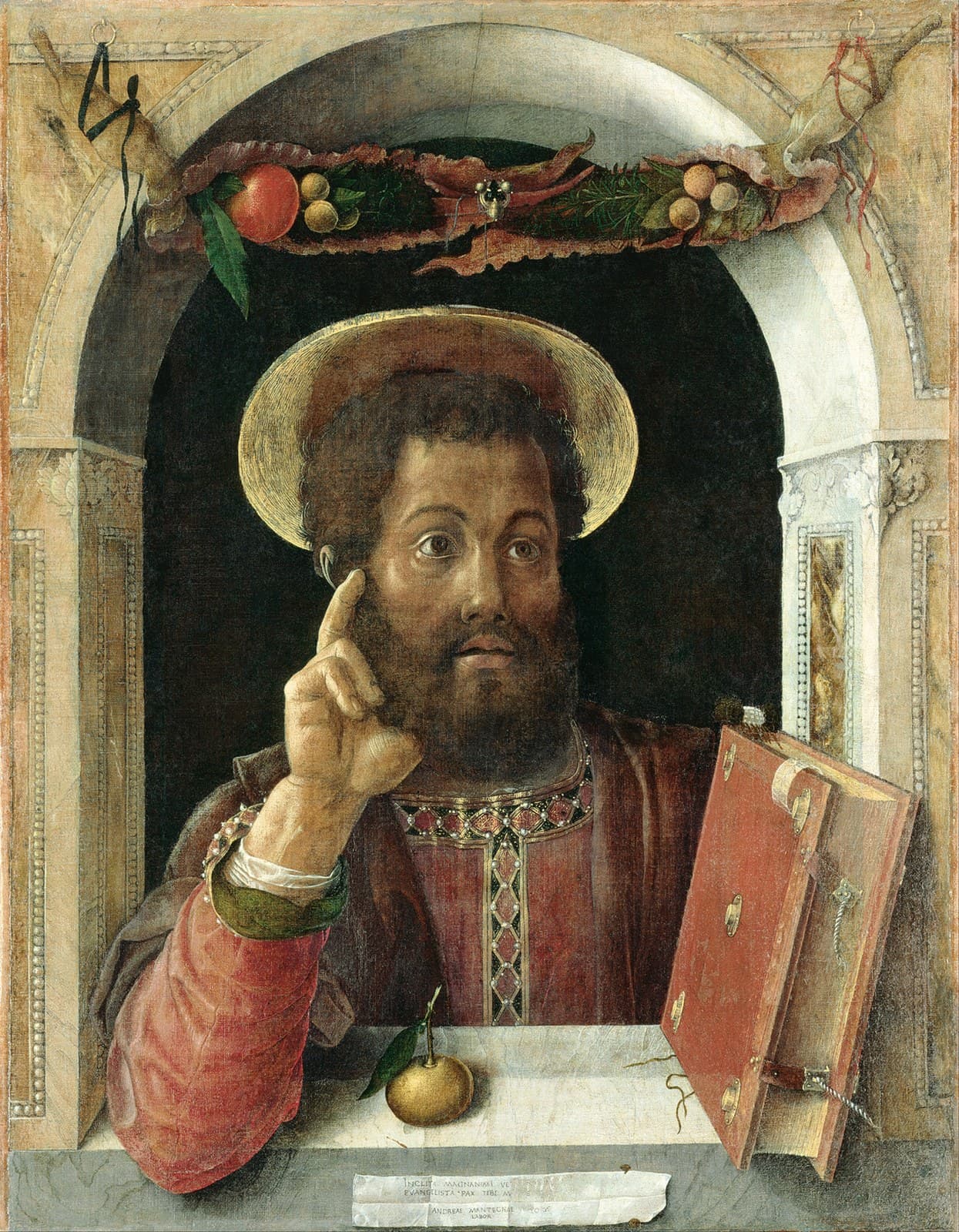
- Feast day
- April 25, the date in the Roman Martyrology 1
- Wrote
- The oldest and shortest of the four Gospels, probably for gentile converts at Rome 2
- Did not
- Know Jesus. Papias says he "neither heard the Lord nor followed Him" 1
- Was
- Peter's interpreter, who wrote down his teaching accurately "though not in order" - Papias, before 130 1
- Symbol
- A winged lion 2
Saint Mark wrote the earliest of the four Gospels, and the New Testament also records that he quit. 12 He went partway on Paul's first missionary journey and turned back to Jerusalem; Paul refused to take him the second time, and the quarrel over it broke up Paul and Barnabas as a pair. 1 A decade later Paul is writing from prison to ask that Mark be sent to him, "for he is profitable to me for the ministry." 1 Almost everything known about him comes from being somebody else's assistant, and what he produced outlasted both of them.
His mother kept the house they all met in
MacRory starts where the evidence does. The Mark called John Mark in Acts, the Mark of Paul's letters and the Mark Peter calls his son are taken to be the same man, and "their identity is not questioned by any ancient writer of note." 1 Franciscan Media agrees: "Most of what we know about Saint Mark comes directly from the New Testament." 2
What that gives is a house. "Mark's mother was a prominent member of the infant Church at Jerusalem; it was to her house that Peter turned on his release from prison." 1 MacRory lingers on the physical detail Acts supplies, because it tells you the family had money: "the house was approached by a porch, there was a slave girl, probably the portress, to open the door, and the house was a meeting-place for the brethren, 'many' of whom were praying there the night St. Peter arrived from prison." 1
So Mark grew up in the room where the Church in Jerusalem met, and Peter was his mother's old friend. 1 Franciscan Media makes the same connection: "When Saint Peter escaped from prison, he went to the home of Mark's mother." 2
He turned back
After the famine of 45 or 46, Barnabas and Saul took him with them from Jerusalem to Antioch, and then on the first missionary journey "as some sort of assistant." 1 MacRory will not say more than that, and explains why: the Greek word is "hupereten", and "the vagueness and variety of meaning of the Greek term makes it uncertain in what precise capacity he acted." 1 He had not been selected by the Holy Spirit or sent by the church at Antioch, as the other two had been; "he was probably taken by the Apostles as one who could be of general help." 1
When they decided to push inland from Perga into central Asia Minor, he left and went home. 1 "What his reasons were for turning back, we cannot say with certainty; Acts 15:38 seems to suggest that he feared the toil." 1 Franciscan Media is briefer and no kinder: "for some reason Mark returned alone to Jerusalem." 2
The consequence was not private. Paul refused to take him on the second journey; Barnabas insisted; "this refusal led to the separation of Paul and Barnabas", and Barnabas sailed for Cyprus with Mark. 1 Franciscan Media draws the plain inference: "It is evident, from Paul's refusal to let Mark accompany him on the second journey despite Barnabas's insistence, that Mark had displeased Paul." 2 Then Acts stops mentioning him for about ten years. 1
Receive him
He reappears in Rome, working with both of the men whose movement he had walked out on. Writing to the Colossians from his first Roman imprisonment, Paul sends greetings from "Mark, the cousin of Barnabas, touching whom you have received commandments; if he come unto you, receive him." 1 That last clause is a recommendation, and it is being made by the man who had refused him.
Shortly before his death Paul writes to Timothy at Ephesus and asks him to "pick up Mark and bring him with him to Rome, adding 'for he is profitable to me for the ministry.'" 1 Franciscan Media reads it the same way: "Because Paul later asks Mark to visit him in prison, we may assume the trouble did not last long." 2
And Peter, writing from "Babylon" - which MacRory says every early Father takes to mean Rome - sends greetings from "Mark my son". 1 MacRory is careful not to over-read it: the word may only mean "affectionate regard for a younger man, who had long ago sat at Peter's feet in Jerusalem, and whose mother had been the Apostle's friend." 1
The Gospel, and what Papias says about it
The oldest statement about how the Gospel came to be written is also the bluntest about its author's standing. Papias, writing no later than about 130 and citing an "elder", says Mark "had been the interpreter of Peter, and wrote down accurately, though not in order, the teaching of Peter." 1 The same source says that Mark "neither heard the Lord nor followed Him", and MacRory notes that Eusebius, Jerome and Augustine all say the same. 1
Franciscan Media agrees and puts it in the plainest terms: "Like another Gospel writer Luke, Saint Mark was not one of the 12 apostles. We cannot be certain whether he knew Jesus personally." 2 It adds the guess that will not go away - that the naked young man who runs from Gethsemane leaving his linen cloth behind is Mark writing himself in - but flags it as a guess: "Some scholars feel that the evangelist is speaking of himself." 2
What he made of it, Franciscan Media describes as a book about a scandal: "the gradual manifestation of a 'scandal': a crucified Messiah", written probably for gentile converts in Rome after Peter and Paul were dead. 2 Peter is "only one of this Gospel's sources", the others being the church in Jerusalem and the church at Antioch. 2
Alexandria, weighed rather than asserted
That Mark founded the church at Alexandria is "a widespread, if somewhat late, tradition", and MacRory takes it apart rather than passing it on. 1 "Though strangely enough Clement and Origen make no reference to the saint's connection with their city, it is attested by Eusebius, by St. Jerome, by the Apostolic Constitutions, by Epiphanius and by many later authorities." 1 Two men who lived and taught in Alexandria never mention it; the witnesses who do are later and elsewhere.
The dating makes it harder still. Eusebius' chronology would have Mark as bishop there for about twenty years - but Acts puts him in Jerusalem, Salamis and Antioch across the same period, and when he left Antioch he sailed to Cyprus, not to Egypt. 1 MacRory's conclusion is a probability and is written as one: "we may perhaps conclude with more probability that it was founded somewhat later", pointing to the decade between 50 and 60 when the New Testament says nothing about him at all. 1
What is Saint Mark the patron saint of?
Neither source cited here gives Saint Mark a thematic patronage. 12 Franciscan Media records a civic one: "Venice, famous for the Piazza San Marco, claims Mark as its patron saint; the large basilica there is believed to contain his remains." 2 Note the wording - believed. This page does not upgrade it.
His symbol is better attested than his patronage. The winged lion comes from the opening of his own Gospel: Franciscan Media traces the lion to Mark's description of John the Baptist as "a voice of one crying out in the desert", which artists compared to a roaring lion, and the wings to Ezekiel's vision of four winged creatures being applied to the four evangelists. 2
Saint Mark's feast day
The feast of Saint Mark is April 25. 1 The encyclopedia gives the date by quoting the Roman Martyrology under that day: "At Alexandria the anniversary of Blessed Mark the Evangelist... at Alexandria of St. Anianus, Bishop, the disciple of Blessed Mark and his successor in the episcopate, who fell asleep in the Lord." 1
Neither source states how he died, and this page does not supply an account of it.
Praying with Saint Mark
He is the saint for having quit something, and for the people who have to decide what to do about someone who did. Both sides of that are in the record. Paul was not wrong that Mark had left when the work got hard, and would not pretend otherwise for the sake of peace - he let the partnership with Barnabas break over it rather than take him. 1 Barnabas was not wrong either, and took Mark to Cyprus.
What the New Testament does not contain is any account of Mark defending himself. He goes to Cyprus, disappears from the narrative for ten years, and turns up in Rome being useful. The rehabilitation is not announced; it is visible only in the way other people start writing about him. "If he come unto you, receive him." "He is profitable to me for the ministry." "Mark my son." 1
He was also, by the oldest account we have, a secondhand witness: he had not heard the Lord or followed him, and what he wrote down was somebody else's preaching, accurately, and out of order. 1 It is worth noticing what that did not disqualify him from. The earliest of the four Gospels was written by a man who had not been there, who had failed at the job once, and whose chief qualification was that he listened carefully to someone who had.
Most of what is claimed about him beyond this is uncertain and his own encyclopedia says so - the Levite priesthood is probably an inference, Alexandria is late and contested, the young man in Gethsemane is a guess. 12 What is not uncertain is a house in Jerusalem with a door somebody had to answer, an argument he caused, and a book.
Saint Mark, pray for us.
Sources
Saints to turn to next
Others in this collection who are turned to for some of the same things.
- Saint Francis BorgiaOctober 28, 1510 - September 30, 1572ConversionDiscernmentWork and vocation
- Saint Aloysius GonzagaMarch 9, 1568 - June 21, 1591DiscernmentConversion
- Saint Angela MericiMarch 21, 1474 - January 27, 1540Work and vocationDiscernment
- Saint Anthony Zaccaria1502 - July 5, 1539Work and vocationConversion