Saint Aloysius Gonzaga
March 9, 1568 - June 21, 1591
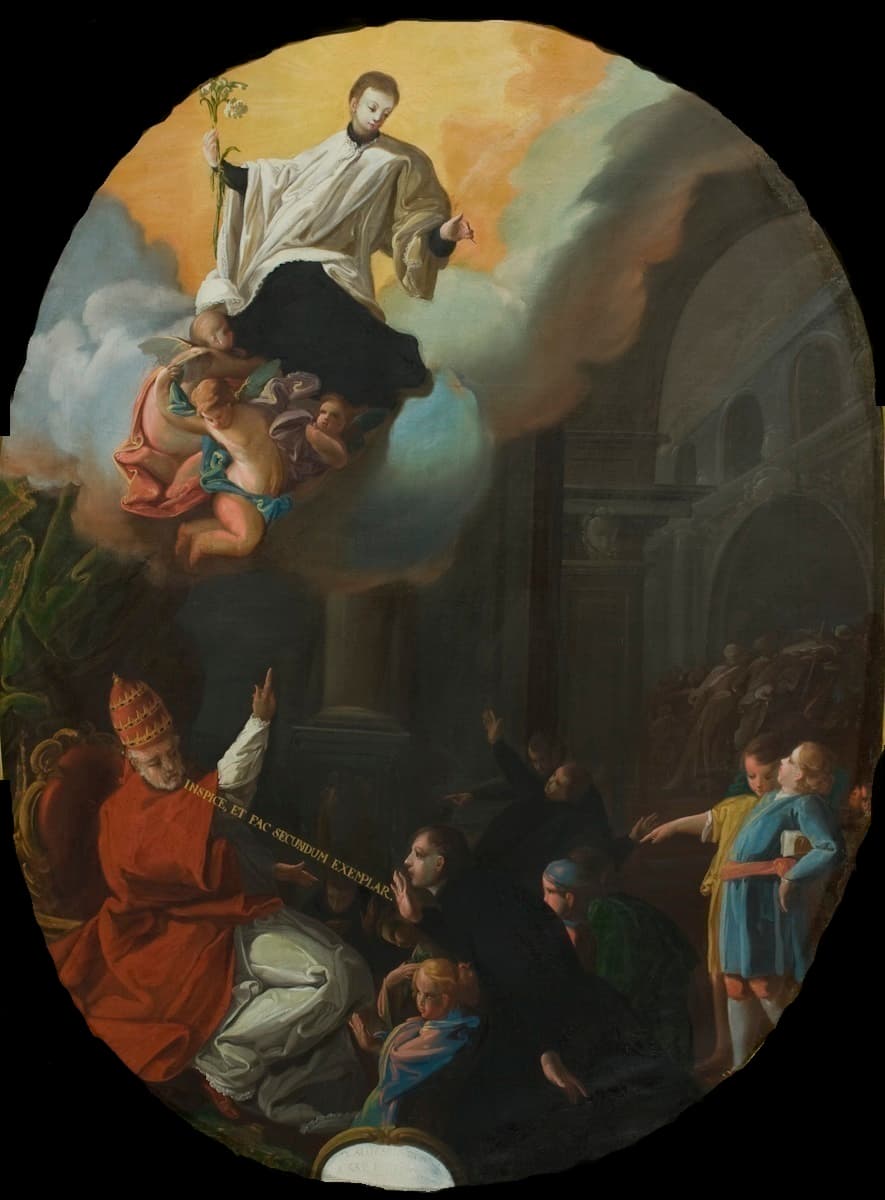
- Patron saint of
- Catholic youth, teenagers and seminarians, per Franciscan Media 2
- Gave up
- His inheritance, to his brother, on 2 November 1585 - a renunciation that needed the emperor's approval, Castiglione being a fief of the empire 1
- Canonized
- Beatified by Gregory XV in 1621; canonized by Benedict XIII 1
Saint Aloysius Gonzaga was heir to a marquisate and spent years fighting his own father for permission to give it away. 12 He had been a page at the court of Philip II, had examined publicly in philosophy and theology at Alcala, and was three years from ordination when plague reached Italy. 1 He carried the sick himself, caught it, and died at twenty-three. 12
A boy raised for the army
He was born in the castle of Castiglione in 1568, son of a princely family, and his father wanted a military hero. 12 Franciscan Media sets the scene without softening it: he grew up in royal courts and army camps, and Florence became "the mother of piety" for him in spite of what it also was - "a society of fraud, dagger, poison, and lust." 2
The dates make the point better than adjectives. At eight he was placed in the court of Francesco de' Medici at Florence, where he stayed two years, and then went on to Mantua. 1 Franciscan Media says that by eleven he was teaching catechism to poor children, fasting three days a week and practicing severe austerities. 2 At twelve, at Brescia, he came under the spiritual direction of Charles Borromeo and received his First Communion from him. 1
In 1581 he went to Spain with his father, and he and his brother were made pages to the son of Philip II. 1 Franciscan Media describes the effect: "the more Aloysius saw of court life, the more disillusioned he became, seeking relief in learning about the lives of saints." 2 A book about Jesuit missionaries in India gave him the idea of entering the Society. 2
He also worked. O'Conor notes that while in Spain he distinguished himself "by a public examination not only in philosophy, but also in theology, at the University of Alcala." 1 He had first considered the Discalced Carmelites before settling on the Jesuits. 1
The inheritance
He returned to Italy in 1584, and then came the part that took years. O'Conor puts it dryly - "after much difficulty in securing his father's consent" - and the difficulty is measurable in the paperwork. 1
On 2 November 1585 he renounced his heritage in favor of his brother, and because Castiglione was a fief of the empire the renunciation required the approval of the emperor. 1 A young man giving up a marquisate had to have it countersigned at that level.
Three weeks later, on 25 November 1585, he presented himself to Claudio Acquaviva, General of the Society of Jesus. 1 Before his novitiate was over he passed a brilliant public act in philosophy, having done his philosophical and mathematical studies before entering. 1 He made his vows on 25 November 1587 and began theology at once, under Vasquez and Azor. 1
The plague
In 1591, while he was in his fourth year of theology, famine and pestilence broke out in Italy. 1
O'Conor gives what happened in a single sentence that this page will not improve on: "Though in delicate health, he devoted himself to the care of the sick, but on March 3 he fell ill and died 21 June, 1591." 1
He was twenty-three. He had renounced a title, argued his father into letting him go, studied hard enough to examine publicly in two faculties, and was three years short of ordination. What he did with the training was carry plague patients until he caught the plague.
What is Saint Aloysius Gonzaga the patron saint of?
Saint Aloysius Gonzaga is the patron saint of Catholic youth, teenagers and seminarians. 2 The fit is exact in a way patronages often are not. He was a teenager through the part of his life that matters - the catechism classes at eleven, the disillusionment at court at thirteen, the fight with his father in his middle teens - and he died a seminarian, three years from the priesthood he never reached. 12 Whoever assigned him those three was not reaching for a connection.
Saint Aloysius Gonzaga's feast day
The feast of Saint Aloysius Gonzaga is June 21, the day he died in 1591. 12 Both sources give the same date for the death and Franciscan Media gives the same date for the feast, so no correction was needed here - unlike several profiles written alongside this one, where the 1913 encyclopedia's date had been superseded. 12 He was beatified by Gregory XV in 1621, thirty years after his death, and canonized by Benedict XIII. 1
Praying with Saint Aloysius
The austerities are the thing most often repeated about him and the least useful. Fasting three days a week at eleven is not a program anybody should copy, and the sources report it without recommending it. What is worth attention is that a boy in that household, being groomed for command, worked out early that he wanted something else and then spent a decade getting permission.
The renunciation is the act that cost him most and it reads as paperwork: a document, a brother, an emperor's signature. 1 Giving things up in real life usually looks like that rather than like a gesture. It took him from 1584 to the end of 1585 and involved a father who did not want to hear it.
Then the plague. He was not sent; he was in delicate health and went anyway, and the sources do not say he was needed more than anyone else or that his death achieved something. 1 He caught it in March and took until June to die. Franciscan Media's own framing is that the Lord can make saints anywhere, "even amid the brutality and license of Renaissance life." 2
What is left for the people he is patron of - the teenagers, the seminarians - is not a model of achievement, because he achieved almost nothing by the measures his family used. He gave away a title they valued, studied for a priesthood he never received, and died young of something he caught helping. The Church looked at that and called it a completed life.
Saint Aloysius Gonzaga, pray for us.
Sources
Saints to turn to next
Others in this collection who are turned to for some of the same things.
- Saint John Paul IIMay 18, 1920 - April 2, 2005Suffering and illnessDiscernmentConversion
- Saint Joseph CafassoJanuary 15, 1811 - June 23, 1860DiscernmentConversionSuffering and illness
- Saint Claude de la Colombiere1641 - February 15, 1682DiscernmentSuffering and illness
- Saint Francis BorgiaOctober 28, 1510 - September 30, 1572ConversionDiscernment