Saint John Paul II
May 18, 1920 - April 2, 2005
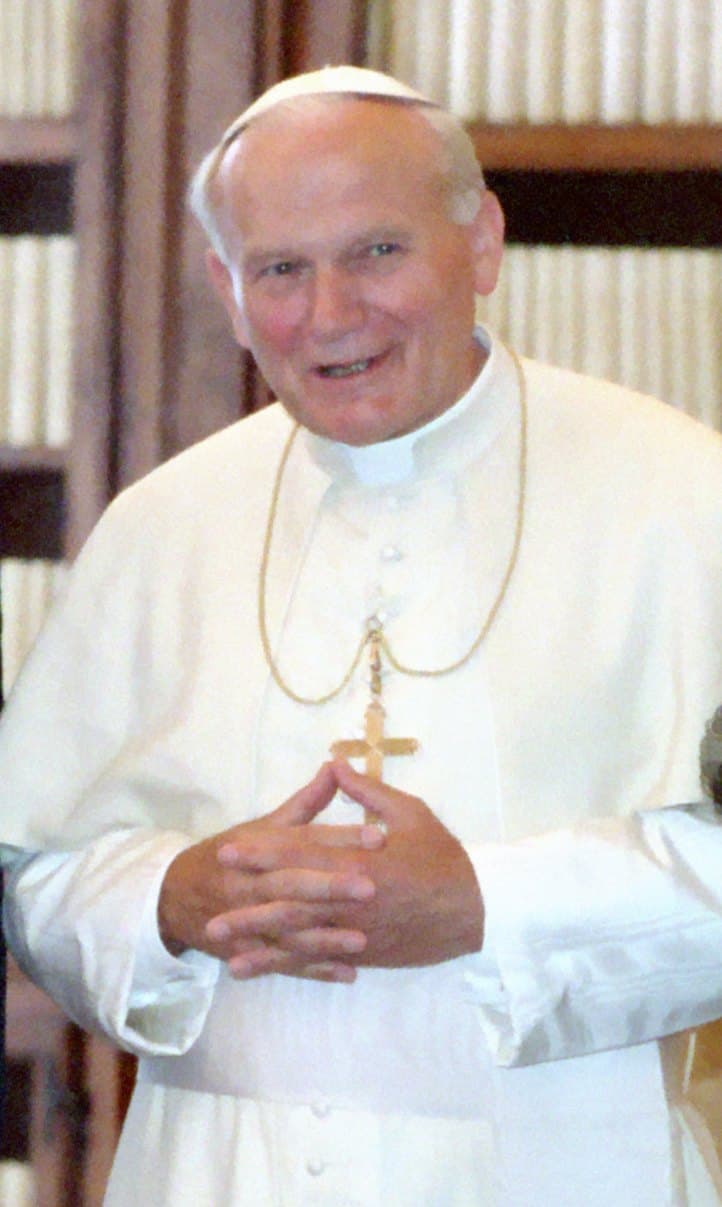
- Feast day
- October 22, the anniversary of his inaugural Mass in 1978 - not the day he died 2
- Orphaned
- He had lost his mother, his father and his older brother before he was twenty-one 1
- Ordained
- 1946, after an underground seminary in occupied Krakow 1
- Made bishop
- In 1958, because Communist officials considered him "a relatively harmless intellectual" 1
- Pastoral visits
- To 124 countries. The first non-Italian pope in 455 years 1
- In 27 years
- 14 encyclicals, five books, 482 saints canonized and 1,338 people beatified 1
Saint John Paul II was made a bishop in 1958 because the Communist authorities looked at him and saw "a relatively harmless intellectual." 1 Franciscan Media's comment on that is three words: "They could not have been more wrong!" 1 He had lost his mother, his father and his brother before he was twenty-one, and studied for the priesthood in an underground seminary while working in a quarry. 1
A quarry and an underground seminary
Karol Jozef Wojtyla was born at Wadowice in 1920 and "had lost his mother, father, and older brother before his 21st birthday." 1 His studies at the Jagiellonian University in Krakow were cut short by the German invasion.
"While working in a quarry and a chemical factory, he enrolled in an 'underground' seminary in Krakow." 1 Being caught would have meant a camp. He was ordained in 1946 and sent straight to Rome for a doctorate in theology. 1
Back in Poland he had a short rural assignment, then "his very fruitful chaplaincy for university students", a second doctorate in philosophy, and a teaching post at Lublin. 1
Then the sentence that decides the century. "Communist officials allowed Wojtyla to be appointed auxiliary bishop of Krakow in 1958, considering him a relatively harmless intellectual. They could not have been more wrong!" 1
He attended all four sessions of Vatican II and "contributed especially to its Pastoral Constitution on the Church in the Modern World", became archbishop of Krakow in 1964 and a cardinal three years later. 1
"Be not afraid"
He was elected in October 1978 and took the name of his predecessor, who had reigned thirty-three days. 1 He was "the first non-Italian pope in 455 years." 1
Vatican News fixes the moment his feast commemorates: October 22, "the anniversary of the inaugural Mass in 1978 at which he cried out to the world, 'Be not afraid!'" 2 Franciscan Media quotes the other line from that homily: "Open wide the doors to Christ." 1
What followed was motion on a scale the office had never seen: "pastoral visits to 124 countries, including several with small Christian populations." 1 He began World Youth Day and traveled for it. He wanted to visit China and the Soviet Union and both governments refused him. 1
"His 1979 visit to Poland encouraged the growth of the Solidarity movement there and the collapse of communism in central and eastern Europe 10 years later." 1
The synagogue, the mosque, and Agca
Franciscan Media lists the openings in sequence, and they are the substance of the pontificate as much as the travel. He "promoted ecumenical and interfaith initiatives, especially the 1986 Day of Prayer for World Peace in Assisi. He visited Rome's main synagogue and the Western Wall in Jerusalem; he also established diplomatic relations between the Holy See and Israel. He improved Catholic-Muslim relations, and in 2001 visited a mosque in Damascus, Syria." 1 Relations with the Orthodox "improved considerably." 1
The Great Jubilee of 2000 was "a key event in John Paul's ministry", marked by celebrations for Catholics and other Christians. 1
And then the photograph. "One of the most well-remembered photos of John Paul II's pontificate was his one-on-one conversation in 1983, with Mehmet Ali Agca, who had attempted to assassinate him two years earlier." 1 He went into the cell and sat with the man who shot him.
Vatican News gives the summary: "This great Pope tirelessly proclaimed the love of Christ, the 'Redeemer of man,' and shepherded the Church into the third Christian millennium." 2 The phrase is the title of his first encyclical, whose opening line Franciscan Media quotes: "Christ is the center of the universe and of human history." 1 At the United Nations in 1995 he described himself as "a witness to hope." 1
"In the last years of his life, he suffered from Parkinson's disease and was forced to cut back on some of his activities." 1 He died on April 2, 2005; Benedict XVI beatified him in 2011 and Francis canonized him in 2014. 1
What is Saint John Paul II the patron saint of
He belongs to young people, having founded World Youth Day and spent his years as a priest chaplain to university students. 1 He belongs to families, and to travelers, for obvious reasons.
Franciscan Media records what happened when he died: "hundreds of thousands of people had waited patiently for a brief moment to pray before his body, which lay in state inside St. Peter's for several days. The media coverage of his funeral was unprecedented." 1
Saint John Paul II's feast day
The feast of Saint John Paul II is October 22. 12 It is not the day he died - that was April 2, 2005 - but the anniversary of the Mass at which he was installed in 1978. 2
Vatican News gives the reason in the same breath as the date: it is the day "at which he cried out to the world, 'Be not afraid!'" 2 The Church chose to keep him on the day he began rather than the day he finished.
Praying with Saint John Paul II
Everybody remembers the travel and the crowds. The sentence to sit with is the quarry. 1 He was a young man with a dead mother, a dead father and a dead brother, cutting stone by day and studying for the priesthood at night in a seminary that would have got him arrested. Nothing about the later confidence is separable from that.
"A relatively harmless intellectual." 1 The people who most wanted to measure him got him completely wrong, and made him a bishop on the strength of it. It is worth remembering when assessing whether anybody is a threat, or whether you are one.
The prison visit is the act that says the most and required the least. 1 No document, no travel, no crowd. He sat down with the man who had shot him and talked to him. It is a photograph rather than an encyclical and it is the one people remember.
And the Parkinson's at the end. 1 A man whose whole ministry had been physical - the flights, the crowds, the skiing, the voice - lost the use of his body in public over years and did not withdraw. The Church kept him on October 22, the day he told everyone not to be afraid, and he had another twenty-seven years to demonstrate what he meant by it.
Saint John Paul II, pray for us.
Sources
Saints to turn to next
Others in this collection who are turned to for some of the same things.
- Saint Aloysius GonzagaMarch 9, 1568 - June 21, 1591DiscernmentSuffering and illnessConversion
- Saints Peter and PaulBoth died at Rome, under Nero, between 64 and 68ConversionCourageDiscernment
- Saint BartholomewFirst centuryDiscernmentConversionCourage
- Saint Claude de la Colombiere1641 - February 15, 1682DiscernmentSuffering and illnessCourage