Saint Bartholomew
First century
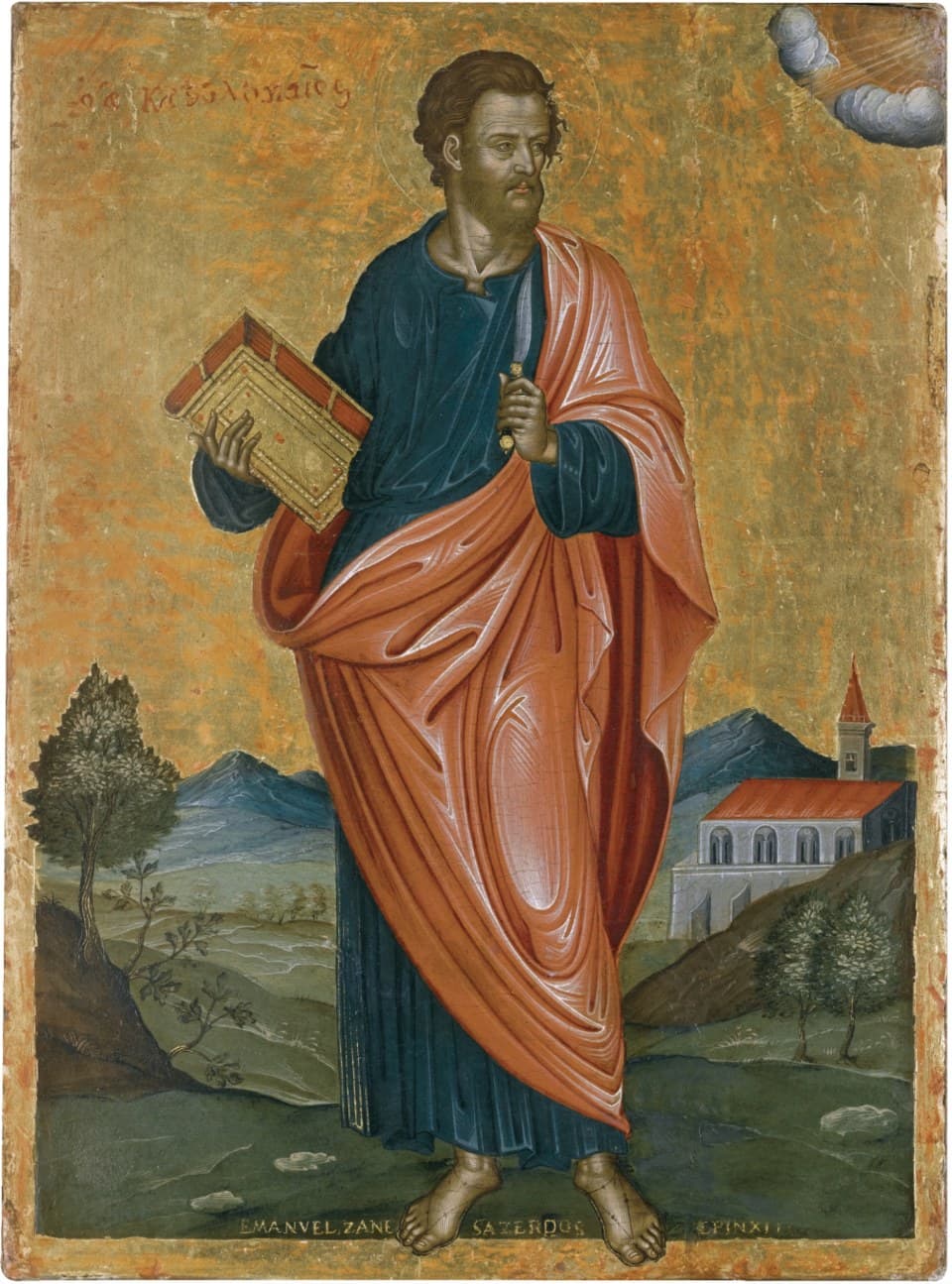
- Feast day
- August 24 1
- Name
- A patronymic: bar Talmay, "son of Talmai." Fenlon notes Talmai was an ancient Hebrew name, borne by a king of Gessur 12
- In the New Testament
- Sixth in the three Gospel lists, seventh in Acts, and nowhere else. Fenlon: "Nothing further is known of him for certain" 1
- Identified with
- Nathanael, on circumstantial evidence Fenlon calls "ingenious and pretty strong" while naming its weak link 12
- Died
- Said to be at Albanopolis in Armenia. Beheaded according to some, flayed alive and crucified head downward according to others 1
Saint Bartholomew is named in every list of the Twelve and appears in no story in the New Testament at all. 12 Everything else told about him depends on whether he is the same man as Nathanael, who asked whether anything good could come out of Nazareth - and the encyclopedia, having argued the case for it, points out the one place the argument could fail. 1 The famous flaying is one of two traditions about his death, and the sources call both uncertain. 1
A name and nothing else
Bartholomew is a patronymic rather than a personal name. It means "son of Talmai," and Fenlon notes that Talmai was an ancient Hebrew name - a king of Gessur bore it, whose daughter was a wife of David. 1 Benedict XVI gives the Aramaic form, bar Talmay. 2 It may have been his actual name or, as Fenlon allows, "simply added to distinguish him as the son of Talmai." 1
He is sixth in the three Gospel lists and seventh in Acts. 1 Benedict observes that he always comes before Matthew while the name before his varies - Philip in Matthew, Mark and Luke, Thomas in Acts. 2 And that is the whole of it. Fenlon: "Outside the instances referred to, no other mention of the name occurs in the New Testament. Nothing further is known of him for certain." 1 Benedict says the same in his own way: "his name always and only appears in the lists of the Twelve mentioned above and is therefore never central to any narrative." 2
Is he Nathanael?
It is worth pausing on how little that is. Four lists, one name, no sentence he speaks and no action he takes. Every other Apostle in this library has at least a scene. Bartholomew has a position in an enumeration, and the position is the main argument for everything else said about him.
Almost everything people know about Bartholomew is borrowed from a man John calls Nathanael, and whether the loan is legitimate is a real question that both sources take seriously.
Fenlon lays out the case. Bartholomew is not a proper name. The name never occurs in the Fourth Gospel, while Nathanael is absent from the synoptics. Bartholomew is coupled with Philip in the lists of Matthew and Luke and sits next to him in Mark, which fits John's account that Philip was an old friend of Nathanael's and brought him to Jesus. Nathanael's call is narrated alongside the calls of several Apostles, at a length that "leads one to expect some important development." He was a Galilean, like most or all of the Twelve. And he is present at the Sea of Tiberias with named Apostles and two unnamed disciples who were almost certainly Apostles too. 1
Then Fenlon does the thing that makes the article worth reading. "This chain of circumstantial evidence is ingenious and pretty strong; the weak link is that, after all, Nathaniel may have been another personage in whom, for some reason, the author of the Fourth Gospel may have been particularly interested, as he was in Nicodemus, who is likewise not named in the synoptics." 1
Benedict XVI proceeds on the identification as traditional, and gives his own reason for it: Nathanael stands next to Philip in the calling scene, which is the position Bartholomew occupies in the other lists. 2 He notes that this Nathanael came from Cana and so may have witnessed the sign Jesus worked there. 2 Fenlon adds a curiosity that cuts the other way: among the various traditions about Bartholomew, "one legend, it is interesting to note, identifies him with Nathaniel" - that is, the identification is itself partly a matter of legend. 1
Can anything good come out of Nazareth?
If the two are one man, this is the scene that belongs to him, and Benedict spends most of his catechesis on it.
Philip tells Nathanael he has found the one Moses and the prophets wrote about, Jesus of Nazareth, and gets an answer Benedict calls "rather strongly prejudiced": "Can anything good come out of Nazareth?" 2 Benedict takes the objection seriously rather than scolding it. By Judaic expectation the Messiah could not come from so obscure a village, so the protest is a reasonable one - and it "highlights God's freedom, which baffles our expectations by causing him to be found in the very place where we least expect him." 2
Philip does not argue. He says "Come and see." 2 Benedict builds the practical point on that: somebody else's testimony is normally how Christian life begins, but it cannot be where it stops, and "we ourselves must then be personally involved in a close and deep relationship with Jesus." 2 He sets it beside the Samaritans, who told the woman at the well that they no longer believed because of her words, having heard for themselves. 2
What Jesus then says to Nathanael is praise: "Behold, an Israelite indeed, in whom there is no guile!" 2 Nathanael asks how he is known, and the answer is the line nobody can explain - "Before Philip called you, when you were under the fig tree, I saw you." 2 Benedict is honest that the meaning is lost: "We do not know what had happened under this fig tree. It is obvious that it had to do with a decisive moment in Nathanael's life." 2 Whatever it was, it was enough, and the man who had just been sneering at Nazareth answered: "Rabbi, you are the Son of God! You are the King of Israel!" 2
India, Armenia, and a skin
The earliest notice of anything he did comes from Eusebius, who records that Pantaenus - the master of Origen - was told while evangelizing India that the Apostle had preached there before him, and had left his converts the Gospel of Matthew in Hebrew, which the Church there still treasured. 12
Fenlon attaches a caution that is easy to miss and changes the claim considerably: "'India' was a name covering a very wide area, including even Arabia Felix." 1 Other traditions put Bartholomew in Mesopotamia, Persia, Egypt, Armenia, Lycaonia, Phrygia and on the shores of the Black Sea. 1
On the death, Fenlon is plain that nothing is settled. It is said to have happened at Albanopolis in Armenia, and "the manner of his death... is equally uncertain; according to some, he was beheaded, according to others, flayed alive and crucified, head downward, by order of Astyages, for having converted his brother, Polymius, King of Armenia." 1
The second version is the one art chose, and Benedict notes why it stuck: Michelangelo painted Bartholomew in the Last Judgment holding his own skin, and put his own self-portrait on it. 2 A tradition the encyclopedia calls uncertain became the single most famous image of the man because of one fresco in the Sistine Chapel.
What is Saint Bartholomew the patron saint of?
Neither source used here states a patronage for Saint Bartholomew, and this profile does not supply one. 12 He is widely associated with tanners, leatherworkers and others who work with skins, which follows from the flaying tradition rather than from anything either source asserts about his death. Since Fenlon calls that tradition uncertain and offers beheading beside it, a patronage resting on it is not something this page will state. 1
Saint Bartholomew's feast day
The feast of Saint Bartholomew is August 24. 1 Fenlon states it plainly and it is still the date, which is not something that can be assumed of a 1907 article - this library has had to correct three pre-reform feast days in the same batch of work. 1 Fenlon also records that an apocryphal gospel of Bartholomew circulated in the early ages, and that his relics are "thought by some" to be at St Bartholomew-in-the-Island in Rome. 1 Benedict adds the tradition that the German Emperor Otto III brought them there in 983. 2
Praying with Saint Bartholomew
Benedict draws the conclusion that this profile exists to carry, and it is unusually modest for a catechesis about an Apostle: "despite the scarcity of information about him, St Bartholomew stands before us to tell us that attachment to Jesus can also be lived and witnessed to without performing sensational deeds." 2 A man named in every list and starring in no story.
The objection is the useful part of him, assuming he is Nathanael. He did not receive the news politely. He said the town was wrong and the claim was implausible, and he was working from a reasonable premise about where the Messiah was supposed to come from. 2 Nothing in the account treats the question as bad faith. Philip does not argue him out of it; he tells him to come and look.
And then there is the fig tree, which is the strangest detail in the scene precisely because it is withheld. Something happened there that mattered enough to change the man when Jesus mentioned it, and no one now knows what. 2 Anyone who has a moment in their own life that would mean nothing said aloud and everything to them will recognize the shape of it.
What the sources will not give is a biography. Two traditions about how he died, a wide word for where he went, relics attributed with a "thought by some," and a famous painting of an execution that may not have been his. 12 He is venerated on the strength of a name in a list and a conversation under a tree, and that has been enough for twenty centuries.
Saint Bartholomew, pray for us.
Sources
Saints to turn to next
Others in this collection who are turned to for some of the same things.