Saint Catherine of Siena
1347 - 1380
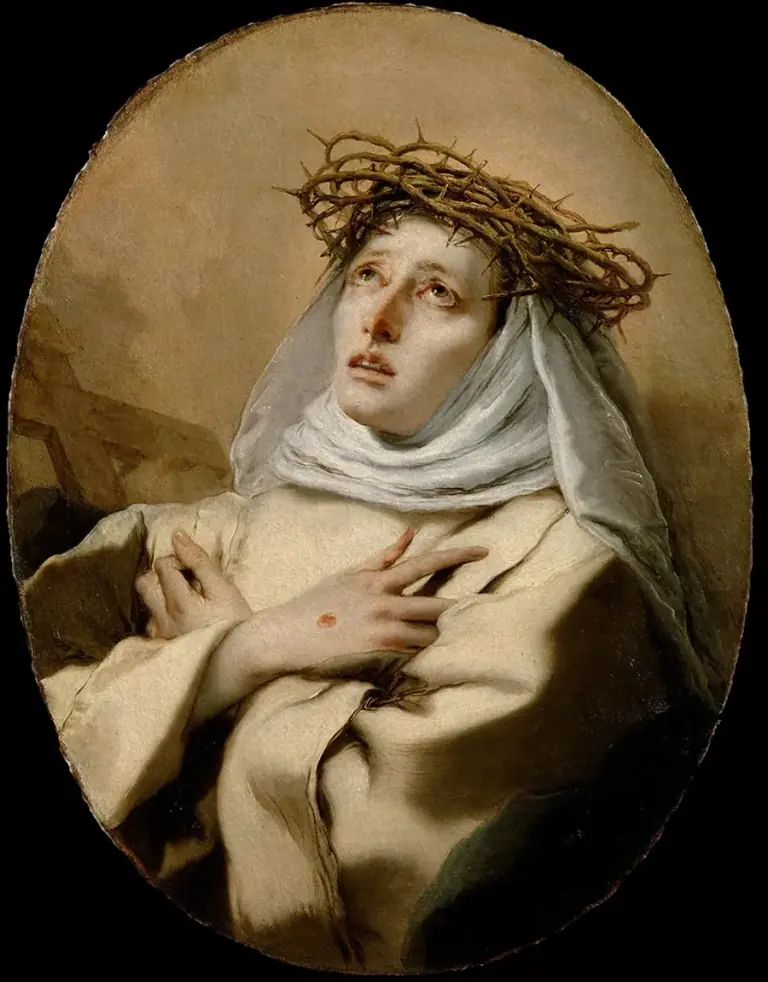
- Patron saint of
- Europe and Italy 2
- Feast day
- April 29 2
- Died
- Rome, 1380, at the age of thirty-three 1
- Joined
- The Mantellate, the Dominican third order, at sixteen 1
- Canonized
- 1461 1
- Co-Patroness of Europe
- Named by Pope John Paul II 1
Saint Catherine of Siena was an unschooled laywoman who told the Pope to go home, and he went. She never held office, never took solemn vows, and died at thirty-three. She is a Doctor of the Church and a patroness of Europe, and the reason is that she combined an extraordinarily intimate life of prayer with a complete unwillingness to be intimidated by anybody.
A laywoman in a large family
Catherine was born in Siena in 1347, one of a very large family. 12 At sixteen, moved by a vision of Saint Dominic, she joined the Mantellate - the women's branch of the Dominican third order - which meant she took on a religious rule while continuing to live at home. 1 She was never a cloistered nun.
She gave herself to "prayer, penance and works of charity, especially for the benefit of the sick." 1 The hospital work came first and the public life grew out of it, not the other way round.
The letters
Catherine dictated a very large correspondence, the Epistolario, alongside her Dialogue and her Prayers. 1 The letters go to popes, monarchs, mercenaries, prisoners and relatives, and their tone is remarkably consistent: direct, affectionate, and entirely unimpressed by rank.
Avignon
For most of the fourteenth century the popes had lived at Avignon rather than Rome. Catherine "energetically and effectively urged" Gregory XI to return. 1 He did, in 1377.
It is worth being clear about who was doing the urging: a woman in her late twenties with no formal education, no office, and no institutional standing whatever, pressing the Pope to reverse seventy years of practice. She was right, and he listened.
The Dialogue
Her masterpiece is the Dialogue of Divine Providence, in which Christ is described as a bridge between heaven and earth, with three stairways to be climbed. 1 It is a book about how a person actually gets from where they are to God, written by someone who assumed the question was practical.
Her prayer has a particular note that Benedict XVI quotes: "Out of mercy you have washed us in his Blood... O mercy! My heart drowns in thinking of you." 1
She died in Rome in 1380, aged thirty-three, was canonized in 1461, declared a Doctor of the Church by Paul VI in 1970 - with Teresa of Avila, the first two women given that title - and named Co-Patroness of Europe by John Paul II. 12
What is Saint Catherine the patron saint of?
Catherine of Siena is a patron saint of Europe and of Italy. 2 The European patronage is the substantive one: she is held up as a figure who called the continent's central institution back to its own responsibilities.
Saint Catherine's feast day
The feast of Saint Catherine of Siena is celebrated on April 29. 2
Praying with Saint Catherine
Catherine had no office, no schooling to speak of, and no standing whatever, and she told Gregory XI to go back to Rome. 1 He went. Whatever authority she had came out of her prayer and her obvious love for the Church, which is not a credential anyone can withhold from you.
She never entered a cloister. She joined the Mantellate at sixteen and stayed in her family home, nursing the sick, and the letters to popes and princes grew out of that rather than replacing it. 1 The most consequential laywoman of her century did her work from the house she grew up in.
Mercy is the note she keeps returning to, and she is not restrained about it. Out of mercy you have washed us in his blood, she writes, and then: my heart drowns in thinking of you. 1 If God's forgiveness has gone abstract on you, she is a good corrective.
She was dead at thirty-three. 1 Franciscan Media frames holiness as the work of a lifetime 2, which is true, and Catherine is the reminder that a lifetime is not always as long as you were counting on.
Saint Catherine of Siena, pray for us.
Sources
Saints to turn to next
Others in this collection who are turned to for some of the same things.