Saint Teresa Benedicta of the Cross
October 12, 1891 - August 9, 1942
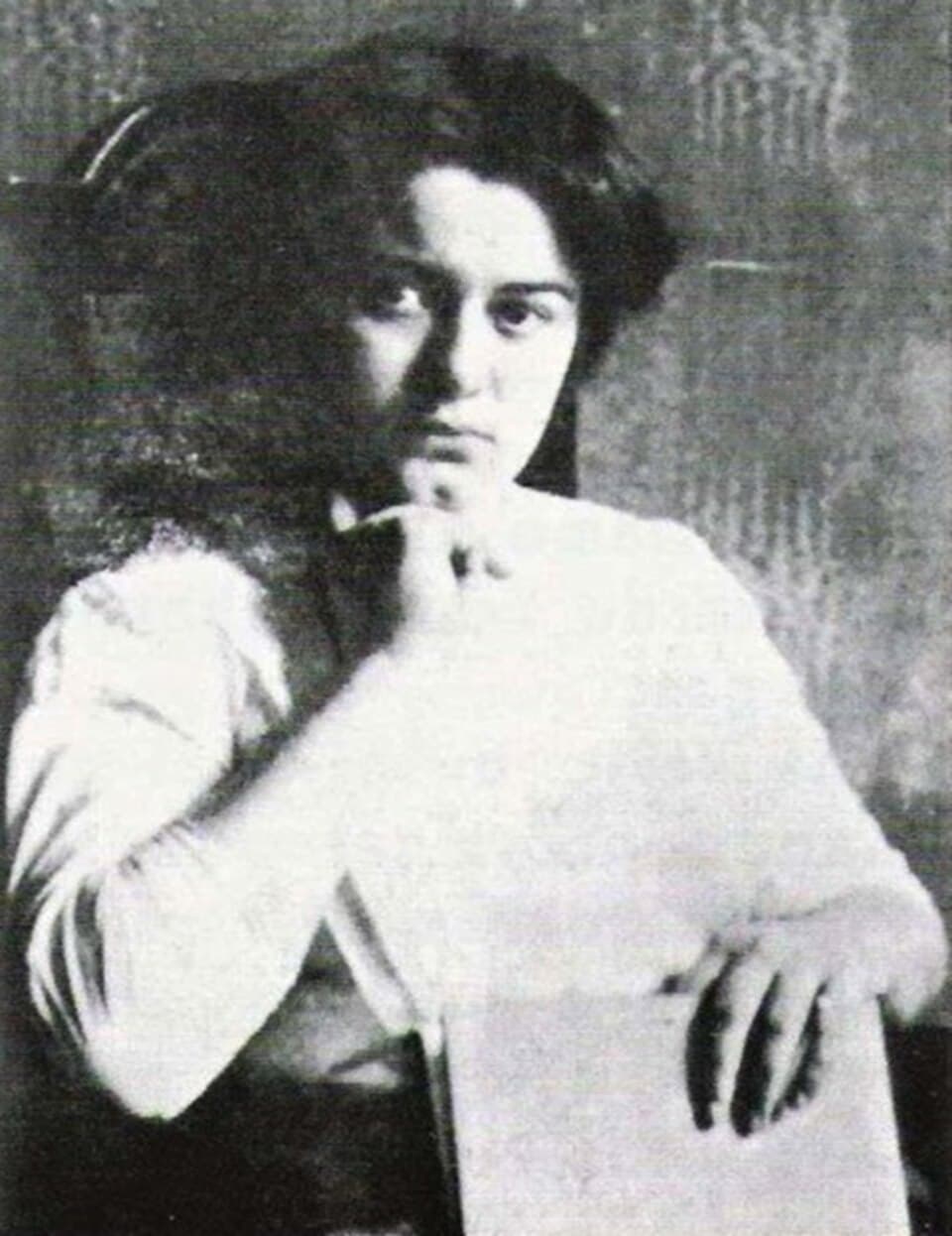
- Died
- Auschwitz, August 9, 1942, according to Vatican News and Franciscan Media; "probably" that day, according to the Holy See biography 145
- Baptized
- January 1, 1922 1
- Religious order
- Discalced Carmelites; entered the Cologne Carmel October 14, 1933 1
- Canonized
- October 11, 1998, by Pope John Paul II 2
Saint Teresa Benedicta of the Cross is Edith Stein, a Jewish philosopher from Breslau who gave up praying at fourteen, became a Catholic in 1922 and a Carmelite nun in Cologne in 1933. 15 In August 1942 the Nazis took her from a convent in the Netherlands to Auschwitz, where she died in the gas chambers with her sister Rosa. 12 John Paul II canonized her on October 11, 1998, and named her a co-patroness of Europe the following year; her feast is August 9. 2345
A Jewish family in Breslau
Edith Stein was born in Breslau on October 12, 1891, the youngest of eleven children, on Yom Kippur, the Day of Atonement. 14 Her father died when she had just turned two, and her mother took over the family timber business. 1
Her mother was devout and raised her in the faith, but at fourteen, in Edith's own words, "I consciously decided, of my own volition, to give up praying." 124 Much later, as a Carmelite, she wrote a memoir of her family, "The Life of a Jewish Family" in the Holy See biography and Life in a Jewish Family in Vatican News, as a witness for a generation "brought up in racial hatred." 14
Husserl, empathy and a field hospital
She enrolled at the University of Breslau in 1911 to read German and history, a "bread-and-butter" choice; what she cared about was philosophy and women's issues, and she joined the Prussian Society for Women's Franchise. 1 In 1913 she moved to Göttingen to study under Edmund Husserl, one of the leading phenomenologists, and became his pupil and then his assistant. 15 There she met Max Scheler, who turned her toward Catholicism. 1
In the First World War she served as a nurse in an Austrian field hospital, including the typhus ward. 14 She followed Husserl to Freiburg in 1916, and the Holy See biography says she took her doctorate there summa cum laude in 1917, with a thesis on "The Problem of Empathy"; Franciscan Media dates the doctorate to 1916. 15 John Paul II called empathy "a word dear to her." 3 A professorship, though, was impossible "for a woman and a Jew," as Vatican News puts it, and the Holy See biography says she was later refused one on account of her Jewishness. 14
"This is the truth"
Three things moved her. In Frankfurt Cathedral she watched a woman come in from the market with a shopping basket and kneel to pray: "It was something I never forgot." 1 In November 1917 her friend Adolf Reinach, Husserl's assistant, was killed in Flanders, and she went to his widow expecting to console her and found a woman of faith. 14 "This was my first encounter with the Cross and the divine power it imparts to those who bear it," she wrote; "it was the moment when my unbelief collapsed." 1
The third was a book. In the summer of 1921, staying at Bergzabern with Hedwig Conrad-Martius, another of Husserl's students, she picked up the autobiography of Teresa of Avila and read it through the night. 15 "When I had finished the book, I said to myself: This is the truth." 1 Looking back, she wrote: "My longing for truth was a single prayer." 1
She was baptized on January 1, 1922, wearing her godmother Hedwig's white wedding cloak. 1 "I had given up practising my Jewish religion when I was a 14-year-old girl and did not begin to feel Jewish again until I had returned to God." 1 Vatican News says she experienced baptism "as both the confirmation and the fulfillment of her Jewish identity." 4 She went home and told her mother, "Mother, I am a Catholic," and the two women cried. 1
Teacher, lecturer, translator
She wanted to enter Carmel at once, and her spiritual mentors stopped her. 1 She taught instead at the Dominican Sisters' school in Speyer, from 1922 according to Franciscan Media, until Easter 1931 according to the Holy See biography. 15 She lectured widely on women's issues, translated Newman and Aquinas, and learned, she said, that it was possible to "pursue scholarship as a service to God." 14
In 1932 she took a lectureship at the German Institute for Educational Studies, at the University of Munster according to the Holy See biography and in Munich according to Franciscan Media. 15 In 1933 the Nazi racial laws ended it. 15 "Now it dawned on me that God had laid his hand heavily on His people, and that the destiny of these people would also be mine." 1
Sister Teresa Benedicta of the Cross
On her last day at home, her birthday in October 1933, she went to the synagogue with her mother, who said of Jesus: "He may have been a very good person. But why did he make himself God?" 1 Two days later she entered the Carmel in Cologne, and in April 1934 she received the habit and the name Teresia Benedicta a Cruce. 1 She wrote to her mother every week and never received an answer; her mother died in 1936, on the day Edith renewed her vows. 1
She made her final profession in 1938. 1 That October she compared herself to Queen Esther, taken from her people to plead for them: "I am a very poor and powerless little Esther." 1 After the synagogues burned that November, her prioress had her smuggled across the border on New Year's Eve to the Carmel at Echt in the Netherlands. 15 There she wrote her will, offering her life "for the peace of the world," and finished The Science of the Cross, her study of John of the Cross. 14
Westerbork and Auschwitz
The Netherlands fell in 1940. 5 When the Dutch Catholic bishops protested the deportation of Jews, the occupiers retaliated by arresting Jews who had become Christians. 15 The Gestapo took Edith from the convent chapel on August 2, 1942, with her sister Rosa, who had also converted and was serving at Echt. 1 Her last words there were to Rosa: "Come, we are going for our people." 14
John Paul II quoted what she said a few days before the deportation, when the question of rescuing her was raised: "Why should I be spared? Is it not right that I should gain no advantage from my Baptism? If I cannot share the lot of my brothers and sisters, my life, in a certain sense, is destroyed." 2 In the transit camps at Amersfoort and Westerbork she said, "I never knew that people could be like this." 1 On August 7, 987 Jews were deported to Auschwitz. 1 The Holy See biography says she, Rosa and many others were gassed "probably on 9 August"; Vatican News and Franciscan Media give August 9, 1942 as the date of her death. 145
How the popes spoke of her death
John Paul II beatified her in Cologne on May 1, 1987, and canonized her in St. Peter's Square on October 11, 1998. 12 At the canonization he said: "Because she was Jewish, Edith Stein was taken with her sister Rosa and many other Catholic Jews from the Netherlands to the concentration camp in Auschwitz, where she died with them in the gas chambers." 2 In the same homily he called her "a saint and martyr" and the "martyr for love, who gave her life for her friends." 2
A year later he wrote that "her voice merged with the cry of all the victims of that appalling tragedy," and that in "her witness as an innocent victim" the Church recognizes "an imitation of the Sacrificial Lamb and a protest against every violation of the fundamental rights of the person." 3 The Holy See biography says she remained faithful, as a Catholic, to the crucified Christ and, as a Jew, "to her people in loving faithfulness." 1
What is Saint Teresa Benedicta of the Cross the patron saint of?
Saint Teresa Benedicta of the Cross is a co-patroness of Europe. 35 John Paul II declared her so on October 1, 1999, with Bridget of Sweden and Catherine of Siena, saying she had become "the symbol of a human, cultural and religious pilgrimage which embodies the deepest tragedy and the deepest hopes of Europe." 3 Franciscan Media lists her as patron of Europe and of converts to Christianity. 5
Saint Teresa Benedicta of the Cross's feast day
Praying with Saint Teresa Benedicta of the Cross
Her conversion came through people as much as arguments: a woman with a shopping basket, a grieving widow, a book read in one night. 1 Then she waited more than a decade for Carmel because her advisers said to. 1 Of those searching years she wrote: "Whoever seeks the truth is seeking God, whether consciously or unconsciously." 2
Her faith cost her family something, and the sources do not soften it. Her mother wept when Edith told her she was a Catholic, wept again at the synagogue on their last day together, and never answered a letter from the convent. 1 John Paul II wrote that "her mother's disapproval" caused her "profound pain." 3 When her mother died, Edith wrote that she was confident she had met "a very merciful judge." 1
At her canonization John Paul II put into one sentence what he said she tells "us all": "Do not accept anything as the truth if it lacks love. And do not accept anything as love which lacks truth!" 2
She died in the Shoah, which John Paul II called "that cruel plan to exterminate a people," and he asked that each year, when her memory is kept, the millions of Jews who died in it be remembered too. 2 At her canonization he prayed for them in the words of the priestly blessing from the Book of Numbers, that the Lord would let his face shine upon them and grant them peace. 2
Saint Teresa Benedicta of the Cross, pray for us.
Sources
- 1."Teresa Benedict of the Cross Edith Stein (1891-1942)," biography published by the Holy See for the canonization of October 11, 1998.
- 2.John Paul II, Homily for the Canonization of Edith Stein, October 11, 1998.
- 3.John Paul II, Apostolic Letter Spes aedificandi, proclaiming Saint Bridget of Sweden, Saint Catherine of Siena and Saint Teresa Benedicta of the Cross Co-Patronesses of Europe, October 1, 1999.
- 4."St. Theresa Benedicta of the Cross (Edith Stein), Carmelite, Virgin and Martyr, Patron of Europe," Saint of the Day, August 9, Vatican News.
- 5."Saint Teresa Benedicta of the Cross," Saint of the Day, Franciscan Media.
Saints to turn to next
Others in this collection who are turned to for some of the same things.