Saint Josephine Bakhita
c. 1869 - February 8, 1947
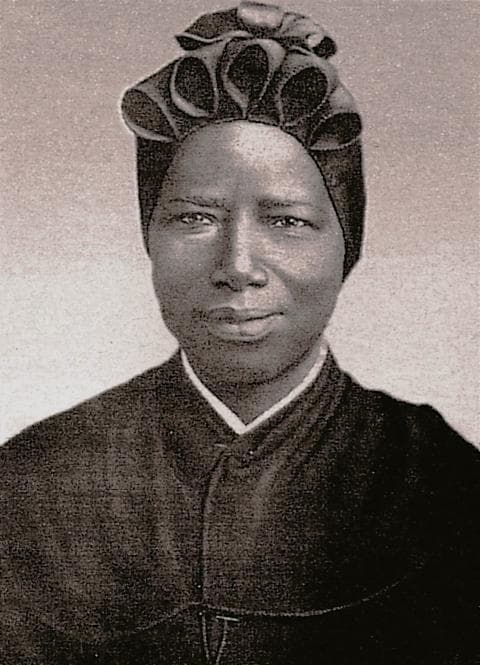
- Kidnapped
- At seven, in Darfur, and sold into slavery. She was resold several times 1
- Her name
- Bakhita, given her by her captors. It means "fortunate" 1
- The court case
- A judge ruled that, slavery being illegal in Italy, she had been free since 1885 1
- Professed
- A Canossian sister in 1896, after entering in 1893 1
- At Schio
- Cooking, sewing, embroidery, and answering the door, for forty-five years 1
Saint Josephine Bakhita was kidnapped at seven in Darfur and sold so many times that she lost her own name - the one she is known by, Bakhita, was given her by the men who bought her, and it means "fortunate." 1 When her owners tried to take her back to Africa she refused to go, and an Italian court found that she had been legally free for eight years without knowing it. 1
Sold
She was born at Olgossa in Darfur, in southern Sudan, around 1869. "Josephine was kidnapped at the age of 7, sold into slavery and given the name Bakhita, which means fortunate." 1 Franciscan Media opens with the sentence the whole life turns on: "For many years, Josephine Bakhita was a slave but her spirit was always free and eventually that spirit prevailed." 1
"She was resold several times, finally in 1883 to Callisto Legnani, Italian consul in Khartoum." 1 Vatican News is blunter about the years in between: her story "is one of the most extraordinary tales of oppression and redemption in the Church," and she "went from chains and torture to the service of the Gospel." 2
Two years later Legnani took her to Italy "and gave her to his friend Augusto Michieli." 1 She was a gift. She became the babysitter of the Michielis' daughter Mimmina.
A door she happened to be standing behind
It was the child's religious instruction that opened it. "Bakhita became babysitter to Mimmina Michieli, whom she accompanied to Venice's Institute of the Catechumens, run by the Canossian Sisters. While Mimmina was being instructed, Josephine felt drawn to the Catholic Church." 1 She was there as an attendant, waiting.
She was baptized and confirmed in 1890, taking the name Josephine. 1
Then the Michielis came back from Africa and wanted both girls. "The future saint refused to go." 1 Refusing is the act that everything else rests on, and she was a woman who had been bought and sold since she was seven.
"During the ensuing court case, the Canossian Sisters and the patriarch of Venice intervened on Josephine's behalf. The judge concluded that since slavery was illegal in Italy, she had actually been free since 1885." 1
Read that again. Not freed by the court - found to have been free already, for eight years, by the operation of a law nobody had told her about. She had been legally a free woman the entire time she was being treated as property.
Forty-five years at the door
She entered the Institute of St. Magdalene of Canossa in 1893 and professed in 1896. 1 In 1902 she was sent to Schio, northeast of Verona, and stayed.
What she did there is listed without ceremony: she "assisted her religious community through cooking, sewing, embroidery, and welcoming visitors at the door." 1 The last of those is what she is remembered for locally - she answered the door for four and a half decades. "She soon became well loved by the children attending the sisters' school and the local citizens." 1
Her own summary of what she had to say: "Be good, love the Lord, pray for those who do not know Him. What a great grace it is to know God!" 1
She died at Schio on February 8, 1947. The first steps toward her beatification began in 1959; she was beatified in 1992 and canonized eight years later. 1 Vatican News lists her simply as "St. Josephine Bakhita, Virgin." 2
What is Saint Josephine Bakhita the patron saint of
She is the patron of Sudan and of survivors of human trafficking and slavery, and February 8 is kept as an international day of prayer against trafficking because it is her day. 12
Franciscan Media states the distinction that matters: "Saint Josephine Bakhita's body was mutilated by those who enslaved her, but they could not touch her spirit." 1 It also notes the irony she lived inside: "She who worked under many 'masters' was finally happy to address God as 'master.'" 1
Saint Josephine Bakhita's feast day
Praying with Saint Josephine Bakhita
The name is the first thing to sit with. Bakhita is not her name. It is what the men who bought her called her, and it means fortunate, and the horror of that is not softened by the fact that she kept it. 1 She was taken at seven and the record does not preserve what she was called before.
The refusal is the hinge. 1 A woman who had been sold repeatedly since childhood said no to the people who considered themselves her owners, and she said it in a country whose language and law she had learned as a servant. Everything after that - the habit, the school, the door at Schio - is downstream of one refusal.
And the finding of the court, which is stranger than a liberation. She had been free since 1885 and nobody had mentioned it. 1 There is a great deal in that for anyone who has been treated as less than they are: the status was already true, and what was missing was that somebody say so out loud.
Then forty-five years of cooking, sewing and answering a door. 1 Nothing about her later life is dramatic, and she was loved by the children and by the town. What she said, when asked, was: be good, love the Lord, pray for those who do not know Him. 1 A woman who had been through what she had been through recommended kindness.
Saint Josephine Bakhita, pray for us.
Sources
Saints to turn to next
Others in this collection who are turned to for some of the same things.
- Saint John EudesNovember 14, 1601 - August 19, 1680PrayerConversionCourage
- Saint Joseph CafassoJanuary 15, 1811 - June 23, 1860PrayerConversionSuffering and illness
- Saint Louis de MontfortJanuary 31, 1673 - April 28, 1716PrayerCourageSuffering and illness
- Saint Maximilian KolbeJanuary 8, 1894 - August 14, 1941CourageSuffering and illnessPrayer