Saint Louis de Montfort
January 31, 1673 - April 28, 1716
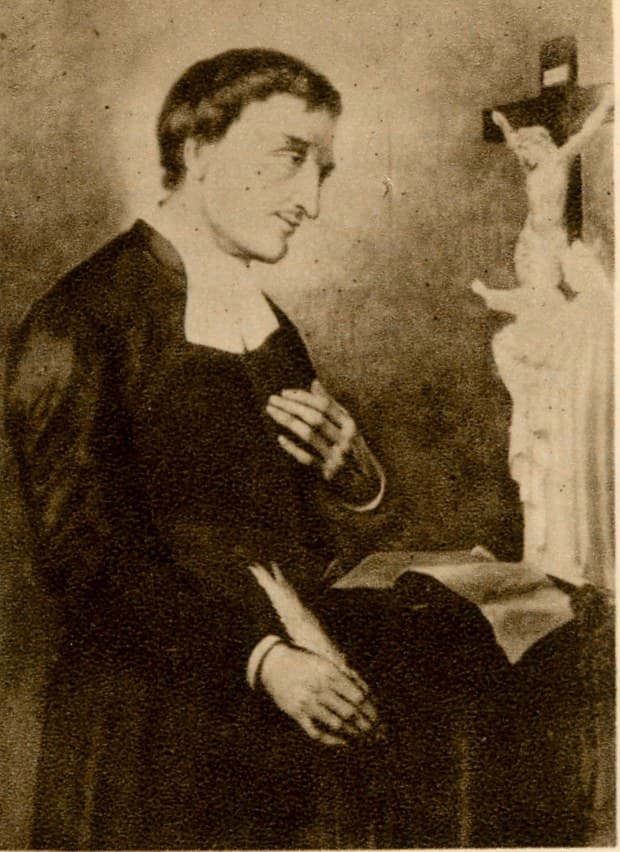
- Born
- Montfort, Brittany, January 31, 1673 1
- Walked to Paris
- At nineteen, giving away his money and clothes on the road, and vowing to live on alms 1
- Preached
- Seventeen years of missions in the towns and villages of Brittany and the Vendee 1
- Founded
- The Sisters of Wisdom and the Company of Mary, a year before he died 1
- Left behind
- Four sisters, two priests and a few brothers. By 1900 the Sisters numbered five thousand 1
Saint Louis de Montfort walked to Paris at nineteen, gave away his money and his clothes on the way, and vowed to live on alms for the rest of his life. 1 He spent seventeen years preaching missions in Brittany and the Vendee, was poisoned once and nearly murdered another time, and watched the king order fifteen months of his work torn down. 1 His whole reply to that last was three words: "Blessed be God!" 1
The road to Paris
From childhood he was "indefatigably devoted to prayer before the Blessed Sacrament", and from the age of twelve, as a day pupil at the Jesuit college at Rennes, "he never failed to visit the church before and after class." 1 He joined a group of young men who spent their holidays with the poor and the incurables in the hospitals, reading aloud to them at meals. 1
At nineteen he went to Paris to study theology, and he went on foot. Poulain records what he did on the way: he "gave away on the journey all his money to the poor, exchanged clothing with them, and made a vow to subsist thenceforth only on alms." 1 He arrived with nothing and a promise never to have anything.
He was ordained at twenty-seven and served for a while as a hospital chaplain. The turn came in 1705, at thirty-two, when he "found his true vocation, and thereafter devoted himself to preaching to the people." 1 Seventeen years followed, in countless towns and villages. 1
The garrison, and the calvary
Poulain gives two instances to show what his preaching did. The first is a mission for the soldiers of the garrison at La Rochelle: "moved by his words, the men wept, and cried aloud for the forgiveness of their sins." 1 At the procession that closed the mission, "an officer walked at the head, barefooted and carrying a banner, and the soldiers, also barefooted, followed, carrying in one hand a crucifix, in the other a rosary, and singing hymns." 1
The second is Pontchateau, and it is the one to sit with. He announced that he would build a monumental calvary on a hill nearby, and the people took up the idea. "For fifteen months between two and four hundred peasants worked daily without recompense, and the task had just been completed, when the king commanded that the whole should be demolished, and the land restored to its former condition." 1
The reason was a lie. The Jansenists "had convinced the Governor of Brittany that a fortress capable of affording aid to persons in revolt was being erected." 1 For several months afterward, "five hundred peasants, watched by a company of soldiers, were compelled to carry out the work of destruction." 1 The people who had built it were made to pull it down, under guard.
Poulain gives his reaction in a single clause: "Father de Montfort was not disturbed on receiving this humiliating news, exclaiming only: 'Blessed be God!'" 1
Poison, and a tree he did not see grow
It was not the only trial. The Jansenists, "irritated by his success, secured by their intrigues his banishment" from districts where he was preaching. 1 At La Rochelle "some wretches put poison into his cup of broth, and, despite the antidote which he swallowed, his health was always impaired." 1 Another time men waited in a narrow street to kill him, "but he had a presentiment of danger and escaped by going by another street." 1
A year before his death he founded two congregations: the Sisters of Wisdom, for hospital work and the instruction of poor girls, and the Company of Mary, for missionaries. 1 He had wanted both for years and circumstances had prevented them.
Poulain is honest about how it looked when he died: "humanly speaking, the work appeared to have failed at his death, since these congregations numbered respectively only four sisters and two priests with a few brothers." 1 Six people and some brothers, after a lifetime.
"But the blessed founder ... knew that the tree would grow." 1 By the beginning of the twentieth century the Sisters of Wisdom numbered five thousand, in every country, with forty-four houses and sixty thousand children under instruction. 1 The Company of Mary was led for thirty-nine years by Father Mulot - a man who had refused to join him, saying, "I cannot become a missionary, for I have been paralysed on one side for years; I have an affection of the lungs which scarcely allows me to breathe." Montfort answered, "As soon as you begin to preach you will be completely cured", and Poulain records that "the event justified the prediction." 1
What is Saint Louis de Montfort the patron saint of
He is a patron of preachers and missionaries, of the two congregations he founded, and of France, where he walked the whole of his ministry. 12 Poulain gives no formal list. 1
What he is plainly for is voluntary poverty that is not a gesture. He took the vow at nineteen and kept it for forty-three years, and the article's word for that kind of life is worth quoting as the judgment of 1910 on it: virtues "difficult for modern degeneracy to comprehend." 1
Saint Louis de Montfort's feast day
Praying with Saint Louis de Montfort
Pontchateau is the whole man in one episode. Fifteen months, four hundred people a day, no wages, a finished monument - and then a royal order, based on a slander, and soldiers standing over the builders while they undid it. 1 Almost any response would be understandable. The record gives two words and an exclamation point.
"Blessed be God!" is not resignation. Resignation would be silence. It is a positive verdict delivered on the worst available evidence, by a man who had just lost something he had no way of rebuilding, and it was said in front of the people whose work had been wasted.
The poison is the detail that makes the rest credible. He survived it and "his health was always impaired" afterward. 1 He preached for years with a body that had been damaged on purpose by someone who disliked his sermons, and the article mentions it in one sentence on the way to something else.
And the six people. 1 He died having founded two congregations that between them could not fill a room, having preached for seventeen years and watched his monument demolished. Poulain says he knew the tree would grow. Whether or not that was prophecy, it was certainly not evidence. Five thousand sisters and sixty thousand children were two centuries of other people's work, and he never saw any of it.
Saint Louis de Montfort, pray for us.
Sources
Saints to turn to next
Others in this collection who are turned to for some of the same things.
- Saint Charles de FoucauldSeptember 15, 1858 - December 1, 1916PrayerPoverty and simplicitySuffering and illness
- Saint Claude de la Colombiere1641 - February 15, 1682PrayerSuffering and illnessCourage
- Saint Teresa of CalcuttaAugust 26, 1910 - September 5, 1997Poverty and simplicitySuffering and illnessPrayer
- Saint Ignatius of Antiochc. 50 - c. 107CourageSuffering and illnessPrayer