Saint Teresa of Calcutta
August 26, 1910 - September 5, 1997
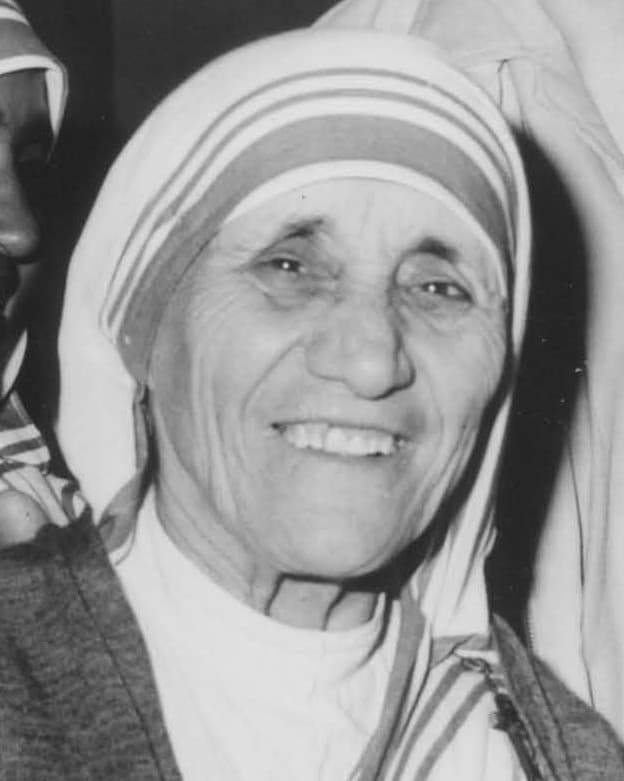
- Born
- Gonxha Agnes Bojaxhiu, to Albanian parents, in what is now Skopje 1
- Left home at
- Eighteen, for the Loreto Sisters of Dublin, in 1928 1
- The call within a call
- On a train to Darjeeling in 1946, seventeen years after she arrived in India 1
Saint Teresa of Calcutta spent seventeen years teaching history and geography to the daughters of the wealthy before she heard, on a train, what she called "a call within a call." 1 She left the convent, took a nursing course, put on a white sari, and moved into the slums. 1 Vatican News calls her "an example for all people of the wonders that one can accomplish when one entrusts oneself totally to Christ." 2
Skopje, Dublin, Darjeeling
She was born Gonxha Agnes Bojaxhiu to Albanian parents in what is now Skopje, the youngest of the three children who survived. 1 For a time the family "lived comfortably, and her father's construction business thrived. But life changed overnight following his unexpected death." 1
In public school she joined a Catholic sodality and showed a strong interest in the foreign missions. 1 At eighteen she entered the Loreto Sisters of Dublin. Franciscan Media marks the year without commentary: "It was 1928 when she said goodbye to her mother for the final time and made her way to a new land and a new life." 1 She never saw her again.
The following year she was sent to the Loreto novitiate in Darjeeling, where she took the name Teresa. 1 She was assigned to a high school for girls in Calcutta and taught history and geography to the daughters of the wealthy. 1
That is where she was for seventeen years, doing good and ordinary work behind a wall. "But she could not escape the realities around her - the poverty, the suffering, the overwhelming numbers of destitute people." 1
A call within a call
In 1946, riding a train to Darjeeling to make a retreat, she heard it. Her own words are the ones to keep: "a call within a call. The message was clear. I was to leave the convent and help the poor while living among them." 1
The phrase is doing precise work. She was already a nun, already a missionary, already in India, already teaching. The first call had been answered eighteen years earlier and was not being revoked. What she heard was a second one inside it: to give up her life with the Sisters of Loreto and "follow Christ into the slums to serve him among the poorest of the poor." 1
It took permission - to leave Loreto, to found a new community, to begin the work - and then several months of a nursing course, because she did not know how to nurse. 1 Then she went back to Calcutta, lived in the slums, and opened a school for poor children. 1
She dressed in a white sari and sandals, "the ordinary dress of an Indian woman", and began getting to know her neighbors by visiting them. 1 Nothing about the beginning was large.
What came of it
"The work was exhausting, but Saint Teresa of Calcutta was not alone for long." 1 Volunteers arrived, some of them her former students, and became the core of the Missionaries of Charity. 1 Others gave food, clothing, supplies and the use of buildings. 1
In 1952 the city of Calcutta gave her a former hostel, which became a home for the dying and the destitute. 1 As the order grew it took in orphans, abandoned children, alcoholics, the aging and street people. 1 Vatican News records what the order became: she is its founder, and the congregation now includes contemplative sisters and brothers and an order of priests. 12
For four decades she "crisscrossed the globe pleading for support and inviting others to see the face of Jesus in the poorest of the poor." 1 She was awarded the Nobel Peace Prize in 1979. 1 She died on September 5, 1997, was beatified on October 19, 2003 - "just over six years after her death" - and was canonized by Pope Francis on September 4, 2016. 1
What is Saint Teresa of Calcutta the patron saint of
She belongs to the poor, to the sick and dying, and to missionaries, which is simply a description of who she spent fifty years with. 1 Vatican News calls her "a witness of charity and mercy." 2
She is also, specifically, for the person who is already doing good work and suspects they are being asked for something else. The call within a call is hers before it is anyone's.
Saint Teresa of Calcutta's feast day
Praying with Saint Teresa of Calcutta
Seventeen years is the number to hold onto. She taught history and geography in a good school, well, to girls who needed teaching, and it was not wrong and it was not wasted, and it was not the thing. 1 Most people who wait that long stop expecting anything else.
The call came on a train, on the way to a retreat rather than during one. 1 She was in transit, doing something ordinary, and it arrived. And what it asked was not more of what she was doing but a different life entirely: leave the convent, live among them. 1
Then the unglamorous middle. Permission had to be sought and granted. She had to go and learn nursing for several months, at thirty-six, because good intentions do not close a wound. 1 She came back and opened a school and went visiting. The home for the dying came six years later, and only because the city handed her a building. 1
And the sari. 1 She did not design a habit for the new order; she put on what the women around her wore. Everything the Missionaries of Charity became is downstream of a decision to be less conspicuous rather than more.
Saint Teresa of Calcutta, pray for us.
Sources
Saints to turn to next
Others in this collection who are turned to for some of the same things.
- Saint Louis de MontfortJanuary 31, 1673 - April 28, 1716PrayerPoverty and simplicitySuffering and illness
- Saint Benedict Joseph Labre1748 - April 16, 1783Poverty and simplicityPrayerDiscernment
- Saint Charles de FoucauldSeptember 15, 1858 - December 1, 1916PrayerPoverty and simplicitySuffering and illness
- Saint Joseph CafassoJanuary 15, 1811 - June 23, 1860PrayerDiscernmentSuffering and illness