Saint Benedict Joseph Labre
1748 - April 16, 1783
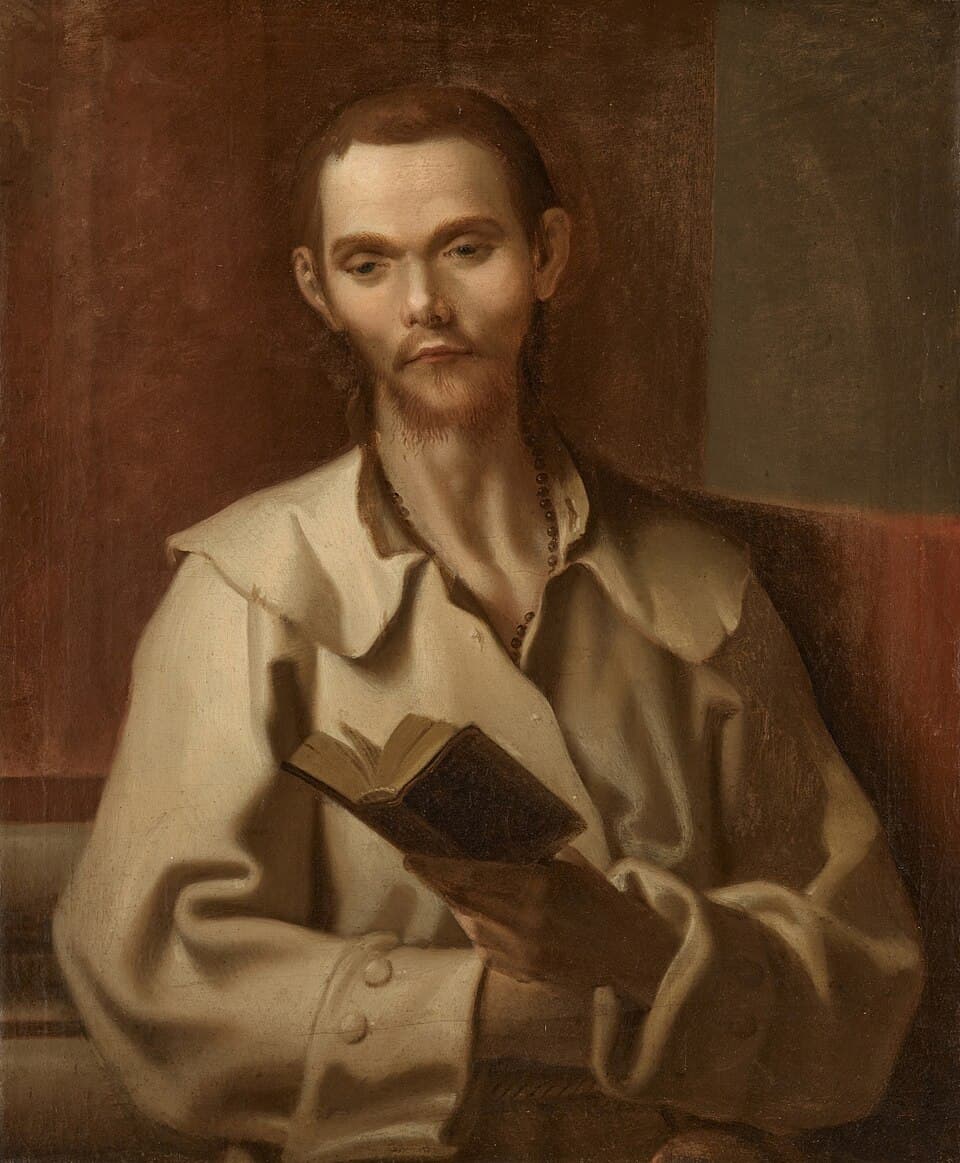
- Patron saint of
- Homeless persons, per Franciscan Media 2
- Born
- Amettes, in the Diocese of Boulogne. Delany gives 26 March 1748; Franciscan Media gives March 25 12
- Died
- Rome, 16 April 1783, aged thirty-five, on the steps of Santa Maria dei Monti 1
- Turned away by
- The Trappists twice, the Carthusians twice, and the Cistercians of Sept-Fonts, who sent him home when his health failed 1
- Canonized
- Declared Venerable by Pius IX in 1859; canonized by Leo XIII on 8 December 1881 1
Saint Benedict Joseph Labre spent thirteen years walking to shrines across Europe in one coat, sleeping outdoors, eating what he was given or what he found on refuse heaps, and never once asking anyone for anything. 1 Four religious orders had already sent him away. 1 He died at thirty-five on the steps of a church in Rome, and the people of the city proclaimed him a saint before anyone in authority had said a word. 2
A boy who could not be placed
He was born at Amettes in the Diocese of Boulogne, the eldest of a very large family - Delany says fifteen children, Franciscan Media says eighteen. 12 The family was middle class and able to educate them. 1 At twelve his schooling passed to his paternal uncle, Francois-Joseph Labre, the priest at Erin, and for six years he studied Latin and history there. 1
Delany records what the boy was like using the two lives written closest to him, his confessor Marconi's and the one compiled from the beatification processes. They agree on "a seriousness of thought and demeanor far beyond his years," a taste for mortification, an aversion to ordinary childish amusements - and, in the same breath, "a frank and open demeanor and a fund of cheerfulness which remained unabated to the end of his life." 1 He was not a gloomy child. He was a cheerful one who could not be interested in anything except God.
The study went the same way. He made real progress and then "found himself unable to conquer a constantly growing distaste for any form of knowledge which did not make directly for union with God." 1 That sentence is the hinge of his whole life. Everything that followed came of his being unable to want what he was supposed to want.
In September 1766 an epidemic reached Erin. His uncle died in it, and Benedict, who had spent the outbreak nursing the sick and the dying, went home to Amettes in November. 1
Four monasteries, five refusals
At sixteen he decided to become a Trappist, and his parents would not consent. 1 He went back to his uncle's rectory and redoubled the penances. 1 After the epidemic his parents gave way, afraid that further opposition would be resistance to the will of God. 1
What followed was six years of being turned down. On his maternal uncle's advice he applied to the Carthusians at Val-Sainte-Aldegonde and was refused; he was directed to Neuville, where he was told that at nineteen there was no hurry and that he must first learn plain-chant and logic. 1 He applied twice more to La Trappe, unsuccessfully both times, and spent six weeks as a postulant at Neuville. 1 In November 1769 the Cistercians of Sept-Fonts finally admitted him. 1
It lasted a matter of months. Delany says his exactness and humility "endeared him to the whole community" and then, flatly, that "his health gave way, and it was decided that his vocation lay elsewhere." 1 Franciscan Media's summary of the whole period is blunter: "Because of poor health and a lack of suitable academic preparation he was unsuccessful in his attempts to enter the religious life." 2
He was twenty-one, had wanted one thing since he was sixteen, and had now been told five times that he could not have it.
The letter from Chieri
Convalescing, he resolved to go to Rome and try one of the stricter Italian monasteries. From Chieri in Piedmont he wrote to his parents about that plan. It was the last letter they ever received from him. 1
Shortly after it was sent, something settled. Delany calls it an internal illumination, and gives what Benedict understood in his own words: "that it was God's will that like St. Alexis he should abandon his country, his parents, and whatever is flattering in the world to lead a new sort of life, a life most painful, most penitential, not in a wilderness nor in a cloister, but in the midst of the world, devoutly visiting as a pilgrim the famous places of Christian devotion." 1
Not in a wilderness nor in a cloister. Having been refused the cloister five times, he was given a vocation that had no walls at all. Delany adds that he submitted the idea repeatedly to experienced confessors and was told he could safely follow it, and that he never afterward wavered. 1
Thirteen years on the road
Delany inventories what he set out with, and the list is short enough to print entire: an old coat, a rosary round his neck, another between his fingers, his arms folded over a crucifix on his breast, and a small wallet holding a Testament, a breviary he recited daily, a copy of the Imitation of Christ and a few other books. 1 "Clothing other than that which covered his person he had none." 1
He slept on the ground, mostly in the open air. He ate a piece of bread or some herbs, often only once a day, "either provided by charity or gotten from some refuse heap." 1 And then the detail that separates him from every other beggar in Europe: "He never asked for alms and was anxious to give away to the poor whatever he received in excess of his scanty wants." 1 Franciscan Media says the same - he "wore the rags of a beggar and shared his food with the poor." 2
The first seven of his remaining thirteen years went in pilgrimages: Loreto, Assisi, Naples, Bari and Fabriano in Italy; Einsiedeln in Switzerland; Compostela in Spain; Paray-le-Monial in France. 1 All of it on foot. The last six years he spent in Rome, leaving only once a year, to walk back to Loreto. 1
In Rome he lived for a time in the Colosseum. 2 The city gave him two names: "the poor man of the Forty Hours devotion," because of where he was always to be found, and "the beggar of Rome." 2 Franciscan Media notes something easy to miss - "The people accepted his ragged appearance better than he did" - and gives what he told himself about it: "our comfort is not in this world." 2
Delany is honest that he did not look like a saint to begin with. It was his "unremitting and ruthless self-denial, his unaffected humility, unhesitating obedience and perfect spirit of union with God in prayer" that "disarmed suspicion not unnaturally aroused as to the genuineness of a Divine call to so extraordinary a way of existence." 1 Not unnaturally aroused. People were right to wonder, and he outlasted the wondering.
The steps of Santa Maria dei Monti
On 16 April 1783, "literally worn out by his sufferings and austerities," he sank down on the steps of the church of Santa Maria dei Monti in Rome and was carried to a neighboring house, where he died. 1 Franciscan Media says he had dragged himself to the church and prayed there for two hours before he collapsed. 2 He was thirty-five.
"Immediately after his death, the people proclaimed him a saint." 2 Delany records that his death was followed by a multitude of miracles attributed to his intercession, and that Marconi's life, published in English in 1785, documents 136 cures certified by 6 July 1783 - within three months. 1
One consequence reached across the Atlantic. Delany writes that the evidence for some of those miracles "had no inconsiderable part in finally determining the conversion of the celebrated American convert, Father John Thayer, of Boston who was in Rome at the time of the saint's death." 1 A Boston Congregationalist minister happened to be in the city that April, and what he saw in the aftermath changed his religion.
Pius IX declared him Venerable in 1859. Leo XIII canonized him on 8 December 1881, ninety-eight years after he died on a doorstep. 12
What is Saint Benedict Joseph Labre the patron saint of?
Saint Benedict Joseph Labre is the patron saint of homeless persons. 2 He is also invoked by pilgrims and by people turned away from what they wanted, both of which follow from the same life. The patronage is not symbolic. He was homeless for thirteen years by choice, slept outdoors, ate from refuse heaps, and died on the street in a city that knew him by sight. 12 Whatever else is true of him, nobody has to explain the connection.
Saint Benedict Joseph Labre's feast day
The feast of Saint Benedict Joseph Labre is April 16. Delany states it outright - "His feast is kept on the 16th of April, the day of his death" - and Franciscan Media's page closes by saying the same: "His liturgical feast is celebrated on April 16." 12
A reader may still meet him on April 17, and this is worth explaining. Franciscan Media runs its Saint of the Day column on the 17th, and its headline dates for him read "March 25, 1748 - April 17, 1783" even though its own text says he died on the 16th. 2 A column has to put somebody in every slot; the slot is not the calendar. Both sources, asked directly, give the 16th.
The birth date is a genuine disagreement rather than a slot: Delany gives 26 March 1748, Franciscan Media March 25. 12 Neither is preferred here.
Praying with Saint Benedict Joseph Labre
He is the saint for people whose vocation was refused. Five times he asked to enter religious life and five times he was sent away, and the reasons were not spiritual - his health was broken and his schooling was thin. 1 There was no lesson in it, no test he passed. He was simply not admitted, repeatedly, over six years, from the age of sixteen.
What he was given instead was not a consolation. It was harder than the cloister he had been refused: no roof, no rule, no community, no fixed abode, and no end date. The wording of the illumination is exact about this - not in a wilderness nor in a cloister, but in the midst of the world. 1 He was to be visibly poor in front of everybody, all the time, with no institution to explain him.
The refusal to beg is the strangest thing about him and probably the most useful. He lived entirely on what was given and never asked, and gave away anything beyond the minimum. 1 A man with nothing still found something to be free about.
Franciscan Media calls him "truly eccentric, one of God's special little ones," and there is no point pretending he is an easy model. 2 Almost nobody should copy his life. But the shape of it is not exotic at all: a person who wanted a good thing, was told no by every door he knocked on, and went on anyway without bitterness, doing the one thing left to him until it killed him. The people of Rome watched that for six years and did not need a process to tell them what they had been looking at.
Saint Benedict Joseph Labre, pray for us.
Sources
Saints to turn to next
Others in this collection who are turned to for some of the same things.
- Saint Teresa of CalcuttaAugust 26, 1910 - September 5, 1997Poverty and simplicityDiscernmentPrayer
- Saint ColetteJanuary 13, 1381 - March 6, 1447Poverty and simplicityPrayerDiscernment
- Saint Anthony of Paduac. 1195 - June 13, 1231Poverty and simplicityPrayer
- Saint Charles de FoucauldSeptember 15, 1858 - December 1, 1916PrayerPoverty and simplicity