Saint Colette
January 13, 1381 - March 6, 1447
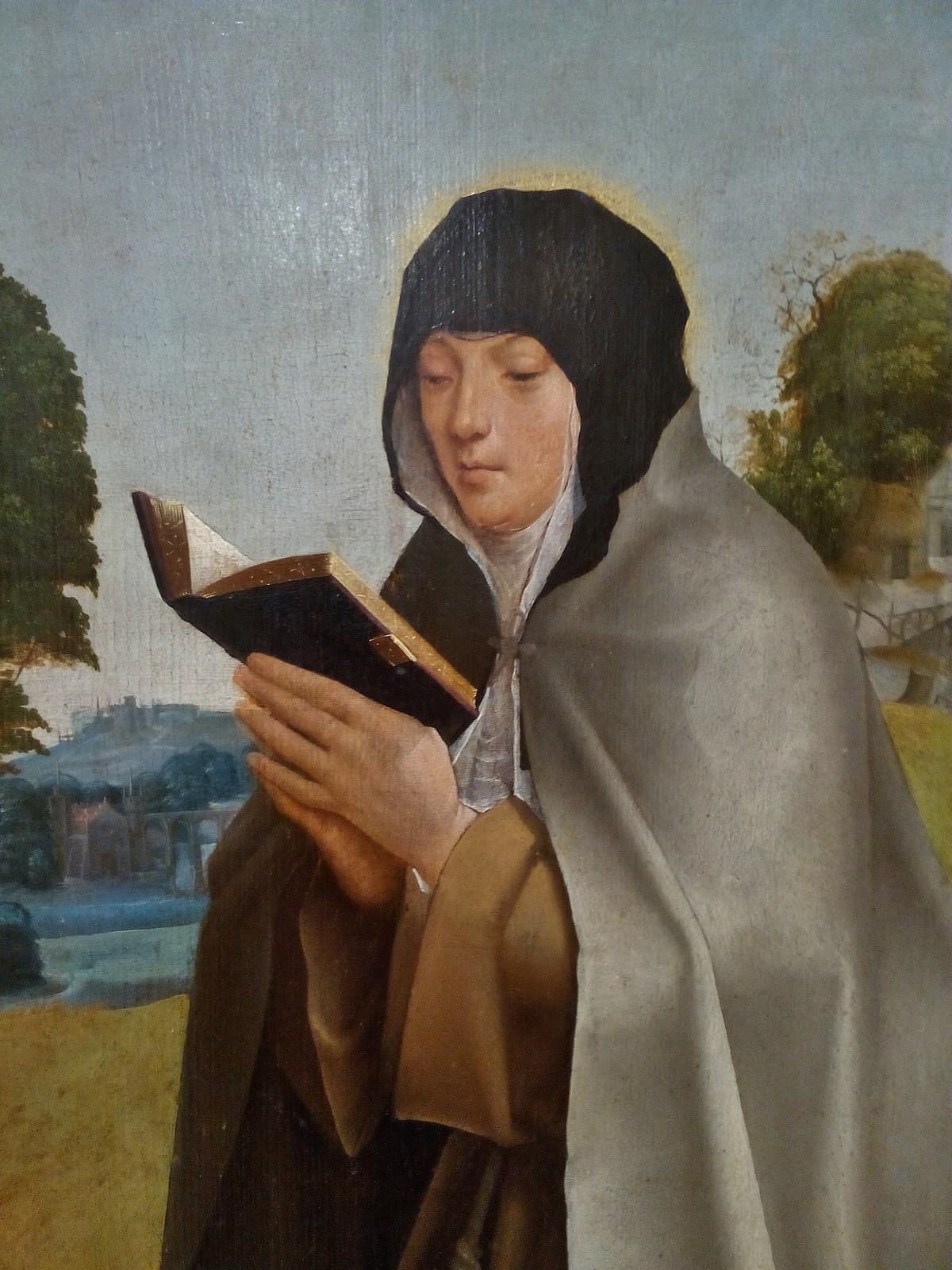
- Born
- Nicoletta Boellet at Corbie in Picardy. Her father was the abbey carpenter 1
- Was walled in
- As an anchoress at twenty-one, in a cell whose one opening looked into a church 2
- Left
- That cell after four years 2
Saint Colette tried four religious lives before she found the one that took - the Beguines, the Benedictines, the Urbanist Poor Clares, and then four years walled into a cell with a single window into a church. 12 She came out of it at twenty-five and spent the rest of her life founding convents: seventeen of them, on a rule of bare feet, perpetual fast and no fixed income at all. 12 The authority she did it on came from a pope the Church later decided had never been pope. 1
Four false starts
She was the carpenter's daughter. Bihl gives the detail exactly: "Her father, Robert Boellet, was the carpenter of the famous Benedictine Abbey of Corbie; her mother's name was Marguerite Moyon." 1 Her name was Nicoletta, and Colette is the diminutive. 1
What followed is a list of things that did not work. "Colette joined successively the Bequines, the Benedictines, and the Urbanist Poor Clares. Later she lived for a while as a recluse." 1 Three communities, none of them right, before she stopped trying communities.
Franciscan Media describes what she did instead, and it is worth stating plainly because the word "anchoress" hides it: "At 21, she began to follow the Third Order Rule and became an anchoress, a woman walled into a room whose only opening was a window into a church." 2 Not a cell she could leave. A room she was sealed into.
And then the sentence that makes her interesting: "After four years of prayer and penance in this cell, she left it." 2 Four years bricked up, and then out again, at about twenty-five, to start the most active phase of her life.
The authority she used
Reforming an order requires permission, and the permission she got has an asterisk on it. Bihl: "Having resolved to reform the Poor Clares, she turned to the antipope, Benedict XIII (Pedro de Luna), then recognized by France as the rightful pope." 1
He gave her everything she asked for. "Benedict allowed her to enter to the order of Poor Clares and empowered her by several Bulls, dated 1406, 1407, 1408, and 1412 to found new convents and complete the reform of the order." 1 Four separate grants over six years.
Franciscan Media renders the same fact in three words - she acted "with the approval and encouragement of the pope" - and does not mention which one. 2 Both versions are here because the difference is the whole point: a French woman in 1406 went to the pope her country recognized, and history later reassigned the title. It did not unmake the convents.
This is the same Benedict XIII whom Vincent Ferrer served, defended in writing, and spent years failing to persuade to resign.
Seventeen houses
She began at Beaume, with the backing of the Countess of Geneva and a Franciscan confessor, Henri de la Beaume. 1 Her first actual convent was a salvage job: she "soon opened at Besançon her first convent in an almost abandoned house of Urbanist Poor Clares." 1 She took over an empty building belonging to the branch of the order she had already left once.
Then it spread, and Bihl gives the dates: "Auxonne (1410), to Poligny, to Ghent (1412), to Heidelberg (1444), to Amiens, etc. To the seventeen convents founded during her lifetime must be added another begun by her at Pont-à-Mousson in Lorraine." 1 Thirty-four years, eighteen houses, across France, Flanders and into Germany.
What she required of them is the part Franciscan Media leads with: "Her sisters were known for their poverty - they rejected any fixed income - and for their perpetual fast." 2 Bihl adds bare feet: "For the convents reformed by her she prescribed extreme poverty, to go barefooted, and the observance of perpetual fast and abstinence." 1
Refusing a fixed income is the radical clause. A convent with an endowment is safe and independent; a convent without one lives on what arrives. That was Clare's original intention and it was what most houses had quietly dropped.
The reform that did not take
She tried the same thing with the men and it failed. "She also inaugurated a reform among the Franciscan friars (the Coletani), not to be confounded with the Observants." 1
Bihl is blunt about the result. They "remained obedient to the authority of the provincial of the Franciscan convents, and never attained much importance even in France. In 1448 they had only thirteen convents, and together with other small branches of the Franciscan Order were suppressed in 1517 by Leo X." 1 A century after she started them, a pope abolished them.
The women's houses went the other way. The Colettine constitutions were sanctioned in 1434 and then confirmed by three separate popes - Nicholas V in 1448, Pius II in 1458, Sixtus IV in 1482. 1 Bihl, writing in 1908, lists where they were then: France, Belgium, Germany, Spain, England and the United States. 1 Franciscan Media, a century later: "Colette's reform movement spread to other countries and is still thriving today." 2
What is Saint Colette the patron saint of?
Neither source cited here gives her a patronage. 12 Bihl's article ends with a list of countries where her sisters are found, and Franciscan Media's with the feast; neither names a cause she is invoked for, and this page does not supply one.
Bihl's estimate of her is worth keeping instead, because it is not the usual vocabulary: "She was not only a woman of sincere piety, but also intelligent and energetic, and exercised a remarkable moral power over all her associates." 1 Intelligent, energetic, and able to move people. That is a description of an administrator.
Saint Colette's feast day
The feast of Saint Colette is March 6, the day she died at Ghent in 1447. Franciscan Media states it: "Her liturgical feast is celebrated on March 6." 2 The encyclopedia gives the same date as her death in its opening line. 1
She was beatified in 1740 and canonized in 1807, three hundred and sixty years after her death. 12
Praying with Saint Colette
She is the saint for having tried several things and failed at all of them. The Beguines, the Benedictines, the Urbanist Poor Clares - three communities she entered and left before she was twenty-one. 1 Nothing in the sources suggests she was difficult or that they were wrong. It simply did not fit, three times running, and then she had herself walled into a room.
The four years in the cell are not the achievement and she seems to have known it. She came out. 2 Everything she is remembered for happened afterward, and it was practical work: buildings, rules, permissions, eighteen foundations in thirty-four years. The contemplative and the administrator were the same woman, in that order.
Her rule is worth taking seriously because it is not symbolic austerity. Refusing any fixed income means a house with no endowment and no security, living on what comes in - which is what Clare had actually intended and what almost everyone had let go. 12 She was not adding severity; she was putting back something that had been quietly removed.
And half her work failed. The friars she reformed dwindled to thirteen houses and were abolished by a pope a century later. 1 She had no way of knowing which half would last. Neither does anybody.
Saint Colette, pray for us.
Sources
Saints to turn to next
Others in this collection who are turned to for some of the same things.
- Saint Benedict Joseph Labre1748 - April 16, 1783Poverty and simplicityPrayerDiscernment
- Saint Teresa of CalcuttaAugust 26, 1910 - September 5, 1997Poverty and simplicityDiscernmentPrayer
- Saint Anthony of Paduac. 1195 - June 13, 1231Poverty and simplicityPrayer
- Saint Basil the Greatc. 329 - January 1, 379Poverty and simplicityPrayer