Saint Anthony of Padua
c. 1195 - June 13, 1231
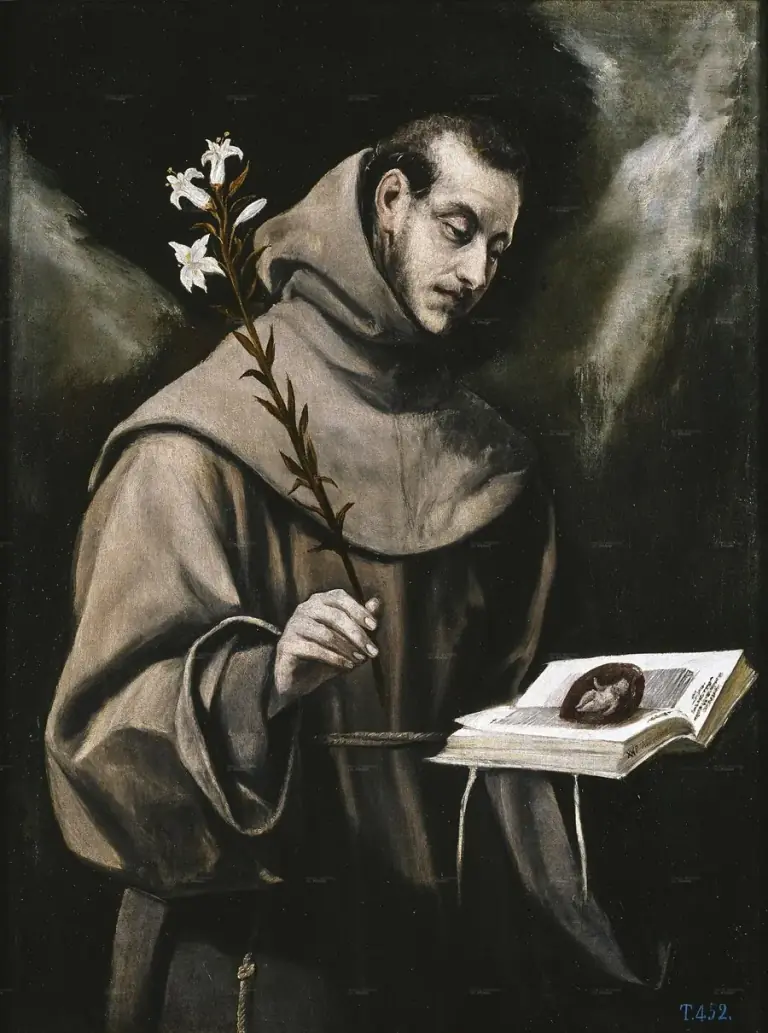
- Patron saint of
- Lost items, the poor, and travelers 3
- Feast day
- June 13 3
- Canonized
- May 30, 1232, by Pope Gregory IX 2
- Doctor of the Church
- Declared in 1946 by Pope Pius XII, titled Doctor Evangelicus 1
- Religious order
- Order of Friars Minor (Franciscans) 1
Saint Anthony of Padua is one of the most widely loved saints in the Catholic Church - the friar people turn to when something has gone missing, whether it is a set of keys or the thread of a prayer life. He lived only thirty-six years. In that span he went from an obscure monastery library in Portugal to preaching before crowds of tens of thousands in northern Italy, and he has been venerated continuously for nearly eight hundred years.
From Lisbon to the Augustinian cloister
He was born in Lisbon around 1195 into a noble family and baptized Fernando. 12 At fifteen he entered the Canons Regular of Saint Augustine, and spent roughly eight years at Coimbra steeped in Sacred Scripture and the writings of the Church Fathers. 2 Those quiet years of study supplied nearly every line of the preaching that would later make him famous - a reminder that hidden formation usually precedes public fruitfulness.
The turning point came in 1220, when the bodies of five Franciscan friars martyred in Morocco were brought to Coimbra. Moved by their witness, Fernando asked to leave the Augustinians and join the young Order of Friars Minor, taking the name Anthony. 12
The shipwreck that redirected his life
In 1221 he sailed for Morocco, intending to preach and, if God allowed it, to die as those martyrs had. Instead he fell gravely ill and had to turn back. On the return voyage a violent storm drove his ship onto the coast of Sicily. 12
What looked like the collapse of his vocation was in fact its beginning. The shipwreck deposited him in Italy, where he made his way to Assisi for the 1221 gathering known as the Chapter of the Mats and saw Saint Francis for himself. 1 Afterward he was sent to a hermitage near Forli, where he lived in obscurity, doing ordinary domestic work and telling no one what he knew. 1
The sermon nobody planned
At an ordination ceremony at Forli, no preacher had been arranged, and Anthony’s superiors asked him to say something. Compelled by obedience, he "spoke at first slowly and timidly, but soon enkindled with fervour." 2 The learning he had hidden for a decade came out all at once, and his life changed direction in a single afternoon.
Saint Francis, hearing what had happened, wrote to him: "I would like you to teach the brethren theology." 1 Anthony became the first theology teacher of the Franciscan order, lecturing at Bologna, Montpellier, and Toulouse. 12
Padua, and a very early death
He served as minister provincial of Emilia, then resigned that office at the general chapter of May 30, 1230, to give himself entirely to preaching. 2 His final Lenten campaign in Padua in 1231 drew crowds reported at thirty thousand and more. 2 The effort exhausted him, and he died on June 13, 1231, at Arcella just outside Padua, aged about thirty-six. 12
Popular devotion was immediate and overwhelming. He was canonized on May 30, 1232 - less than a year after his death - by Pope Gregory IX, who had heard him preach and called him the "Ark of the Testament." 12 His relics were moved to the basilica in Padua in 1263, where his tongue was found preserved, "uninjured, fresh, and of a lively red colour." 2 In 1946 Pope Pius XII declared him a Doctor of the Church with the title Doctor Evangelicus, the Evangelical Doctor. 1
What is Saint Anthony the patron saint of?
Saint Anthony is the patron saint of lost items, the poor, and travelers. 3 He has been invoked for the recovery of lost things for centuries. 2
That association is not a modern invention. A responsory written for him by the friar Julian of Speyer within a few years of his death already sings that under his intercession "treasures lost are found again" - Catholics have asked him for lost things since the generation that knew him. 45
Saint Anthony's feast day
Praying with Saint Anthony
Anthony meant to die in Morocco. He got sick instead, turned back, and a storm put him ashore in Sicily. 12 The shipwreck is the reason anybody knows his name, and there is no sign he understood that while it was happening.
People ask him for keys and wallets, and he is genuinely the patron of lost things. 3 He is asked just as often for the harder losses, and the Church has never treated that as a lesser use of him. A habit of prayer that quietly stopped. A person who is no longer in touch.
He also taught about prayer directly. Benedict XVI draws out four movements in it: opening your heart, speaking to God with affection, laying out what you need, and saying thank you. 1 It is a plain enough shape for anyone whose prayer has narrowed down to requests.
One line of his is worth carrying around. Charity is the soul of faith, he preached, and without love faith dies. 1 His answer to a cold stretch was never more information.
Saint Anthony of Padua, pray for us.
Sources
- 1.Pope Benedict XVI, General Audience of 10 February 2010: Saint Anthony of Padua. The Holy See.
- 2.Paschal Robinson, "St. Anthony of Padua," The Catholic Encyclopedia, Vol. 1 (New York: Robert Appleton Company, 1907).
- 3."Saint Anthony of Padua," Saint of the Day, Franciscan Media.
- 4."Si Quaeris," Pontifical Basilica of Saint Anthony of Padua.
- 5.Gregory DiPippo, "The Miraculous Responsory of St. Anthony of Padua," New Liturgical Movement, June 13, 2013.
Saints to turn to next
Others in this collection who are turned to for some of the same things.
- Saint Zita of LuccaEarly 13th century - April 27, 1271, 1272 or 1278Poverty and simplicityLost thingsPrayer
- Saint Benedict Joseph Labre1748 - April 16, 1783Poverty and simplicityPrayer
- Saint Alexius of RomeFifth century, by traditionPoverty and simplicityPrayer
- Saint Charles de FoucauldSeptember 15, 1858 - December 1, 1916PrayerPoverty and simplicity