Saint Zita of Lucca
Early 13th century - April 27, 1271, 1272 or 1278
- Patron saint of
- Domestic servants, per the 1912 Catholic Encyclopedia 1; domestic workers, servants, waiters, lost keys and the city of Lucca, per EWTN 3
Saint Zita went into service with a family in Lucca at the age of twelve and stayed in that one house for the rest of her life. 12 The 1912 Catholic Encyclopedia calls her the "model and heavenly patroness of domestic servants," and after her death Lucca took her so much to heart that Dante could name the city simply "Santa Zita." 1 She is also, by a popular devotion that EWTN traces to a legend, the saint people turn to over lost keys. 3
A girl from the hills above Lucca
Zita was born into a poor family at Montsegradi, a small village near Lucca in Tuscany, early in the 13th century, according to the 1912 Catholic Encyclopedia. 1 EWTN puts her birth around 1212 and describes the family as poor but devout. 3 Nothing more is recorded about her parents except that her mother taught her. The encyclopedia credits "a naturally happy disposition and the teaching of a virtuous mother, aided by Divine grace" with forming the qualities she was later known for: sweetness, modesty, and a steady, conscientious habit of work. 1
At twelve she entered the service of the Fatinelli family in Lucca. 13 Vatican News describes them as a noble family. 2 By EWTN's count she worked for them for 48 years. 3 There is no record that she ever lived anywhere else.
Hated for doing the work well
The first years went badly, and the encyclopedia is plain about why. Zita was pious and exact about her duties, regarded herself as serving God rather than her employers, and quietly made up for whatever her fellow servants left undone. 1 None of that won her any affection. It brought, in the encyclopedia's words, "every manner of ill-treatment" from the other servants and, through their accusations, from the family itself. 1 Vatican News says simply that she was mistreated, and that she kept smiling through it. 2 EWTN describes some of the household as demanding and unkind. 3
According to the encyclopedia, the "incessant ill-usage" could not take from her "her inward peace, her love of those who wronged her, and her respect for her employers." 1 It also gives the result: by meek and humble self-restraint she eventually overcame the malice of the household, and the family placed her in charge of all its affairs. 1 Vatican News says the same in a sentence: the family came to recognize her gifts and entrusted her with running the household. 2 EWTN adds that she became a source of spiritual counsel to many people in Lucca. 3
What she did with that authority is the most specific part of the old account. She was kind to the servants who had made her life miserable and asked no reckoning from them for the years of mistreatment. 1 She was strict only when vice threatened to take hold among the staff. And when one of them was at fault, she took it on herself to excuse or defend them to the family. 1
Prayer, the poor, and a household's storeroom
EWTN describes a day built around prayer. Zita rose early to go to Mass before work whenever she could, kept her mind on God while she cooked, cleaned and sewed, fasted throughout the year, and spent her free time in prayer or with the poor. 3 Vatican News says she was always ready to help the poor. 2
Her giving had two sources. EWTN says she gave away her own food and clothing and a third of her wages, alongside the alms the Fatinelli family provided. 3 The encyclopedia adds a detail about her judgment: once she had charge of the house, she used her "ample authority" to give generously, but was careful to give only to those really in need. 1
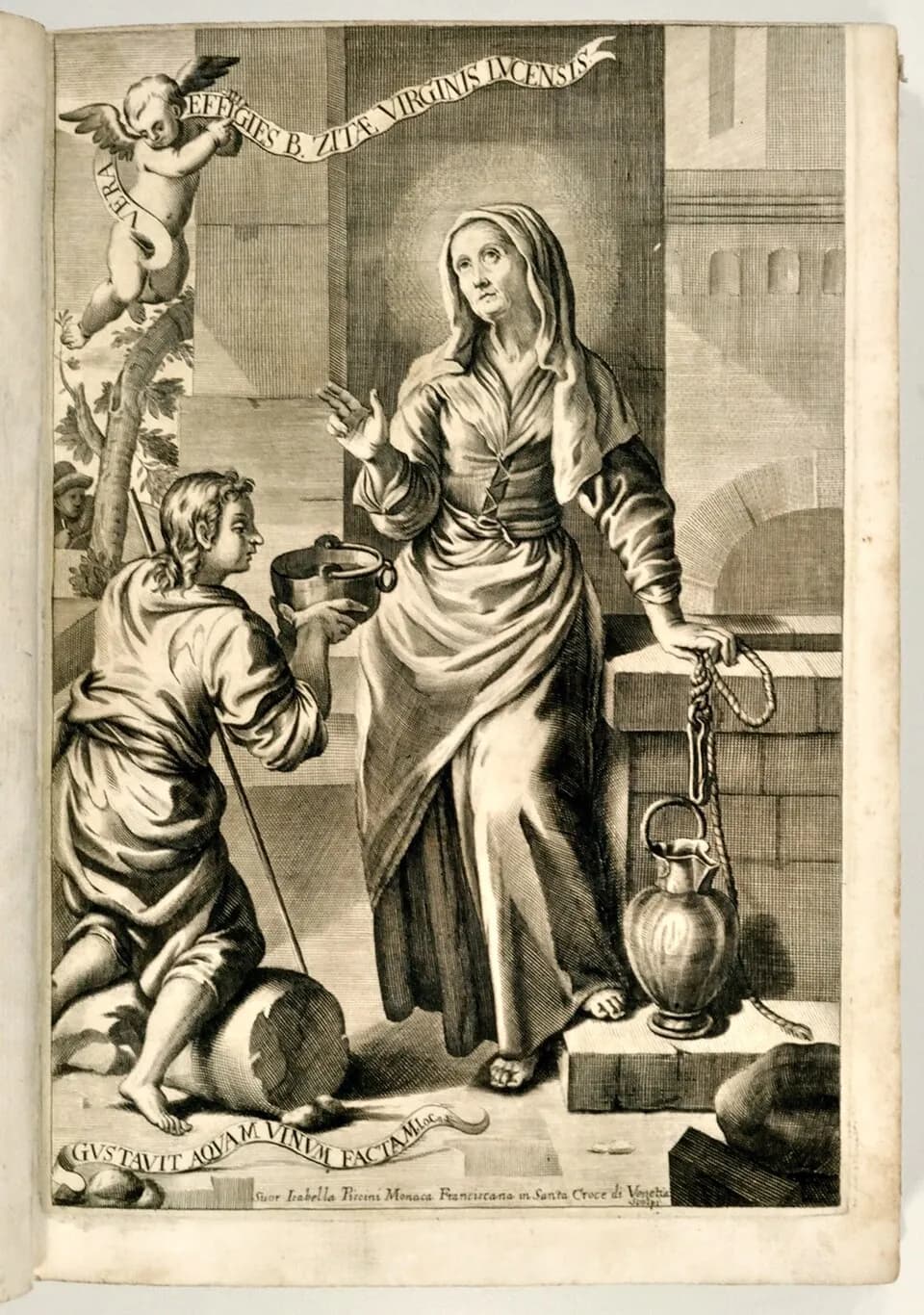
Several stories gathered around that generosity, and EWTN tells them as "accounts" rather than as history. Once, delayed by taking alms to the poor, she came back to find the family's bread already baked, and the accounts credit angels with the work. 3 During a famine she gave away her master's beans, and when he went to check the supply, the story goes, he found it full. 3 She is said to have given his fur cloak to a shivering beggar and to have had it returned by an angel the next day, and to have drawn water for thirsty travelers that turned out to be wine. 3 That last story is the one engraved on the frontispiece of the 1688 Life of Zita, shown on this page.
Death, and a city that took her name
Zita died in Lucca on April 27. The year depends on the source. The 1912 Catholic Encyclopedia gives 1271, EWTN gives 1272, and Vatican News says she ran the Fatinelli household until her death in 1278. 123 EWTN says the people of Lucca already regarded her as a saint when she died. 3
After her death, the encyclopedia records, "numerous miracles were wrought at her intercession," and she came to be venerated as a saint in the neighborhood of Lucca. 1 EWTN says that more than 150 miracles were investigated. 3 Her fame reached the poets. Fazio degli Uberti and Dante both refer to the city of Lucca simply as "Santa Zita," Dante in the Inferno. 1
The formal steps came slowly. Pope Leo X approved an office in her honor. 1 In 1580 her tomb was discovered in the Church of San Frediano in Lucca, and that discovery, the encyclopedia says, prompted the request for solemn approval of her cult, which Innocent XII granted in 1696. 1 EWTN describes the same 1696 act as her canonization. 3 EWTN also reports that her body lies in a glass reliquary in the Basilica of San Frediano and calls it incorrupt. 3
Almost everything known about her comes from one manuscript. The earliest Life of Zita is an anonymous account that belonged to the Fatinelli family, the household she served, and a member of that family, Monsignor Fatinelli, published it at Ferrara in 1688. 1 A fuller Italian Life by Bartolomeo Fiorito followed in 1752, drawing on that text and on the process assembled to prove her cult was immemorial. 1
What is Saint Zita the patron saint of?
The 1912 Catholic Encyclopedia opens its article by calling Zita the "model and heavenly patroness of domestic servants." 1 EWTN lists her as patron of domestic workers, servants, waiters, lost keys, and the city of Lucca. 3
The keys are the patronage people ask about most, and they are a legend. EWTN explains it as resting "primarily" on the story that she lost her employer's house keys in a river, prayed for them, and saw them float back to the surface. 3 It adds that as the housekeeper who held the keys to the pantry and the rest of the Fatinelli house, she became a natural person to ask about things lost at home. 3 Neither the encyclopedia nor Vatican News mentions keys.
Saint Zita's feast day
Praying with Saint Zita
Zita's life was almost entirely work done for someone else, in someone else's house, from the age of twelve. 13 The sources do not describe a calling that took her out of that life. The encyclopedia's account of her holiness is an account of how she did the job: exactly, on time, and with the gaps other people left filled in. 1
The hard part of her story is that doing the job well made things worse for years. Her fellow servants resented her and turned the family against her, and the ill-treatment, the encyclopedia says, was "incessant." 1 The old account says she kept her peace and her respect for her employers, and the sources do not say she was spared any of it. 1 Anyone who has been punished at work for being conscientious will recognize the situation, and the story does not pretend it was short.
When the tables turned and she was put in charge, she did not settle scores. She asked no reckoning from the people who had mistreated her, and she stood up for them when they were in trouble with the family. 1 She also gave away what was hers and, with permission, what was the household's, while taking care that it went to people who actually needed it. 13
The keys, the bread and the cloak belong to the legends that grew up around her, and EWTN tells them as such. 3 Under them is a woman who held the keys to a house that was not hers for most of her life, and was trusted with them. 13
Saint Zita of Lucca, pray for us.
Sources
Saints to turn to next
Others in this collection who are turned to for some of the same things.
- Saint Anthony of Paduac. 1195 - June 13, 1231Lost thingsPoverty and simplicityPrayer
- Saint Isidore the Farmerc. 1070 - May 15, 1130Work and vocationPrayerPoverty and simplicity
- Saint André BessetteAugust 9, 1845 - January 6, 1937PrayerWork and vocationPoverty and simplicity
- Saint Benedict the Moor1524 or 1526 - April 4, 1589Work and vocationPoverty and simplicityPrayer