Saint Isidore the Farmer
c. 1070 - May 15, 1130
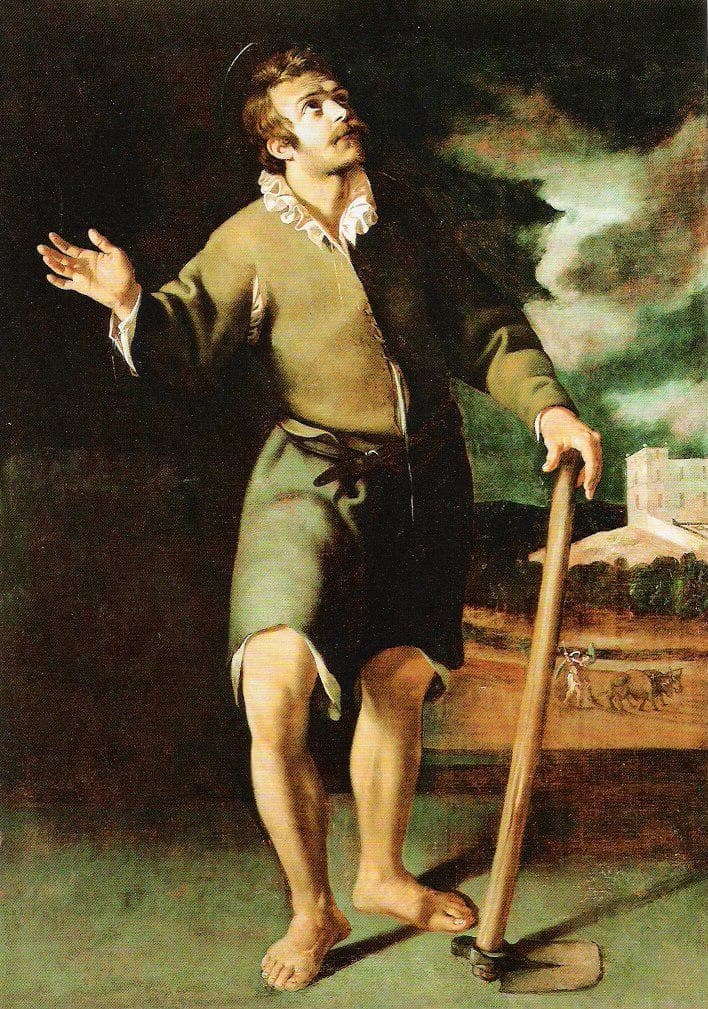
- Patron saint of
- Farmers and rural laborers, per Franciscan Media 2; "peasants and day-labourers," per the 1913 Catholic Encyclopedia 1; the farmers and peasants of Spain, by John XXIII's declaration of 1960 3
- Canonized
- March 12, 1622, by Gregory XV, with Ignatius of Loyola, Francis Xavier, Teresa of Avila and Philip Neri 12
- Earliest Life
- Written in 1265 by John, a deacon of the church of Saint Andrew in Madrid 1
Saint Isidore the Farmer was a hired hand on an estate outside Madrid who went to Mass every morning before he went to the fields, and was canonized in 1622 alongside Ignatius of Loyola, Francis Xavier, Teresa of Avila and Philip Neri. 12 He died on May 15, 1130, and that is his feast day. 12 He is the patron of farmers and rural laborers, and of the city of Madrid. 12 He is a different man from Isidore of Seville, the bishop and scholar who lived five centuries earlier.
A day laborer near Madrid
The 1913 Catholic Encyclopedia describes him in three words, "a Spanish daylabourer," and dates him from about 1070, born near Madrid, to May 15, 1130, when he died in the same place. 1 Franciscan Media gives the same years. 2
He worked a farm near Madrid for a landowner whom the encyclopedia calls Juan de Vargas and Franciscan Media calls John de Vergas. 12 Franciscan Media says he entered that service "when he was barely old enough to wield a hoe" and stayed on the estate "for the rest of his life." 2 Neither source mentions any other employer, any land of his own, or any schooling.
He married Maria, whom the encyclopedia calls Maria Torribia and Franciscan Media calls Maria de la Cabeza. 12 She is a canonized saint as well. 12 Her name in Spain, the encyclopedia explains, comes from the custom of carrying her head (cabeza, in Spanish) in procession, "especially in time of drought." 1 Franciscan Media describes her as "a young woman as simple and upright as himself." 2
Mass before work
The fact both sources build on is that he prayed before he plowed. "Every morning before going to work he was accustomed to hear a Mass at one of the churches in Madrid," the encyclopedia says. 1 Franciscan Media adds that he spent many holidays visiting the churches of Madrid and the surrounding area, and that "all day long, as he walked behind the plow, he communed with God." 2
It caused trouble. The other laborers complained to the master that Isidore was always late in the morning. 12 Franciscan Media puts it with some dry humor: his devotion, "one might say, became a problem." 2
Franciscan Media also remembers him for "his love of the poor" and for "a great concern for the proper treatment of animals." 2 It mentions that there are accounts of his feeding the poor miraculously, and leaves the accounts there. 2
The angels at the plow, and the other legends
What happened when the master went to see for himself is the story Isidore is known for, and the encyclopedia is careful to call it a legend. "Upon investigation, so runs the legend, the master found Isidore at prayer, while an angel was doing the ploughing for him." 1 A second version has the master seeing an angel plowing on either side of him, "so that Isidore's work was equal to that of three of his fellow-labourers." 1 Franciscan Media refers to "legends about angel helpers and mysterious oxen," and reads them as a way of saying that his work was never neglected. 2
Its own conclusion is modest. "Perhaps the truth which emerges is this," Franciscan Media writes: "If you have your spiritual self in order, your earthly commitments will fall into order also." 2 It sets beside that the words of "the carpenter from Nazareth" in Matthew 6:33, to seek first the kingdom of God, and all these things will be given besides. 2 Whatever one makes of the angels, that is a claim about the man's priorities rather than about the oxen.
The 1913 article collects several more legends, each introduced with "is said to." Isidore is said to have brought his master's dead daughter back to life, and to have made a spring of fresh water break out of dry ground when his master was thirsty. 1 After his death he is said to have appeared to Alfonso of Castile and shown him the hidden path by which the king surprised the Moors at Las Navas de Tolosa in 1212. 1 The encyclopedia spells the place "Las Nevas."
None of this is presented as history by the sources that tell it, and this page does not present it that way either. The earliest written Life the encyclopedia knows of was composed in 1265 by John, a deacon of the church of Saint Andrew in Madrid, and supplemented by him in 1275, well over a century after Isidore died. 1 That Life later served as the basis for Lope de Vega's religious poem San Isidro of 1599. 1
Their son
Isidore and Maria had one son, and he died young. 12 The encyclopedia records one more story about him from earlier in his life: he fell into a deep well, and at his parents' prayers the water "is said to have risen miraculously to the level of the ground, bringing the child with it, alive and well." 1
It then adds a detail that Franciscan Media does not mention. After the rescue, "the parents made a vow of continence and lived in separate houses." 1 The article gives no reason and no date, and neither does this page.
Relics, a king, and five saints in one day
Forty years after his death, Isidore's body was moved from the cemetery into the church of Saint Andrew. 1 Centuries later King Philip III of Spain, according to the encyclopedia, was cured of a deadly illness by touching the relics and replaced the old reliquary with a costly silver one. 1
Gregory XV canonized him on March 12, 1622, in the same ceremony as Ignatius of Loyola, Francis Xavier, Teresa of Avila and Philip Neri. 12 Franciscan Media notes that in Spain the group is known as "the five saints." 2 Isidore was the one who had spent his life behind a plow.
What is Saint Isidore the Farmer the patron saint of?
Franciscan Media lists him as the patron saint of farmers and rural laborers, and calls him "the patron of farmers and rural communities." 2 The 1913 Catholic Encyclopedia says he "is widely venerated as the patron of peasants and day-labourers." 1
He is the patron of Madrid. 12 The encyclopedia adds that "the cities of Madrid, Leon, Saragossa, and Seville also, honour him as their patron." 1 In the United States, Franciscan Media notes, he is patron of the National Rural Life Conference. 2
In 1960 John XXIII made the Spanish patronage formal. The bull opens with the praise farming has received from Christian and pagan writers alike, naming Saint Augustine and Cicero, and then turns to a worry: that in an age reducing everything to the material, people who work the land need help from above to keep their lives in harmony with their faith. 3 It describes Isidore as humble and simple, and holds him up to Spain's farmers as a shining example of someone who combined diligent work in the fields with obedience and charity. 3
The request came from Cardinal Enrique Pla y Deniel, Archbishop of Toledo, and from Spain's farmers' brotherhoods, and after consulting the Sacred Congregation of Rites the pope granted it: Agri culturam declared Isidore the heavenly patron of the farmers and peasants of the Spanish nation. 3 In the same document the pope recalled that he was himself born into a family that worked the land. 3
Saint Isidore the Farmer's feast day
His feast day is May 15, the date of his death in 1130. 12 The 1913 Catholic Encyclopedia, Franciscan Media and Vatican News all give May 15. 124 It is kept in the United States, where "Saint Isidore" appears on May 15 in the proper calendar for the dioceses of the country approved by the US bishops and confirmed by the Holy See. 5
Praying with Saint Isidore
Isidore did one kind of work, for one landowner, for his whole working life. 12 Nothing in the sources suggests he wanted another life. Franciscan Media draws the plain conclusion that physical labor has dignity and that holiness does not depend on status or learning. 2 It is a useful saint to have when the work in front of you is repetitive and nobody is going to write it down.
The order of his morning is the part anyone can copy. He went to Mass first and to the field second, every day, and was late often enough that the other men complained about it. 12 The legends answer that complaint with angels. The sources that tell them take care to call them legends, and the habit underneath them, time given to God before the day belongs to someone else, needs no miracle to be worth imitating.
He was also a husband and a father who lost his only child. 12 The sources record his death in a few words and move on, and there is no reason to make that loss into a lesson. Maria shares his sainthood, and in Spain her relics have been carried in procession, especially in time of drought. 1
He is widely venerated as a patron by the people who grow food, from the farmers of Spain to the rural communities of the United States. 123 Those who depend on the weather and the harvest have a saint who knew both.
Saint Isidore the Farmer, pray for us.
Sources
- 1.Michael Ott, "St. Isidore the Labourer," The Catholic Encyclopedia, Vol. 8 (New York: Robert Appleton Company, 1910).
- 2."Saint Isidore the Farmer," Saint of the Day, Franciscan Media.
- 3.John XXIII, Bull "Agri culturam," proclaiming Saint Isidore the Farmer patron of the farmers of Spain, 16 December 1960 (AAS 53 [1961] 357-358). Spanish text.
- 4."St. Isidore the Farmer," Saint of the Day, 15 May, Vatican News.
- 5."Proper Calendar for the Dioceses of the United States of America," United States Conference of Catholic Bishops, last updated September 23, 2015.
Saints to turn to next
Others in this collection who are turned to for some of the same things.
- Saint Dominic of Silosc. 1000 - December 20, 1073PrayerMarriage and familyWork and vocation
- Saint Katharine DrexelNovember 26, 1858 - March 3, 1955Poverty and simplicityWork and vocationPrayer
- Saint LukeFirst centuryWork and vocationPrayerPoverty and simplicity
- Saint Margaret of Scotlandc. 1045 - November 16, 1093Marriage and familyPrayerPoverty and simplicity