Saint Margaret of Scotland
c. 1045 - November 16, 1093
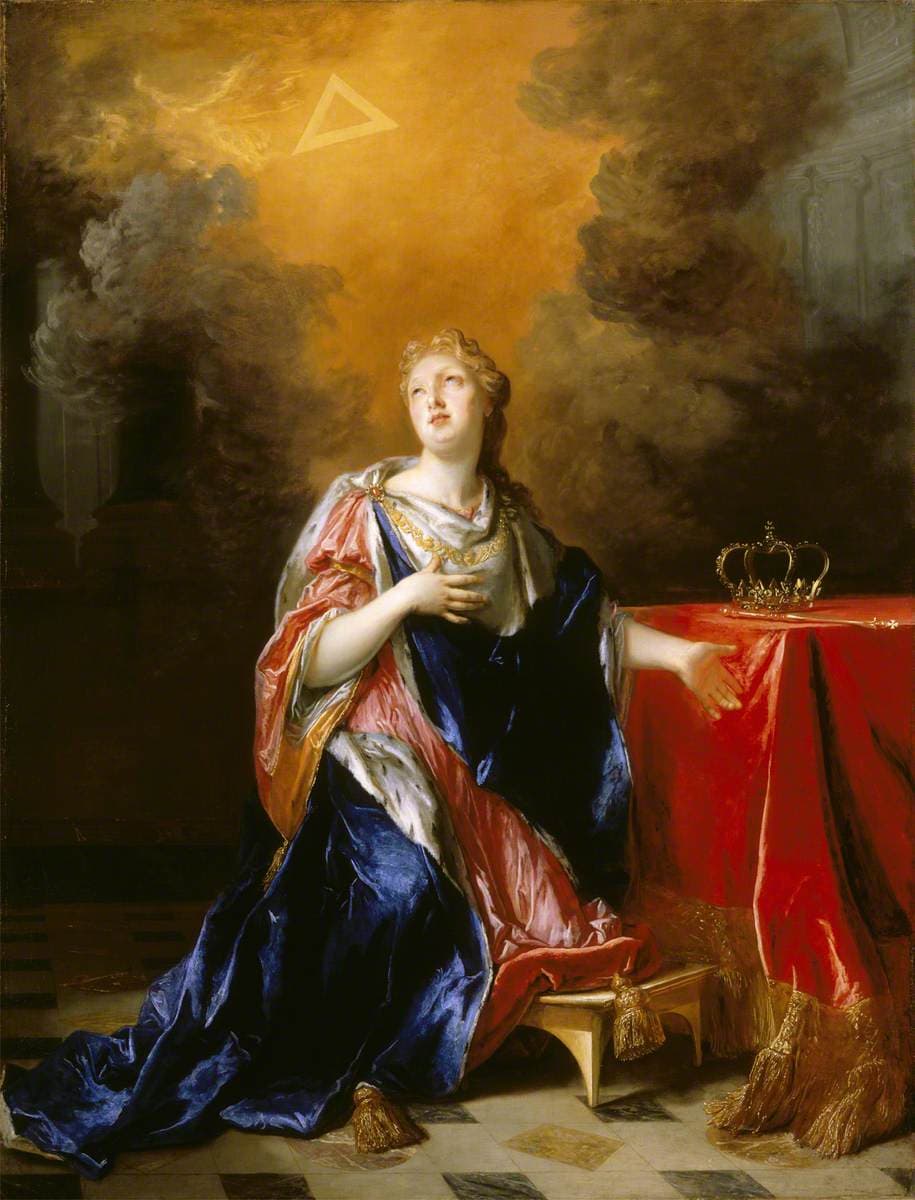
- Patron saint of
- Neither source assigns a patronage. She is patron of Scotland and invoked by mothers 12
- Feast day
- November 16, the day she died. In 1910 the whole Church kept her on 10 June 1
- Came to Scotland
- By shipwreck. A storm drove her family's vessel there while they fled the Normans 12
- Married
- Malcolm III, between 1067 and 1070 - delayed because she had wanted to enter religious life 12
- Children
- Six sons and two daughters, whose education she supervised herself 2
- Canonized
- By Innocent IV in 1250 1
Saint Margaret of Scotland became a Scottish queen by shipwreck. 12 Her family was fleeing the Normans when a storm drove their ship onto the Scottish coast, where Malcolm III took them in and then married her - a marriage delayed because she had meant to enter religious life. 1 She had eight children, reformed the Scottish church by synod, and fed the poor at her own table every day before she ate. 2
An exile twice over
She was born about 1045, daughter of Edward the Exile and of Agatha, a kinswoman of the wife of Saint Stephen of Hungary - and granddaughter of Edmund Ironside, king of England. 1 Franciscan Media: "Not Scottish by birth, Margaret was the daughter of Princess Agatha of Hungary and the Anglo-Saxon Prince Edward Atheling." 2
Huddleston is careful about the family tradition. It is constantly asserted that her father and his brother were sent to Hungary for safety during the reign of Canute, "but no record of the fact has been found in that country." 1 Nor can her birth be dated exactly - only placed between 1038 and 1057. 1
She came to England with her father in 1057, and spent part of her youth at the court of her great-uncle Edward the Confessor. 12 Then her father died and the Normans took England.
Her mother decided to go back to the Continent, and the sea decided otherwise. "A storm however drove their ship to Scotland, where Malcolm III received the party under his protection, subsequently taking Margaret to wife." 1 Franciscan Media: the family "was shipwrecked off the coast of Scotland. King Malcolm befriended them and was captivated by the beautiful, gracious Margaret." 2
She did not want to marry him. Huddleston: "This event had been delayed for a while by Margaret's desire to enter religion, but it took place some time between 1067 and 1070." 1 Franciscan Media dates the wedding to 1070 at Dunfermline. 2
What she did with a king
Franciscan Media is refreshingly blunt about her husband: "Malcolm was good-hearted, but rough and uncultured, as was his country." 2
And about what she made of that: "Because of Malcolm's love for Margaret, she was able to soften his temper, polish his manners, and help him become a virtuous king. He left all domestic affairs to her, and often consulted her in state matters." 2
Huddleston gives the substance of her public work. "In her position as queen, all Margaret's great influence was thrown into the cause of religion and piety. A synod was held, and among the special reforms instituted the most important were the regulation of the Lenten fast, observance of the Easter communion, and the removal of certain abuses concerning marriage within the prohibited degrees." 1
Franciscan Media adds what else was on the agenda - "simony, usury, and incestuous marriages" - and notes that she "was present for the discussions." 2 She did not send instructions; she sat in the room.
She also "tried to improve her adopted country by promoting the arts and education", and with Malcolm founded several churches. 12 Chief among them was Dunfermline Abbey, which Huddleston says was "built to enshrine her greatest treasure, a relic of the true Cross." 1
One object of hers survives and can still be seen. Her book of the Gospels, "richly adorned with jewels, which one day dropped into a river and was according to legend miraculously recovered, is now in the Bodleian library at Oxford." 1 A queen's personal gospel-book, nine hundred years later, on a shelf in Oxford.
The household
She and Malcolm had six sons and two daughters, and Franciscan Media records that "Margaret personally supervised their religious instruction and other studies." 2 Three of the sons became kings of Scotland; one daughter became queen of England.
"Although she was very much caught up in the affairs of the household and country, she remained detached from the world. Her private life was austere." 2 She kept fixed times for prayer and for reading Scripture, ate sparingly, and slept little so as to have the hours. 2
The particulars are worth having because they are specific rather than general. She and Malcolm kept two Lents a year, one before Easter and one before Christmas, and during them she rose at midnight for Mass. "On the way home she would wash the feet of six poor persons and give them alms." 2
And the detail that ends Franciscan Media's account of her charity: "She was always surrounded by beggars in public and never refused them. It is recorded that she never sat down to eat without first feeding nine orphans and 24 adults." 2
Thirty-three people fed before the queen had her own dinner, every day.
Four days
In 1093 William Rufus attacked Alnwick castle without warning. "King Malcolm and his oldest son, Edward, were killed." 2
Margaret was already dying. "Margaret, already on her deathbed, died four days after her husband." 2 Huddleston adds that "she foretold the day of her death, which took place at Edinburgh on 16 Nov., 1093." 1 She was buried before the high altar at Dunfermline, in the church she had built. 1
Innocent IV canonized her in 1250, and in 1259 her relics were moved to a new shrine "the base of which is still visible beyond the modern east wall of the restored church." 1
After that they were lost, twice. At the Reformation her head "passed into the possession of Mary Queen of Scots, and later was secured by the Jesuits at Douai, where it is believed to have perished during the French Revolution." 1 The rest, together with Malcolm's, were acquired by Philip II of Spain and placed in two urns in the Escorial - and when the Bishop of Edinburgh applied through Pius IX to have them brought home, "they could not be found." 1
One more uncertainty belongs on the record. The chief source for her life is a biography written by somebody who knew her, and nobody is sure who. It has been ascribed to Turgot, her own confessor, and to an obscure monk named Theodoric, "but in spite of much controversy the point remains quite unsettled." 1
What is Saint Margaret of Scotland the patron saint of?
Neither Huddleston nor Franciscan Media assigns Saint Margaret a formal patronage in these entries. 12 She is in practice the patron of Scotland, and is invoked by mothers, by large families, and by widows.
She has a particular claim on people who did not get the life they intended. She had wanted to enter religion; she was married to a king instead, and made the marriage into the vocation. 1 Franciscan Media opens by calling her "a truly liberated woman in the sense that she was free to be herself. For her, that meant freedom to love God and serve others." 2
And she belongs to anyone whose faith has to be practiced in public, under observation, with no privacy. Her Lents, her midnight Masses, her washing of feet and her table full of orphans were all done as the queen, in front of a court. 2
Saint Margaret of Scotland's feast day
The feast of Saint Margaret of Scotland is November 16, the day she died at Edinburgh in 1093. 1
This is one of the clearest cases in the library of a feast that has moved, and Huddleston records the old arrangement in his closing line: "The feast of St. Margaret is now observed by the whole Church on 10 June." 1 That was the universal date when he wrote in 1910. The calendar has since returned her to the anniversary of her death, and November 16 is the day kept now. Both are recorded here.
In Scotland she has long been kept on the 16th regardless, which is one reason a reader will find both dates in circulation. 12
Praying with Saint Margaret
She wanted to be a nun and became a queen, and the sources are explicit that the marriage was delayed by her reluctance. 1 What she then did was not to treat the crown as a consolation prize. She used it: a synod, a reformed Lent, schools, churches, an abbey built around a relic, and a rough king made into a better one by somebody who loved him. 12 The life she did not choose turned out to have more scope than the one she had asked for.
The thirty-three people at her table are the thing to remember about her charity, because the number is what makes it real. 2 Nine orphans and twenty-four adults, before she ate, every day. Not a gesture on feast days - a standing arrangement that somebody had to organize, provision and repeat.
Her private austerity was hidden inside a public life. She rose at midnight during two Lents a year, washed the feet of six poor people on the way back from Mass, ate little and slept less, and did all of it while running a household and being consulted on affairs of state. 2 It is a rebuke to the idea that a serious interior life requires withdrawal.
And the ending offers no consolation at all. Her husband and her eldest son were killed in a surprise attack, she was already dying, and the news reached her four days before the end. 2 The Church did not canonize her for how she died. It canonized her for thirty years of feeding people first.
Saint Margaret of Scotland, pray for us.
Sources
Saints to turn to next
Others in this collection who are turned to for some of the same things.