Saint Bridget of Sweden
c. 1303 - July 23, 1373
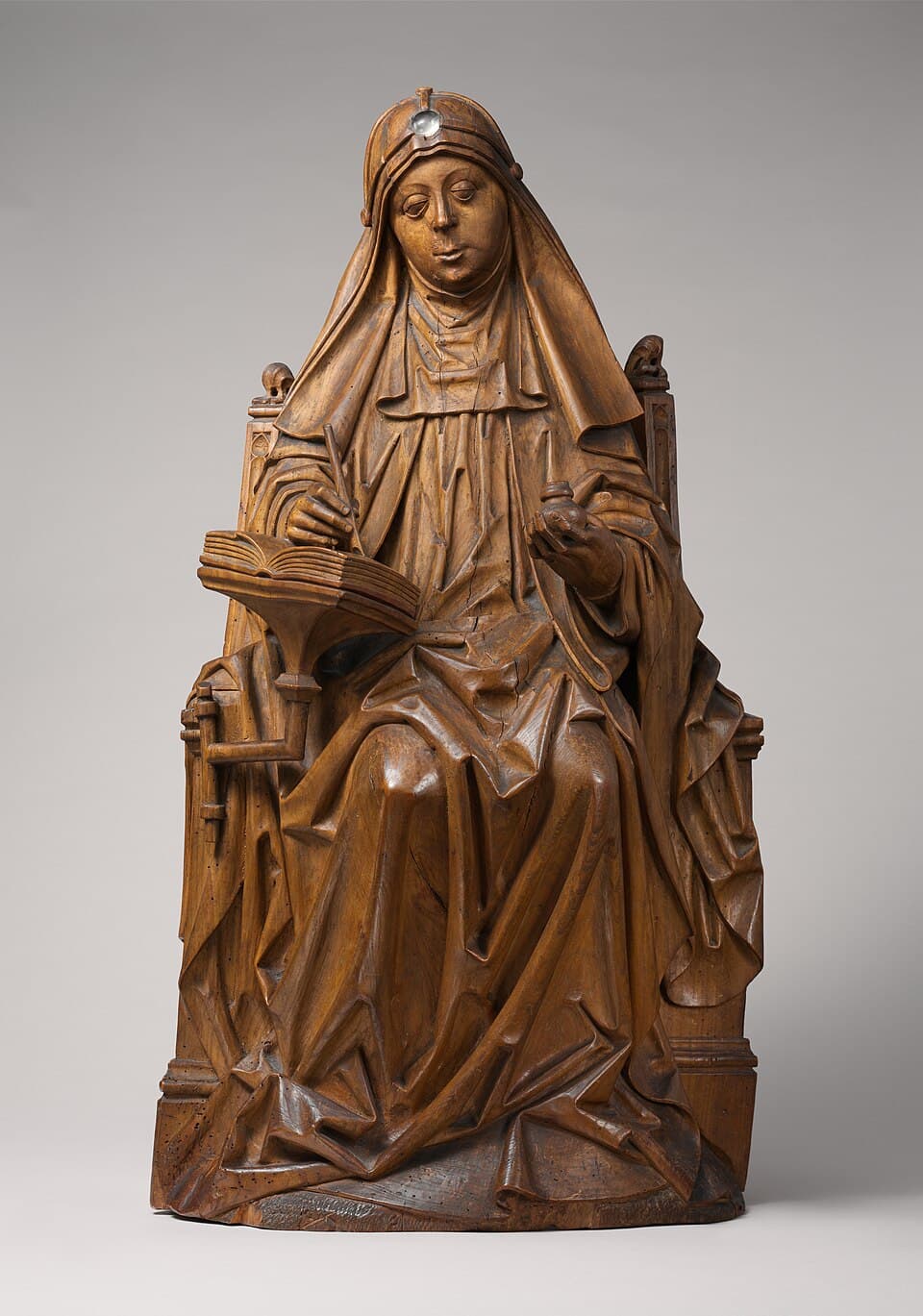
- Patron saint of
- Europe - named a co-patroness in 1999, with Catherine of Siena and Teresa Benedicta of the Cross 2
- Born
- About 1303, daughter of Birger Persson, provincial judge of Uppland and one of the wealthiest landholders in Sweden 1
- Married
- At thirteen, in 1316, to Ulf Gudmarsson, who was eighteen 1
- Founded
- The Order of St. Saviour, the Brigittines, whose chief monastery at Vadstena was endowed by the king in 1346 1
- Canonized
- By Boniface IX on 7 October 1391, eighteen years after her death 1
Saint Bridget of Sweden was married at thirteen, bore eight children, buried her husband at about forty, and then spent the last thirty years of her life telling popes and kings what they were doing wrong. 12 She founded an order, walked to Compostela and to Jerusalem, and spent more than two decades in Rome pressing for the papacy to come back from Avignon - hounded, meanwhile, by her creditors. 12
A daughter of the governing class
Kirsch calls her "the most celebrated saint of the Northern kingdoms." 1 She was born about 1303 to Birger Persson, governor and provincial judge of Uppland and one of the wealthiest landholders in the country, and to Ingeborg Bengtsdotter. 1 Both parents were known for their piety, and Saint Ingrid, who had died some twenty years before Bridget was born, was a near relative. 1
Two things from her childhood carry forward. The first is that "from her seventh year" she showed "signs of extraordinary religious impressions and illuminations." 1 Franciscan Media is more specific about what she saw: "From age 7 on, Bridget had visions of Christ crucified." 2
The second is her mother's death, about 1315, and the aunt who raised her afterward. Kirsch credits that aunt directly with the quality that defined her: "To her education, and particularly to the influence of an aunt who took the place of Bridget's mother after the latter's death, she owed that unswerving strength of will which later distinguished her." 1 The woman who would later lecture Urban V learned to be immovable from the aunt who brought her up.
Twenty-eight years of marriage
In 1316, at thirteen, she was married to Ulf Gudmarsson, who was eighteen. 1 Kirsch describes what followed without qualification: "She acquired great influence over her noble and pious husband, and the happy marriage was blessed with eight children, among them St. Catherine of Sweden." 1 Her second child became a canonized saint in her own right. 2
She was not private about her religion, and she was not isolated either. Kirsch lists the theologians she knew and worked with - Nicolaus Hermanni, later Bishop of Linkoping; Matthias, canon of Linkoping, who was her confessor; Peter, Prior of Alvastra; and Peter Magister, her confessor after Matthias. 1 These are the men who would later translate her Revelations into Latin. 1
She was also at court. Kirsch says she was at the court of King Magnus Eriksson, "over whom she gradually acquired great influence." 1 Franciscan Media, calling him Magnus II, adds the shape of that relationship: she "constantly strove to exert her good influence over Magnus; while never fully reforming, he did give her land and buildings to found a monastery for men and women." 2 Thirty years of effort on one man, resulting in a partial success and a real endowment.
Between 1341 and 1343 she and Ulf made the pilgrimage to Santiago de Compostela together. 1 On the way home he was taken ill, recovered enough to finish the journey, and died the following year, in 1344, at the Cistercian monastery of Alvastra. 1
What she did with the second half
After the funeral she "devoted herself entirely to practices of religion and asceticism, and to religious undertakings," and Franciscan Media says plainly that she "lived the strict life of a penitent after her husband's death." 12 The visions "now became more frequent and definite." 1
She wrote them down. Kirsch is careful about how he puts it - "She believed that Christ Himself appeared to her, and she wrote down the revelations she then received, which were in great repute during the Middle Ages" - and Matthias Magister and Prior Peter translated them into Latin. 1 Franciscan Media makes the point that matters about how she used them: "Her visions formed the basis for her activity - always with the emphasis on charity rather than spiritual favors." 2 Whatever she was receiving, she spent it outward.
Then she founded an order: the Brigittines, or Order of St. Saviour, with its chief monastery at Vadstena, richly endowed by King Magnus and his queen in 1346. 1 Urban V confirmed its Rule in August 1370, twenty-four years later. 1 She had to go to Rome to get it, and she never came home.
Rome, and what it cost
She went south to obtain confirmation for her institute and to find a wider field for what Kirsch calls "her mission, which was the moral uplifting of the period." 1 He dates the journey to 1349; Franciscan Media puts it at 1350, the jubilee year, and adds the detail that makes it something other than a pious trip: she "braved a plague-stricken Europe to make a pilgrimage to Rome." 12 The Black Death was moving through the continent as she crossed it.
She stayed until she died, twenty-three years, leaving only for pilgrimages. 1 And here the sources part company. Kirsch reports the achievement: "She accomplished the greatest good in Rome, however, by her pious and charitable life, and her earnest admonitions to others to adopt a better life." 1 Franciscan Media reports the experience: "Although she never returned to Sweden, her years in Rome were far from happy, being hounded by debts and by opposition to her work against Church abuses." 2
Both are true and the second is the one usually left out. A widow of the Swedish nobility spent more than two decades in a foreign city, in debt, publicly criticizing clerical corruption, and being resented for it.
Her most famous campaign was the one she lost in her lifetime. Kirsch: "Bridget made earnest representations to Pope Urban, urging the removal of the Holy See from Avignon back to Rome." 1 She died in 1373 with the papacy still in France. It returned in 1377, four years later.
The last journey was to the Holy Land in 1373. Franciscan Media gives what happened on it: "A final pilgrimage to the Holy Land, marred by shipwreck and the death of her son, Charles, eventually led to her death in 1373." 2 She was about seventy, she had been shipwrecked, and she had buried another child.
She died in Rome on 23 July 1373. 1 The following year her remains were carried back to Vadstena, to the monastery she had founded and had not seen in a quarter of a century. 1 Boniface IX canonized her on 7 October 1391. 1
What is Saint Bridget of Sweden the patron saint of?
Neither source gives Saint Bridget a trade or an ailment, which is unusual in this library and worth saying rather than covering over. What Franciscan Media records is larger and more recent: "In 1999, Bridget of Sweden, Saint Catherine of Siena, and Saint Teresa Benedicta of the Cross, were named co-patronesses of Europe." 2 Three women - a Swedish widow, an Italian Dominican tertiary and a Jewish philosopher murdered at Auschwitz - given jointly to a continent.
In practice she is also turned to by widows, by mothers, and by people who have spent years pressing for a change they may not live to see. All three follow from the life rather than from any grant. 12
Saint Bridget of Sweden's feast day
The feast of Saint Bridget of Sweden is July 23, the day she died in Rome in 1373. 12 Kirsch gives the death date outright and Franciscan Media presents her on the same day, so the two eras agree here and no correction was needed. 12
She is not to be confused with Saint Brigid of Ireland, the fifth-century abbess of Kildare, whose feast is February 1. The names are close enough in English that the two are regularly mixed up; they are separated by eight hundred years and a continent.
Praying with Saint Bridget
She is the patron in practice of people doing unwelcome work in an institution they love. That is what the Roman years were. She was not opposing the Church; she was inside it, pressing it, and being disliked for it by people who had the power to make her life difficult - and they did, for twenty-three years. 2 She did not win the argument about Avignon until four years after she was dead.
The visions are the part of her that resists borrowing, and Franciscan Media points at what can be borrowed: the emphasis was "on charity rather than spiritual favors." 2 She did not treat what she was given as a possession. She treated it as instructions, and the instructions sent her to the poor, to the king, to the pope and eventually onto a ship to Jerusalem.
Her life also refuses the division people make between the married half and the holy half. She was married at thirteen to a man she came to love, had eight children with him, ran a great household, walked to Compostela with him and buried him. 1 Then she founded an order. The second half did not correct the first; Kirsch treats the marriage as a good in itself and says so - "the happy marriage was blessed with eight children." 1
The end is not tidy. Shipwrecked, bereaved of her son Charles, in debt, far from home, and dead within months of getting back to Rome. 2 Eighteen years later she was canonized, and six centuries after that a pope handed her a continent. Neither of those was visible to her on the ship.
Saint Bridget of Sweden, pray for us.
Sources
Saints to turn to next
Others in this collection who are turned to for some of the same things.
- Saint Joachima de Vedruna1783 - 1854Marriage and familySuffering and illnessPrayer
- Saint Elizabeth of Portugal1271 - July 4, 1336Marriage and familySuffering and illnessPrayer
- Saint Frances of Rome1384 - March 9, 1440Marriage and familyPrayerSuffering and illness
- Saint Claude de la Colombiere1641 - February 15, 1682PrayerSuffering and illness