Saint Frances of Rome
1384 - March 9, 1440
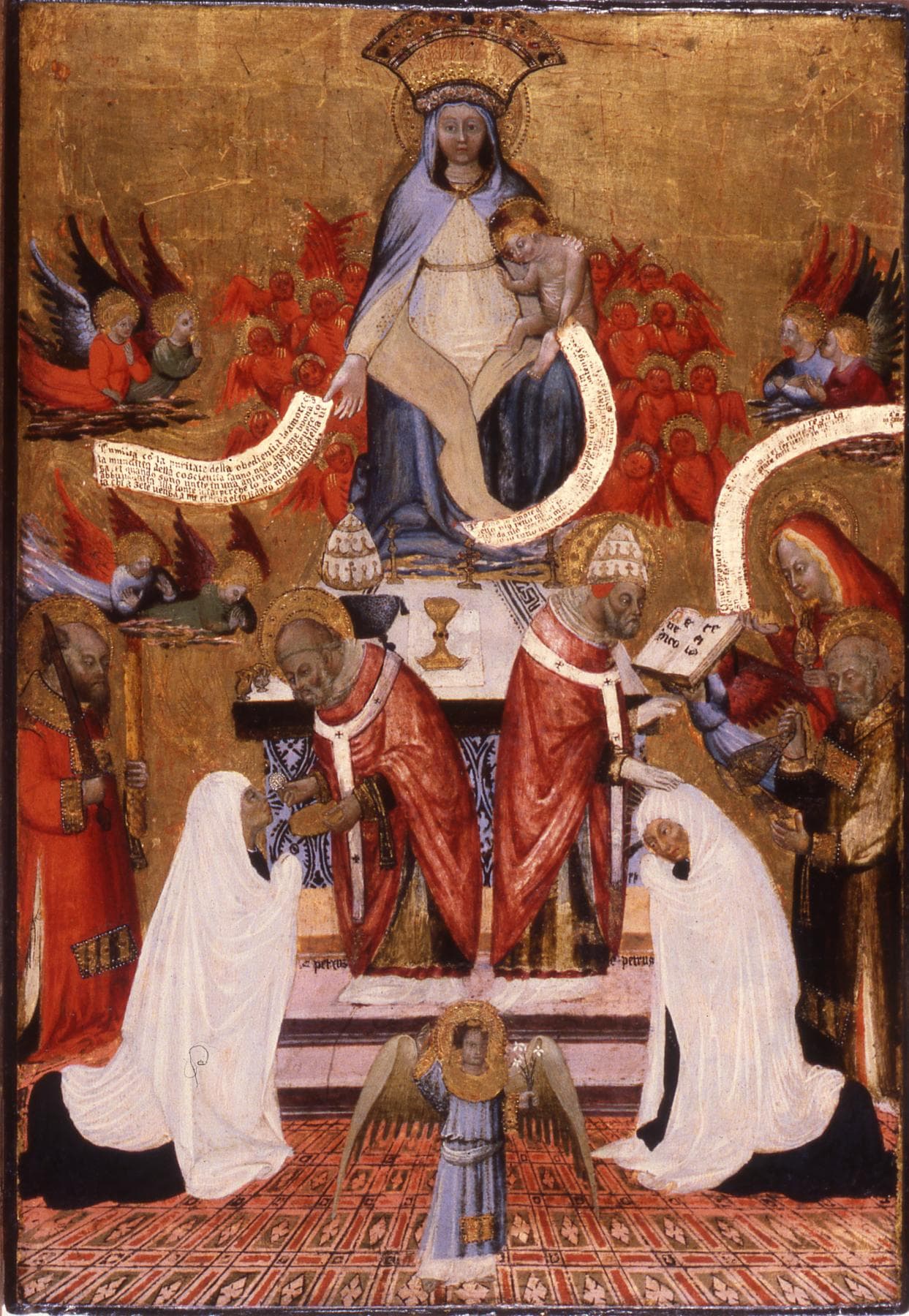
- Patron saint of
- Motorists and widows, per Franciscan Media 2
- Feast day
- March 9, assigned by Paul V at her canonization in 1608 1
- Born
- Rome, 1384, of a noble family. Her name was Bussa di Leoni 1
- Founded
- The Oblates of Tor di Specchi in 1433 - religious life without cloister or formal vows 1
- Endured
- Her husband's banishment, her son Battista's captivity, the death of two children, and the loss of everything she owned 1
- Canonized
- By Paul V on 9 May 1608, after three processes 1
Saint Frances of Rome wanted to be a nun and was married at twelve instead. 1 She stayed married for forty years, buried two of her three children in a plague, sold everything she owned to buy medicine, and went begging door to door with her sister-in-law when the money ran out. 12 She founded a community of women who took no vows at all - and then went on living at home with her husband. 2
Married at twelve
She was born at Rome in 1384, of a noble family, and Paoli calls her "one of the greatest mystics of the fifteenth century." 1 Her own plan was different: "Her youthful desire was to enter religion, but at her father's wish she married, at the age of twelve, Lorenzo de' Ponziani." 1 Franciscan Media puts it the same way - her parents objected to the religious life "and a young nobleman was selected to be her husband." 2
What she found in her husband's family changed the shape of her life. Franciscan Media: "As she became acquainted with her new relatives, Frances soon discovered that the wife of her husband's brother also wished to live a life of service and prayer. So the two, Frances and Vannozza, set out together - with their husbands' blessings - to help the poor." 2 Two young wives in the same house who wanted the same thing, and two husbands who did not stand in the way.
She had three children: Battista, who carried on the family name; Evangelista, whom Paoli calls "a child of great gifts"; and Agnes. 1 Franciscan Media notes that with a family to run, "the young mother turned her attention more to the needs of her own household" for a period. 2 The service did not replace the marriage; it took its turn.
The plague
Then the plague came through Italy and, Franciscan Media says, "struck Rome with devastating cruelty and left Frances' second son dead." 2 Evangelista died in 1411. 1
What she did is recorded without ornament: "Frances used all her money and sold her possessions to buy whatever the sick might possibly need. When all the resources had been exhausted, Frances and Vannozza went door to door begging." 2 A woman of the Roman nobility, who had just buried a child, knocking on doors for money to buy medicine for other people's children.
Agnes died two years later, in 1413. 1 "Later, Frances' daughter died, and the saint opened a section of her house as a hospital." 2
Paoli's summary of her endurance is a single clause and it covers more than the plague: her patience was "exemplified on the occasion of her husband's banishment, the captivity of Battista, her sons' death, and the loss of all her property." 1 Rome in those decades was violent; her husband was exiled, her surviving son was taken and held, and the family was ruined. She is not being praised for composure in comfortable circumstances.
A rule with no vows in it
What she built out of this was unusual, and Paoli is precise about what made it so. She "won away many Roman ladies from a life of frivolity, and united them in an association of oblates attached to the White Benedictine monastery of Santa Maria Nuova." 1 In 1433 they became the Benedictine Oblate Congregation of Tor di Specchi, approved by Eugene IV that July. 1
And then the definition that is the whole point of them: "Its members led the life of religious, but without the strict cloister or formal vows, and gave themselves up to prayer and good works." 1 Franciscan Media says the same - "a society of women bound by no vows. They simply offered themselves to God and to the service of the poor." 2
No enclosure, no vows, no separation from the city. In the fifteenth century that was close to a contradiction in terms, and Frances got it approved.
She then declined to live in her own foundation. "Once the society was established, Frances chose not to live at the community residence, but rather at home with her husband. She did this for seven years, until her husband passed away." 2 She had founded a religious community and stayed married.
Paoli adds what the marriage had become by then: "With her husband's consent Frances practiced continency, and advanced in a life of contemplation." 1 By consent, not by withdrawal. Lorenzo died in 1436, after forty years.
What she saw
Paoli states her mystical life as fact, briskly, without commentary, and this page reports it the same way rather than ruling on it.
"Her visions often assumed the form of drama enacted for her by heavenly personages. She had the gift of miracles and ecstasy, as well as the bodily vision of her guardian angel, had revelations concerning purgatory and hell, and foretold the ending of the Western Schism. She could read the secrets of consciences and detect plots of diabolical origin." 1
The guardian angel is the detail that survived into popular devotion, and it is the reason for her oddest patronage. She was said to see her angel bodily, and to be lit on her way by him at night - which is how the patron of motorists came to be a fifteenth-century Roman widow. 2
Her husband dead, she finally entered Tor di Specchi, and Paoli catches the manner of it: she went "seeking admission for charity's sake, and was made superior." 1 She asked to be let in as a favor to her, to the community she had founded, and they elected her to run it.
She died on 9 March 1440, having fallen ill during a visit to her son - "and died on the day she had foretold." 1 Three canonization processes followed, in 1440, 1443 and 1451, and Paul V declared her a saint on 9 May 1608. 1
What is Saint Frances of Rome the patron saint of?
Saint Frances of Rome is the patron saint of motorists and of widows. 2
The second is straightforward: she was widowed after forty years and spent the four that remained to her in the community she had founded. 12
The first is one of the more charming patronages in the calendar and rests on the angel. She was said to see her guardian angel with her bodily eyes, and the tradition holds that he lit the road in front of her when she went out at night. 1 When cars arrived, the Church looked for someone to give the drivers and picked the woman who had been escorted through the dark streets of Rome. It is a strange line of reasoning and it is not a bad one.
In practice she is also asked for by women trying to hold together a serious interior life and a household, which she did for four decades without resolving the tension in either direction. 12
Saint Frances of Rome's feast day
The feast of Saint Frances of Rome is March 9, the day she died in 1440. Paoli records that Paul V, canonizing her in 1608, assigned 9 March as her feast day. 1 Franciscan Media presents her on the same day. 2
Her body lies in the church of Santa Maria Nuova in the Roman Forum, which Paoli notes has since been renamed for her: it is now the church of Santa Francesca Romana. 1 Long before the canonization, he says, "the faithful were wont to venerate her body" there. 1 Rome had settled the question well ahead of the paperwork.
Praying with Saint Frances of Rome
She is the answer to a question a lot of people have: whether a life full of other obligations can be a serious one. Frances wanted the convent at eleven and was married at twelve, and she never got the life she originally asked for. 1 What she got instead was forty years of marriage, three children of whom two died young, a husband exiled, a son kidnapped, a house lost, and a city full of plague. Out of that she founded an order.
The detail to hold onto is that she would not move into it. She had the community, the approval of the pope and every reason to go; she stayed home with Lorenzo for seven more years until he died. 2 Whatever she thought her vocation was at eleven, she had decided by then that the marriage was not an obstacle to it.
The begging is the part that should not be softened. When the money was gone, she and her sister-in-law went from door to door asking for more, and they did it in a city where everyone knew who they were. 2 She had buried a son by then. There is no version of that which is dignified, and she did it anyway, which is what the word humility is actually for.
And the community she left is defined by what it does not have: no cloister, no vows, no separation. 1 Women who lived in Rome and belonged to God and to the poor, and went home at the end of it. That she is now the patron of people driving to work is a fitting accident. She spent her whole life in the traffic of an ordinary city and was not thereby prevented from anything.
Saint Frances of Rome, pray for us.
Sources
Saints to turn to next
Others in this collection who are turned to for some of the same things.
- Saint Elizabeth of Portugal1271 - July 4, 1336Marriage and familySuffering and illnessPrayer
- Saint Bridget of Swedenc. 1303 - July 23, 1373PrayerMarriage and familySuffering and illness
- Saint Joachima de Vedruna1783 - 1854Marriage and familySuffering and illnessPrayer
- Saint Catherine of Genoa1447 - September 15, 1510Suffering and illnessPrayer