Saint Joachima de Vedruna
1783 - 1854
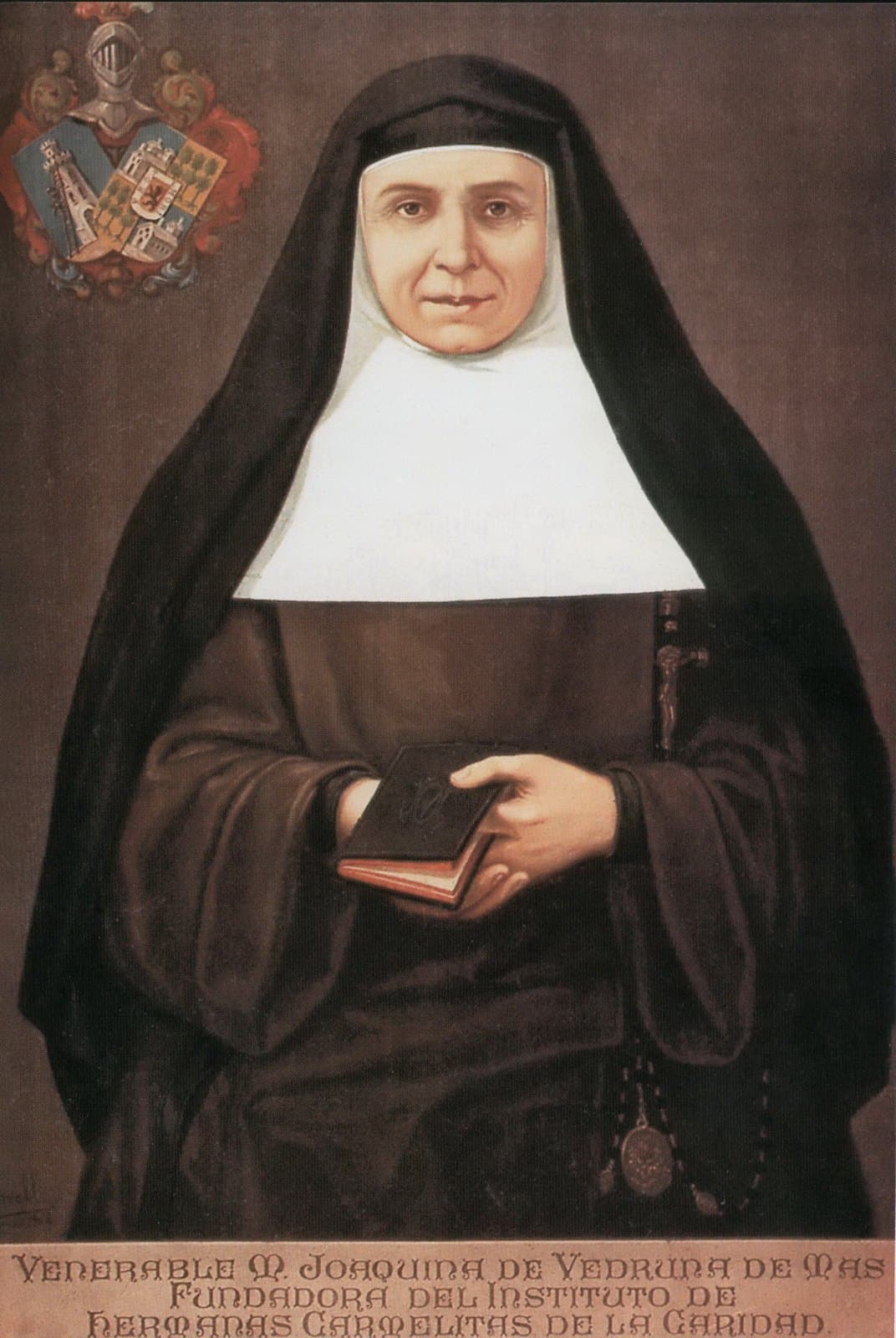
- Feast day
- August 28 1
- Born
- Barcelona, 1783, into an aristocratic family 1
- At twelve
- She said she wanted to be a Carmelite nun 1
- At sixteen
- She married Theodore de Mas, a young lawyer. They raised eight children 1
- Widowed
- By Napoleon's invasion. She fled with the children; Theodore stayed behind and died 1
- Founded
- The Carmelite Sisters of Charity - only once her younger children were provided for 1
Saint Joachima de Vedruna wanted to be a Carmelite at twelve and became one at forty-three. 1 In between she married a lawyer at sixteen, raised eight children, fled Napoleon's army, and was widowed. 1 When the desire returned she did not act on it: "she attended to her duties as a mother" until the younger children were settled. 1
Thirty-one years of waiting
She was born into an aristocratic family in Barcelona in 1783, and "was 12 when she expressed a desire to become a Carmelite nun. But her life took an altogether different turn at 16 with her marriage to a young lawyer, Theodore de Mas." 1
They raised eight children. 1 Franciscan Media calls what followed "the normalcy of their family life", and records how it ended: "The normalcy of their family life was interrupted when Napoleon invaded Spain. Saint Joachima had to flee with the children; Theodore remained behind and died." 1
The desire came back and she did not follow it. "Though Joachima re-experienced a desire to enter a religious community, she attended to her duties as a mother." 1 She was a widow with eight children and a war on, and the vocation waited again.
What she did instead was live as though she had entered one. "The young widow led a life of austerity and chose to wear" plain dress, praying and visiting the sick. 1 The convent was not available; the life was.
It took four more years. "With some of her children now married and younger ones under their care, Joachima confessed her desire to a priest to join a religious order. With his encouragement, she established the Carmelite Sisters of Charity." 1 She did not join an order in the end. She made one.
Prison, exile, paralysis
The new congregation was founded into a civil war. "In the midst of the fratricidal wars occurring at the time, Joachima was briefly imprisoned and later exiled to France for several years." 1
Then her health went. "Sickness ultimately compelled her to resign as superior of her order." 1 She had founded it, led it through imprisonment and exile, and had to hand it over.
Franciscan Media's phrase for the last four years is the hardest sentence on the page: "Over the next four years she slowly succumbed to paralysis, which caused her to die by inches." 1
She died in 1854 at seventy-one, "known and admired for her high degree of prayer, deep trust in God, and selfless charity." 1 Pius XII beatified her in 1940; John XXIII canonized her on April 12, 1959, in the Vatican Basilica, alongside Charles of Sezze. 12
What is Saint Joachima the patron saint of
She belongs to widows, to mothers, and to the Carmelite Sisters of Charity, whose work is nursing and the care of the sick. 1 Neither source gives a formal list. 12
More particularly she belongs to anyone whose vocation has been postponed by an obligation they will not put down. Hers was postponed twice, by a marriage and then by eight children, and she was in her forties before she acted on it.
Saint Joachima's feast day
The feast of Saint Joachima de Vedruna is August 28. Franciscan Media states it: "Her liturgical feast is celebrated on August 28." 1
That is the only explicit statement of the day in the sources cited here. Vatican News does not list her on August 28, but it does not list her on any other day either, and its Saint of the Day calendar is selective rather than complete - an absence there is not evidence against a date. Franciscan Media runs its own column on her on June 10, which is a publishing slot and not the feast.
Praying with Saint Joachima
Thirty-one years between wanting the thing and having it. 1 That is the shape of her life and there is no way to make it shorter. She said at twelve what she wanted, and she was in her forties before anything came of it, and nothing in between was a detour - the marriage was real, the eight children were real, the widowhood and the flight from the French army were real.
The sentence to sit with is the smallest one: "she attended to her duties as a mother." 1 She had wanted this since she was a child. Her husband was dead. The desire had come back. And she looked at the children who still needed raising and did not go.
What she did do was live the life where she was - austerity, prayer, visiting the sick, while running a household. 1 She did not treat her circumstances as the obstacle to holiness. She treated them as the place it had to happen, and when the circumstances finally changed she was already formed.
And then the end, which the record refuses to make gentle: imprisoned, exiled, forced to resign the work she had founded, and four years of paralysis that "caused her to die by inches." 1 She had waited thirty-one years to begin and was given twenty-eight to do it, and spent the last four losing the use of her body. What she was admired for at her death was trust. 1
Saint Joachima de Vedruna, pray for us.
Sources
Saints to turn to next
Others in this collection who are turned to for some of the same things.
- Saint Bridget of Swedenc. 1303 - July 23, 1373PrayerMarriage and familySuffering and illness
- Saint Elizabeth of Portugal1271 - July 4, 1336Marriage and familySuffering and illnessPrayer
- Saint Frances of Rome1384 - March 9, 1440Marriage and familyPrayerSuffering and illness
- Saint AnneFirst century BC to first century ADParentingMarriage and family