Saint Elizabeth of Portugal
1271 - July 4, 1336
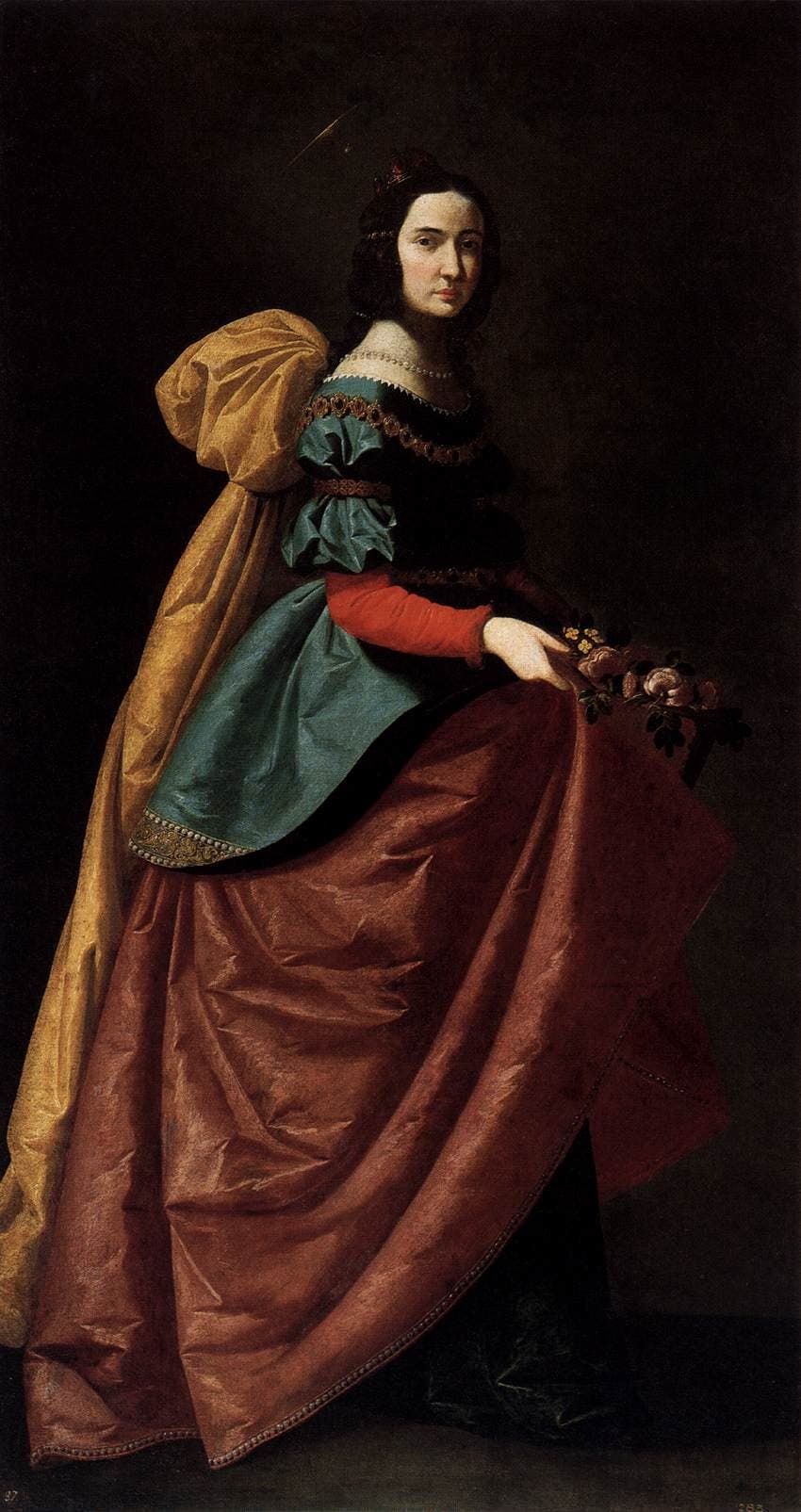
- Patron saint of
- Neither source assigns a patronage. She is invoked for peace, and by women in difficult marriages 12
- Feast day
- July 4, the day she died at Estremoz. Capes states it outright 1
- Born
- 1271, daughter of Pedro III of Aragon. Named for her great-aunt Elizabeth of Hungary 1
- Known as
- The Peacemaker. In Portugal she is Isabel, the Spanish form of her name 1
- Canonized
- By Urban VIII in 1625 1
Saint Elizabeth of Portugal was married at twelve to a king whose infidelity was, in Franciscan Media's words, "a scandal to the kingdom." 2 She spent forty years being patient with him, and then, when her husband and her son brought armies into the field against each other, she rode out and put herself between them. 1 Thirteen years later she did it again, at sixty-five, and the effort killed her. 1
A court she was too good for
She was born in 1271, daughter of Pedro III, King of Aragon, and Constantia, a granddaughter of the Emperor Frederick II. 1 Franciscan Media notes that at her birth her father was reconciled with his own father, the reigning king - "a portent of things to come." 2 She was named for her great-aunt, Elizabeth of Hungary, though Portuguese history knows her by the Spanish form, Isabel. 1
Capes describes a childhood of unusual severity chosen rather than imposed: she "led a life of strict regularity and self-denial from her childhood: she said the full Divine Office daily, fasted and did other penances, and gave up amusement." 1 The full Office is a substantial daily commitment for an adult in religious life. She was a child.
She was married at twelve to Diniz, King of Portugal. 12 Capes is careful to give him his due: a poet, and known as Rei Lavrador, the working king, "from his hard work in his country's service." 1 Then the rest of it: "His morals, however, were extremely bad, and the court to which his young wife was brought consequently most corrupt." 1 Franciscan Media says the infidelity "was a scandal to the kingdom." 2
What she did about it was not to withdraw. Capes: "Nevertheless, Elizabeth quietly pursued the regular religious practices of her maidenhood, whilst doing her best to win her husband's affections by gentleness and extraordinary forbearance." 1 She went on with daily Mass, and with the poor - "she was devoted to the poor and sick, and gave every moment she could spare to helping them, even pressing her court ladies into their service." 1 Franciscan Media lists who came to her: "pilgrims, strangers, the sick, the poor - in a word, all those whose need came to her notice." 2
It did not make her popular. Capes notes the obvious: "Naturally, such a life was a reproach to many around her, and caused ill will in some quarters." 1 A pious queen in a corrupt court is not merely out of place; she is an accusation walking around.
One famous episode Capes reports at arm's length, and this page keeps the distance. "A popular story is told of how her husband's jealousy was roused by an evil-speaking page; of how he condemned the queen's supposed guilty accomplice to a cruel death; and was finally convinced of her innocence by the strange accidental substitution of her accuser for the intended victim." 1 Told, not recorded.
Diniz did change, eventually. Capes: he "does not appear to have reformed in morals till late in life, when we are told that the saint won him to repentance by her prayers and unfailing sweetness." 1 Franciscan Media: "Elizabeth of Portugal long sought peace for him with God, and was finally rewarded when he gave up his life of sin." 2 It took most of a lifetime.
Between her husband and her son
They had two children, Constantia and Affonso. 1 The trouble came from the same source as everything else: the king had illegitimate sons, and he favored them. Capes: Affonso "so greatly resented the favours shown to the king's illegitimate sons that he rebelled, and in 1323 war was declared between him and his father." 1
Her husband's army on one side, her son's on the other.
Capes gives what she did in one sentence and does not decorate it: "St. Elizabeth, however, rode in person between the opposing armies, and so reconciled her husband and son." 1 Franciscan Media says she "repeatedly sought and effected peace between the king and their rebellious son Alfonso." 2
She mediated outside her own family too. Franciscan Media records that she "acted as peacemaker in the struggle between Ferdinand, king of Aragon, and his cousin James, who claimed the crown." 2 Capes calls her, in his opening line, the Peacemaker - "sometimes known as the PEACEMAKER" - and it is the title she carries in Portugal still. 1
Estremoz
Diniz died in 1325 and Affonso succeeded him as Affonso IV. 1 Elizabeth retired to the convent of Poor Clares she had founded at Coimbra and took the Franciscan tertiary habit, "wishing to devote the rest of her life to the poor and sick in obscurity." 1 She was in her middle fifties and she had earned it.
Eleven years later her son marched on Castile. Capes gives the grievance, and it was a real one: Affonso had married his daughter Maria to the King of Castile, "who had neglected and ill-treated her." 1 A father going to war over his daughter's treatment is not an unreasonable father.
Elizabeth was sixty-five. "In spite of age and weakness, the holy queen dowager insisted on hurrying to Estremoz, where the two king's armies were drawn up." 1 Franciscan Media: she "set out and was able to bring about a lasting peace between her son Alfonso, now king of Portugal, and his son-in-law, the king of Castile." 2
Capes finishes it plainly. "She again stopped the fighting and caused terms of peace to be arranged. But the exertion brought on her final illness; and as soon as her mission was fulfilled she died of a fever, full of heavenly joy, and exhorting her son to the love of holiness and peace." 1
As soon as her mission was fulfilled. She was buried at Coimbra, in her own foundation, and Urban VIII canonized her in 1625. 1
What is Saint Elizabeth of Portugal the patron saint of?
Neither Capes nor Franciscan Media assigns Saint Elizabeth of Portugal a formal patronage. 12 What she is invoked for follows from the two things she is documented as doing, and needs no grant.
She is asked for peace - between countries, between factions, and between members of a family who have stopped speaking. Twice she physically placed herself in the gap between armies raised by people she loved, and both times the fighting stopped. 12
And she is asked by women whose marriages are humiliating. She had one, publicly, for decades, in front of a court that knew everything. 12 She neither left nor pretended. Franciscan Media's phrase for her conduct is that she "remained devoted to her husband" while his infidelity scandalized the kingdom, which is an uncomfortable sentence and an honest one. 2 Nothing here should be read as counsel to endure abuse; what it records is that she found a way to keep her own life intact inside a bad situation, and used the position it left her to stop two wars.
Franciscan Media notes how she is recognized in art: "in royal garb with a dove or an olive branch." 2 A queen carrying the sign of peace.
Saint Elizabeth of Portugal's feast day
The feast of Saint Elizabeth of Portugal is July 4. Capes states it in his closing line - "her feast is kept on 4 July" - and Franciscan Media presents her on the same day. 12 It is the day she died at Estremoz in 1336, hours after stopping her son's war. 1
American readers will find the date occupied by other things. That is a coincidence of calendars and nothing more, though a feast of peacemaking on Independence Day is a pleasant accident.
She is not to be confused with Saint Elizabeth of Hungary, her own great-aunt, who died in 1231 and is kept on November 17. 1 The two are regularly mixed up, not least because the story of roses in an apron is told of both.
Praying with Saint Elizabeth of Portugal
Her life answers a question people actually have: what do you do when you cannot fix the central fact of your situation? Elizabeth could not make Diniz faithful. She tried for forty years and he reformed, Capes says, only late in life. 1 In the meantime she did the Office, went to Mass, fed the poor, and drafted her court ladies into nursing. She built a life that was not a reaction to his.
The two rides are what she is for. It is worth being concrete about what riding between two armies means: she had no power to compel either side, and both were commanded by men who loved her. That was the whole of her leverage, and she spent it twice. 12 Her son at Estremoz had a good reason for his war - his daughter was being mistreated - and she stopped it anyway, because she thought the fighting was worse than the grievance.
The second ride killed her and she knew what she was risking. Capes says she insisted on going "in spite of age and weakness." 1 There is a kind of courage that does not look like courage because it looks like an old woman traveling in bad health, and the only way to see it is to notice that she did not have to go.
What is easy to miss is how much of her was ordinary. She said her prayers, she visited the sick, she was kind to a man who did not deserve it, and she took the habit of a lay Franciscan at the end and asked to be left in obscurity. 1 Nobody was proposing to canonize her for any of that. Then a message came that two armies were drawn up, and everything she had been quietly doing for fifty years turned out to be the thing that let her walk out between them.
Saint Elizabeth of Portugal, pray for us.
Sources
Saints to turn to next
Others in this collection who are turned to for some of the same things.
- Saint Frances of Rome1384 - March 9, 1440Marriage and familyPrayerSuffering and illness
- Saint Bridget of Swedenc. 1303 - July 23, 1373PrayerMarriage and familySuffering and illness
- Saint Joachima de Vedruna1783 - 1854Marriage and familySuffering and illnessPrayer
- Saint Catherine of Genoa1447 - September 15, 1510Suffering and illnessPrayer