Saint Catherine of Genoa
1447 - September 15, 1510
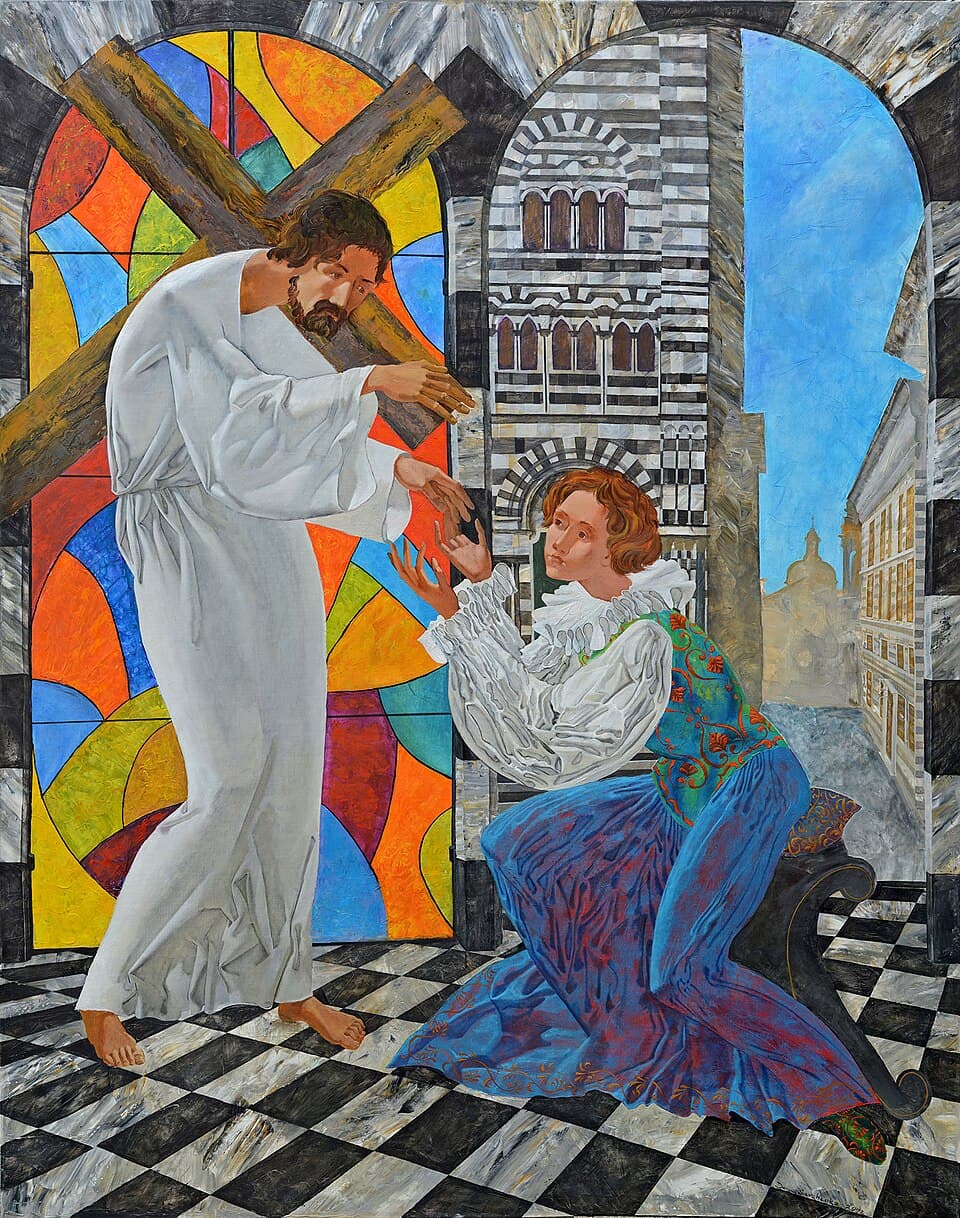
- Patron saint of
- Neither source assigns a patronage. She is invoked by nurses, and by women in unhappy marriages 12
- Born
- Genoa, 1447, into the Fieschi family, which had already given the Church two popes 1
- Ran
- The Pammatone, the great hospital of Genoa, after her husband's death in 1497 2
- Wrote
- The Dialogues of the Soul and Body, and the Treatise on Purgatory 1
Saint Catherine of Genoa was refused by a convent at thirteen and married at sixteen to a man who was, in her encyclopedia's words, "faithless, violent-tempered, and a spendthrift." 1 She spent five years in silent misery and five more looking for distraction, and then, kneeling in a confessional she never used, something happened in a single moment that did not leave her for the remaining thirty-seven years of her life. 1
Ten years of a bad marriage
She was born at Genoa in 1447 to Jacopo Fieschi and Francesca di Negro, "both of illustrious Italian birth." 1 Two popes had come from the Fieschi family and her father became Viceroy of Naples. 1 Franciscan Media sets the period: Italian nobles were patronizing the Renaissance, and "the needs of the poor and the sick were often overshadowed by a hunger for luxury and self-indulgence." 2
At about thirteen she asked to enter a convent and the nuns refused her for her age. Capes notes what she did next, and it is a small sad detail: "she appears to have put the idea aside without any further attempt." 1 She did not press it.
At sixteen she was married, "by her parents' wish", to Giuliano Adorno. 1 Capes does not soften what followed: "The marriage turned out wretchedly; Giuliano proved faithless, violent-tempered, and a spendthrift. And made the life of his wife a misery." 21
The ten years are divided exactly. "Catherine spent the first five years of her marriage in silent, melancholy submission to her husband; and that she then, for another five, turned a little to the world for consolation in her troubles." 1
And Capes defends her about the second five, which most accounts do not. "The distractions she took were most innocent" - he says it plainly - and yet in her case they produced "lukewarmness, the end of which was such intense weariness and depression that she prayed earnestly for a return of her old fervour." 1 Franciscan Media's version is blunter: "For a while she tried to numb her disappointment by a life of selfish pleasure." 2
Capes' account is the fairer one and this page follows it. A miserable young woman sought some harmless amusement, found it did not help, and ended up more exhausted than before.
The confession she did not make
"Then, just ten years after her marriage, came the event of her life, in answer to her prayer." 1
She went, "full of melancholy", to a convent in Genoa where a sister of hers was a nun. The sister suggested she make her confession to the nuns' confessor, and Catherine agreed - with no particular expectation. 1 Franciscan Media: "Going to confession one day was the turning point of Catherine's life." 2
What happened took no time at all. "No sooner, however, had she knelt down in the confessional than a ray of Divine light pierced her soul, and in one moment manifested her own sinfulness and the Love of God with equal clearness." 1
Both at once, with equal clearness. Franciscan Media renders it as "a new sense of her own sins and how much God loved her." 2 Not one followed by the other; the same instant.
"The revelation was so overwhelming that she lost consciousness and fell into a kind of ecstacy, for a space during which the confessor happened to be called away. When he returned, Catherine could only murmur that she would put off her confession, and go home quickly." 1
The priest had stepped out and missed it entirely. She never made the confession. She got up and went home.
And it did not wear off. "From the moment of that sudden vision of herself and God, the saint's interior state seems never to have changed, save by varying in intensity." 1 Capes opens his whole article by saying that her life "may more properly be described as a state than as a life in the ordinary sense", and that this condition "lasted till her death" - thirty-seven years later. 1
The hospital
What she did with it was not withdraw. Franciscan Media traces what happened to the marriage: "She reformed her life and gave good example to Julian, who soon turned from his self-centered life of distraction." 2 The husband changed too.
But his spending had destroyed them. "Julian's spending, however, had ruined them financially. He and Catherine decided to live in the Pammatone, a large hospital in Genoa, and to dedicate themselves to works of charity there." 2
A Fieschi and an Adorno, bankrupt, moved into a hospital and worked in it. Together.
He died in 1497 and "Catherine took over management of the hospital." 2 She ran the Pammatone - the largest in Genoa - through the plague years, which is where most of the rest of her life went.
Franciscan Media's summary of the end is four words long and exact: "Exhausted by her life of self-sacrifice, Catherine died September 15, 1510." 2 She was canonized in 1737. 2
What she wrote about purgatory
Her two books - the "Dialogues of the Soul and Body" and the "Treatise on Purgatory" - are the reason she is read by people who never read saints. 1
Capes is careful about their provenance. Her biographies are "chiefly translations or adaptations of an old Italian one which is itself founded on 'Memoirs' drawn up by the saint's own confessor and a friend", and he complains that they mingle the facts of her outward life with her doctrine "regardless of sequence, and in an almost casual fashion." 1 The books represent her teaching as those who heard it wrote it down.
Franciscan Media gives the substance in two sentences: "Saint Catherine of Genoa wrote about purgatory which, she said, begins on earth for souls open to God. Life with God in heaven is a continuation and perfection of the life with God begun on earth." 2
That is a startling idea and it follows directly from what happened to her in the confessional. If seeing your own sin and God's love in the same instant is what purgation is, then it had already started in her, in Genoa, at twenty-six - and heaven would simply be more of it.
What is Saint Catherine of Genoa the patron saint of?
Neither Capes nor Franciscan Media assigns Saint Catherine of Genoa a patronage. 12 She is invoked in practice by nurses and hospital administrators, which she was for the second half of her life, and by people who care about the dead.
She belongs particularly to women in unhappy marriages who cannot leave them. That was her situation for a decade, described by her own encyclopedia as a misery, and what changed was not her circumstances but something that happened to her inside them - after which the marriage itself changed too. 12
And she is a patron for people who have been told their low period was a moral failing. Capes will not have it: the distractions were innocent, and what they produced was exhaustion and depression rather than sin. 1
Saint Catherine of Genoa's feast day
The feast of Saint Catherine of Genoa is September 15. Franciscan Media states it outright and Capes gives her death at Genoa on the same date in 1510. 12
This library first recorded her on March 26, which is the slot the Saint of the Day column runs her in - one of twenty-five such errors the research pipeline found and corrected. The column's own text gives September 15. 2
She should not be confused with Catherine of Siena, Catherine of Bologna or Catherine of Alexandria, all of whom have their own entries here.
Praying with Saint Catherine
Her life divides at twenty-six and the first half is the part worth reading slowly. Refused by a convent at thirteen and not persistent enough to ask again; married at sixteen to a man who was unfaithful, violent-tempered and spending them into ruin; five years of silence, then five of looking for something to take her mind off it. 1 Nothing about that decade is edifying and her own encyclopedia does not pretend it is.
What ended it was not a decision. She went to a confessional she had not planned on, knelt down, and it happened before she said anything - and the priest was out of the room. 1 Nobody witnessed the central event of her life. She could not even complete the sacrament she had come for; she went home.
The content of what she saw is the useful part. Her own sinfulness and the love of God, in one moment, with equal clearness. 1 Not condemnation followed by relief, not reassurance that the sin was small. Both at full strength at once - which is, she later argued, exactly what purgatory is, and why she thought it could begin here.
And then twenty years running a hospital in a bankrupt household. 2 The vision did not take her out of anything; it put her into the Pammatone with her husband, and after he died it left her there alone with the work. Franciscan Media says plainly what finished her: exhaustion.
Saint Catherine of Genoa, pray for us.
Sources
Saints to turn to next
Others in this collection who are turned to for some of the same things.
- Saint Rose of LimaApril 20, 1586 - August 1617Suffering and illnessPrayerAnxiety and mental health
- Saint Mary Magdalene de' PazziApril 2, 1566 - May 25, 1607PrayerAnxiety and mental healthSuffering and illness
- Saint Elizabeth of Portugal1271 - July 4, 1336Suffering and illnessPrayer
- Saint Frances of Rome1384 - March 9, 1440PrayerSuffering and illness