Saint Mary Magdalene de' Pazzi
April 2, 1566 - May 25, 1607
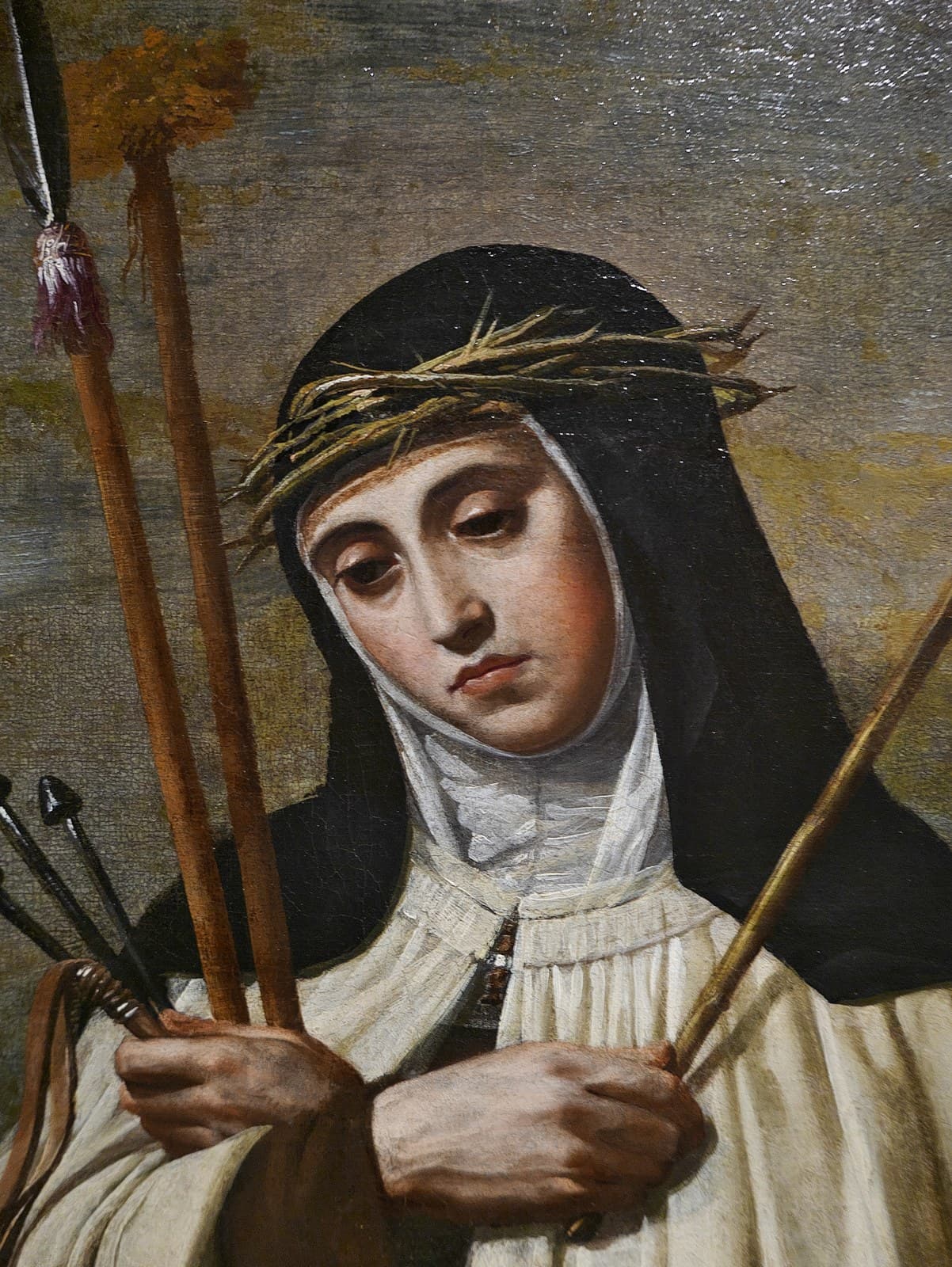
Saint Mary Magdalene de' Pazzi is called the ecstatic saint, and the useful thing about her is that the ecstasies were not the point. 2 She chose her convent because the nuns there received Communion every day. 12 She spent five years in a darkness in which, Franciscan Media says, "she saw nothing but what was horrible in herself and all around her." 2 She never wrote a word: five volumes of her sayings exist because the people around her took them down. 12
She picked the convent for the Communions
Capes opens with a warning about the shape of the life: "Of outward events there were very few in the saint's life." 1 She was born Caterina, into two noble Florentine families, and baptized in the great baptistery. 1
Everything in the childhood points one way. Capes lists the usual marks of a young mystic and then says what actually distinguished her: "above all other spiritual characteristics was Caterina's intense attraction towards the Blessed Sacrament, her longing to receive It, and her delight in touching and being near those who were speaking of It, or who had just been to Communion." 1
Franciscan Media dates the steps: she learned to meditate at nine from the family confessor, made her first Communion at ten, "and made a vow of virginity one month later." 2 Capes agrees on the Communion and the vow. 1
And when it came to choosing a house, the reason was the same one. She entered the Carmelite convent of Santa Maria degl' Angeli in December 1582, and Capes is explicit: "Her chief reason for choosing this convent was the rule there followed of daily Communion." 1 Franciscan Media says the same: "At 16, Catherine entered the Carmelite convent in Florence because she could receive Communion daily there." 2
Her parents took persuading - "after a little difficulty in persuading them to relinquish their only daughter" - but Capes calls them "truly spiritual people" and they let her go. 1
Professed from a cot
A year into the novitiate she nearly died. Franciscan Media: "Death seemed near, so her superiors let her make her profession of vows in a private ceremony from a cot in the chapel." 2 Capes dates it to May 29, 1584, "being then so ill that they feared she would not recover." 1
What happened immediately afterward is the thing she is known for. "Immediately after, Mary Magdalene fell into an ecstasy that lasted about two hours. This was repeated after Communion on the following 40 mornings." 2 Capes: "she was subject to an extraordinary daily ecstasy for forty consecutive days, at the end of which time she appeared at the point of death. She recovered, however, miraculously." 1
Capes describes what the raptures were actually like, and the details are strange in a specific rather than a vague way. They sometimes "seized upon her whole being with such force as to compel her to rapid motion (e.g. towards some sacred object)." And: "she was frequently able, whilst in ecstasy, to carry on work belonging to her office - e.g., embroidery, painting, etc. - with perfect composure and efficiency." 1 She kept working through them.
Five volumes she did not write
What survives of her is a large body of spiritual counsel, and she wrote none of it. Capes: "These utterances have been preserved to us by the saint's companions, who (unknown to her) took them down from her lips as she poured them forth." 1 And the caveat: "These maxims of the saint are sometimes described as her 'Works', although she wrote down none of them herself." 1
Franciscan Media tells it the other way round: "As a safeguard against deception and to preserve the revelations, her confessor asked Mary Magdalene to dictate her experiences to sister secretaries." 2 One account has her recorded without her knowledge; the other has her instructed to dictate. This page does not choose between them.
The scale is not in dispute. "Over the next six years, five large volumes were filled." 2 Franciscan Media catalogs them: the first three record ecstasies from May 1584 to Pentecost week the following year; the fourth records a five-year trial; the fifth is "a collection of letters concerning reform and renewal"; and a further book, "Admonitions", collects her sayings on forming women religious. 2
Capes passes on one editor's estimate of their standing, attributed rather than asserted: "a modern editor of a selection of them declares" the maxims to be "more frequently quoted by spiritual writers than those even of St. Teresa". 1
The five years
Franciscan Media refuses the obvious reading of her life and the refusal is the best writing in either source. "It would be easy to dwell on the ecstasies and pretend that Mary Magdalene only had spiritual highs. This is far from true." 2
From 1585 to 1590 there was nothing. Capes: "God allowed her to be tried by terrible inward desolation and temptations, and by external diabolic attacks." 1 Franciscan Media describes the interior weather: "She was plunged into a state of darkness in which she saw nothing but what was horrible in herself and all around her. She had violent temptations and endured great physical suffering." 2
That is five years, immediately following the forty days of ecstasy, and lasting longer than the ecstasies did. Franciscan Media's reading of the sequence is worth keeping: "It seems that God permitted her this special closeness to prepare her for the five years of desolation that followed." 2 The consolation came first, and was preparation for its absence.
Capes notes what came out of it publicly: "the courageous severity and deep humility of the means that she took for overcoming these only served to make her virtues shine more brilliantly in the eyes of her community." 1
The office-holder
None of this stopped her working. "This ecstatic life in no wise interfered with the saint's usefulness in her community." 1 She was in turn mistress of externs, teacher and mistress of the juniors, novice mistress for six years, and from 1604 superior - "in spite of constant bad health". 1
And Capes describes a manager rather than a visionary: "She was noted for her strong common-sense, as well as for the high standard and strictness of her government, and was most dearly loved to the end of her life by all for the spirit of intense charity that accompanied her somewhat severe code of discipline." 1 Strict, and loved for the charity that came with the strictness.
Capes also records the odder claims - reading her novices' hearts, seeing at a distance, once watching Catherine de' Ricci read a letter she had sent her at Prato, "but the two saints never met in a natural manner." 1 Franciscan Media has the same class of report: "She read the thoughts of others and predicted future events." 2
She died at forty-one "after an illness of nearly three years' duration and of indescribable painfulness, borne with heroic joy to the end." 1 Her cause was begun in 1610 and finished in 1626, and she was canonized in 1669 - "sixty-two years after her death." 1
What is Saint Mary Magdalene de' Pazzi the patron saint of?
Neither source cited here gives her a patronage. 12 Capes ends with a bibliography and Franciscan Media with the feast; neither names a cause she is invoked for, and this page does not supply one.
The title she is given instead is descriptive: the ecstatic saint. 2 Franciscan Media defines the term first, which is unusual and useful - mystical ecstasy is "the elevation of the spirit to God in such a way that the person is aware of this union with God while both internal and external senses are detached from the sensible world." 2
Saint Mary Magdalene de' Pazzi's feast day
The feast of Saint Mary Magdalene de' Pazzi is May 25, the day she died in 1607. Franciscan Media states it: "Her liturgical feast is celebrated on May 25." 2
The 1910 encyclopedia gives a different date: "Her feast is kept on 27 May." 1 That was correct when it was printed. Both are here so that a reader meeting May 27 in an older book knows what they are looking at.
One further caution about the sources, because it matters for anyone following the citations: the Catholic Encyclopedia has a separate and much longer article on Mary Magdalen of the Gospels, and it is a different person. The article cited here is the one about the Carmelite of Florence. 1
Praying with Saint Mary Magdalene de' Pazzi
She is the saint for when prayer stops working. That is not the obvious use of somebody nicknamed the ecstatic saint, which is exactly why Franciscan Media leads its reflection with a correction: it would be easy "to pretend that Mary Magdalene only had spiritual highs. This is far from true." 2 Forty days of ecstasy, and then five years in which she saw nothing but what was horrible in herself and everything around her. 2
The ordering matters. The consolation came first and the darkness came after, and lasted far longer - and Franciscan Media reads the first as preparation for the second. 2 Whatever she was given at twenty, she spent from twenty to twenty-five without it. Nobody who has had a good year of prayer and then a bad decade is in unprecedented territory.
She kept working throughout. Mistress of externs, teacher, novice mistress, superior, in constant bad health, doing her embroidery through the raptures and her office through the desolation. 1 Capes' word for her is common-sense, which is not what the nickname leads you to expect.
And she wrote nothing. Five volumes of her exist because other people wrote down what she said - in one account without her knowing. 12 Whatever she was doing, she was not producing a body of work. Somebody else did that afterward, out of what she happened to say out loud.
Saint Mary Magdalene de' Pazzi, pray for us.
Sources
Saints to turn to next
Others in this collection who are turned to for some of the same things.
- Saint Catherine of Genoa1447 - September 15, 1510Anxiety and mental healthSuffering and illnessPrayer
- Saint Rose of LimaApril 20, 1586 - August 1617Suffering and illnessPrayerAnxiety and mental health
- Saint Alphonsus LiguoriSeptember 27, 1696 - August 1, 1787PrayerAnxiety and mental health
- Saint Alphonsus Rodriguez1532 or 1533 - October 1617PrayerSuffering and illness