Saint Alphonsus Liguori
September 27, 1696 - August 1, 1787
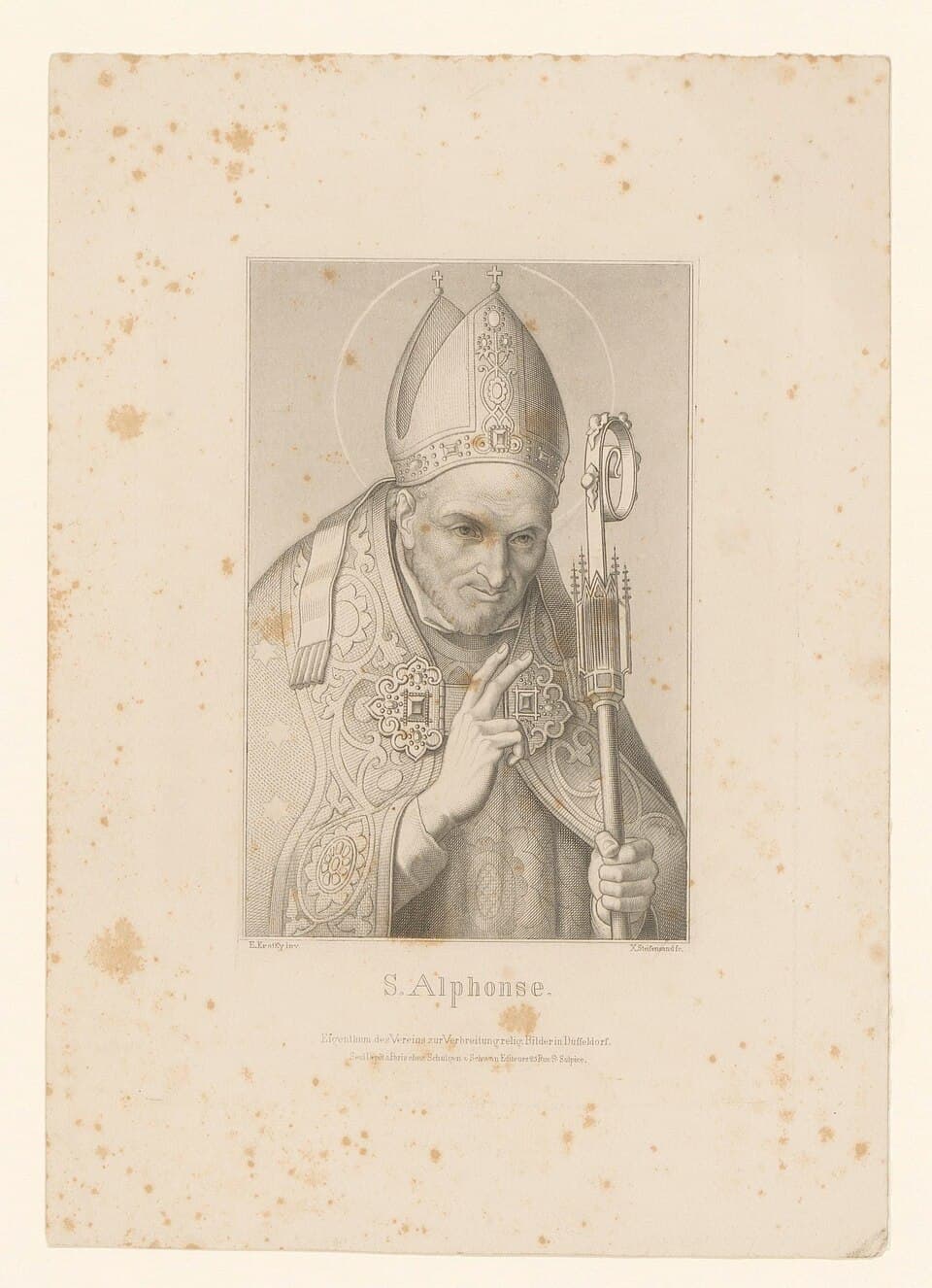
- Patron saint of
- Confessors and moral theologians, by Pius XII; Franciscan Media lists theologians and vocations 23
- Born
- Marianella, near Naples, September 27, 1696, eldest of seven, to an old noble family 1
- Doctor of Laws
- At sixteen, four years under the statutory age; Castle says he was "almost buried in his doctor's gown" and the spectators laughed 1
- Founded
- The Congregation of the Most Holy Redeemer, the Redemptorists, in 1732 2
- Died
- Nocera de' Pagani, August 1, 1787, as the midday Angelus rang, aged nearly 91 1
Saint Alphonsus Liguori took a doctorate in law at sixteen and left the Neapolitan bar at twenty-seven in disgust at its corruption. 12 He spent the next sixty years arguing that God is not the grim figure the Jansenists described, wrote the moral theology that made him patron of confessors, and composed a Christmas carol Italians still sing. 2 Three years before he died, he lost his own peace entirely. 1
The most brilliant lawyer in Naples
He was born near Naples in 1696, eldest of seven, into an old noble family whose branch had become somewhat impoverished; his father was a naval officer and Captain of the Royal Galleys. 1 Castle records the father's assessment of his son, which turns out to describe the whole life: "I know his obstinacy; when he once makes up his mind he is inflexible." 1
The boy practiced the harpsichord three hours a day at his father's insistence and played it at thirteen "with the perfection of a master." 1 He took his Doctorate of Laws at sixteen, four years below the statutory age, and Castle preserves his own memory of the occasion: he was so small that he was almost buried in the doctor's gown, and the spectators laughed. 1
Then the detail everybody repeats, which the two sources handle differently. Benedict XVI states it flatly: "He was the most brilliant lawyer in the tribunal of Naples: for eight years he won all the cases he defended." 2 Castle reports the same tradition and then steps back from it: "he is said never to have lost a case. Even if there be some exaggeration in this, for it is not in an advocate's power always to be on the winning side, the tradition shows that he was extraordinarily able and successful." 1 By twenty-seven he was one of the leaders of the Neapolitan bar. 1
He left in 1723. Benedict gives the reason as disgust: "indignant at the corruption and injustice that was ruining the legal milieu, he abandoned his profession - and with it riches and success - and decided to become a priest despite the opposition of his father." 2 He was ordained in 1726. 2
The evening chapels
What he did first is the part least known and among the most interesting. He began preaching and catechizing among the poorest people in Naples - many of them, Benedict says plainly, "very often prone to vice and involved in crime." 2 He taught them to pray and encouraged them to change how they lived. 2
It grew into something with a structure. Groups began meeting in the evenings in private houses and workshops to pray and meditate on Scripture, led by catechists Alphonsus and other priests had trained, with the priests visiting regularly. 2 When the Archbishop of Naples had the meetings moved into the city chapels they acquired a name: the "evening chapels." 2
Benedict reports the result without hedging it: they were "a true and proper source of moral education, of social improvement and of reciprocal help among the poor: thefts, duels, prostitution ended by almost disappearing." 2 And he draws the model out for the present - priests doing spiritual ministry while "well-trained lay people could be effective Christian animators, an authentic Gospel leaven in the midst of society." 2
At thirty-five he met the peasants and shepherds of the country outside Naples, was struck by their ignorance of religion and the neglect they lived in, and left the capital for them. 2 In 1732 he founded the Congregation of the Most Holy Redeemer - itinerant missionaries reaching the remotest villages. 2 The Redemptorists are still at it, and Benedict says so with evident affection. 2
Against a grim God
The moral theology is why he is a Doctor of the Church, and Benedict is precise about what it was answering. In Alphonsus's day a very strict reading of the moral life was widespread "because of the Jansenist mentality which, instead of fostering trust and hope in God's mercy, fomented fear and presented a grim and severe face of God, very remote from the face revealed to us by Jesus." 2
His Moral Theology set against that "a balanced and convincing synthesis" - the requirements of God's law on one side, and on the other "the dynamics of the conscience and of human freedom, which precisely in adherence to truth and goodness permit the person's development and fulfilment." 2
The practical instruction is the part a penitent would notice. He told confessors to be faithful to Catholic moral doctrine and at the same time to take "a charitable, understanding and gentle attitude so that penitents might feel accompanied, supported and encouraged." 2 He never tired of repeating, Benedict says, that priests are "a visible sign of the infinite mercy of God." 2
He also wrote for people who would never read a theologian. Benedict lists The Eternal Maxims, the Glories of Mary, and The Practice of Loving Jesus Christ, which he calls the synthesis of his thought and his masterpiece, and notes that his plain, pleasant style "contributed to molding the popular spirituality of the last two centuries." 2 He wrote the words and music of Tu scendi dalle stelle, which Benedict calls one of the most popular Christmas carols in Italy and beyond. 2
The last three years
He was made Bishop of Sant'Agata dei Goti in 1762 and resigned in 1775, worn down by the illness that had disabled him, with Pius VI's permission. 2
Then Castle records what happened at the end, and it is the hardest thing in either source. "About three years before his death he went through a veritable 'Night of the Soul'. Fearful temptations against every virtue crowded upon him, together with diabolical apparitions and illusions, and terrible scruples and impulses to despair which made life a hell." 1
Scruples and impulses to despair, in the man who had spent his life telling confessors to be gentle and arguing that the Jansenists had God's face wrong. Neither source explains it and this page will not either. Castle records simply that "at last came peace," and that on 1 August 1787, as the midday Angelus was ringing, he died, having nearly completed his ninety-first year. 1
Benedict adds what the pope said on hearing of it. Pius VI, told of the death "which occurred after great suffering," exclaimed: "he was a saint!" 2 He was declared Venerable in 1796, beatified in 1816, canonized in 1839, and made a Doctor of the Church in 1871. 12
What is Saint Alphonsus Liguori the patron saint of?
Saint Alphonsus Liguori is the patron saint of confessors and moral theologians. Benedict XVI records that Pius XII proclaimed him "Patron of all confessors and moral theologians," on the strength of a moral teaching that "expressed adequately the Catholic doctrine." 2 Franciscan Media lists theologians and vocations. 3 It is a patronage with a shape to it: the man invoked by confessors is the one who told them to be gentle. 2
Saint Alphonsus Liguori's feast day
The feast of Saint Alphonsus Liguori is August 1, the day he died. 13 Castle gives the death as 1 August 1787 at Nocera de' Pagani, and Franciscan Media gives the current feast as the same date. 13 It is one of the rare cases in this library where the day of death and the day of the feast are the same, which is worth stating precisely because the opposite is so common - the encyclopedia's own article on Gregory the Great gives a death in March and a feast in September, and four profiles written alongside this one needed their feast days corrected against a current source.
Praying with Saint Alphonsus
He is the saint to reach for when religion has been made frightening. That was his actual problem, described in those terms by the pope who wrote about him: a widespread mentality that "fomented fear and presented a grim and severe face of God." 2 He did not answer it by lowering the standard. He answered it by insisting that the law and the conscience are both real, and that the priest in the confessional is meant to look like mercy rather than like a magistrate. 2
The evening chapels are the most practical thing he left. Ordinary people meeting in workshops and front rooms to pray and read Scripture, with trained lay leaders and priests coming round - and thefts, duels and prostitution in those districts nearly stopping. 2 It was not a program run from a chancery. It was neighbors, organized.
The end refuses to be tidy. A man who had argued all his life against a religion of terror spent his last three years in scruples and impulses to despair, with life, in Castle's word, a hell. 1 There is no lesson offered for that here and none in the sources. It is worth knowing about him anyway, because anyone who has been through something similar has usually been told that faith should have prevented it.
What came after, Castle gives in four words - "at last came peace" - and then the Angelus ringing at midday and an old man dying in the middle of it. 1 Pius VI's reaction on hearing the news is the whole verdict: he was a saint. 2
Saint Alphonsus Liguori, pray for us.
Sources
Saints to turn to next
Others in this collection who are turned to for some of the same things.