Saint Francis of Assisi
c. 1181 - October 3, 1226
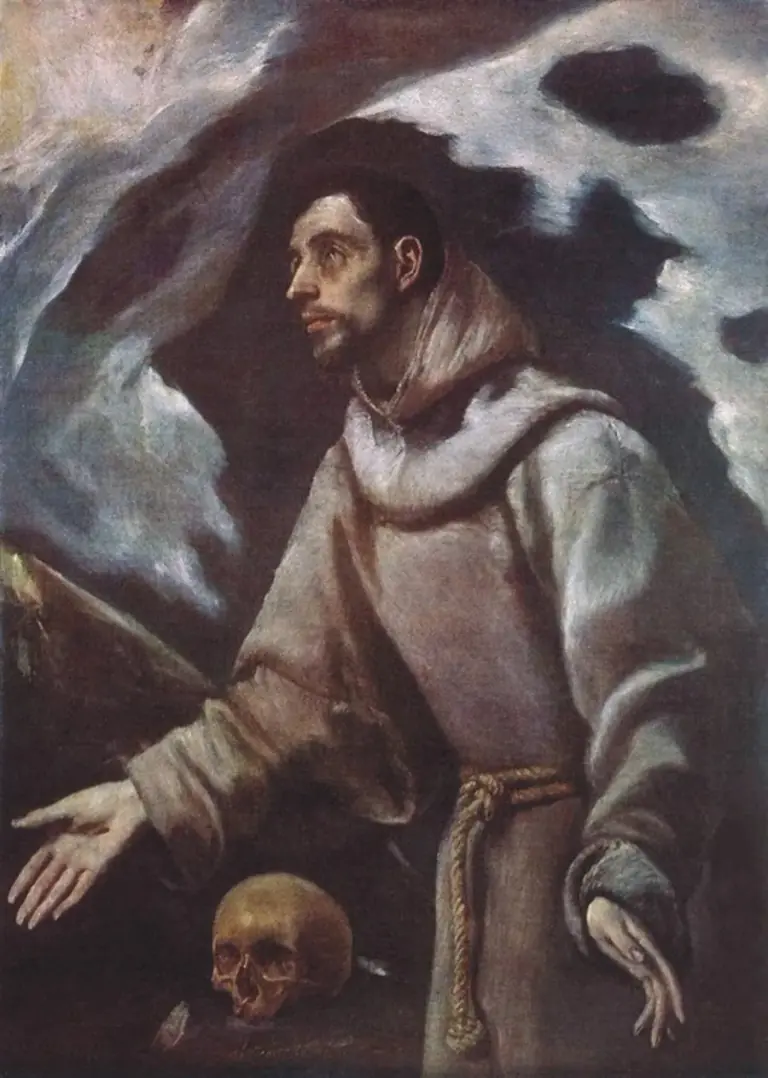
- Patron saint of
- Animals, ecology, merchants, and Italy 2
- Feast day
- October 4 2
- Canonized
- 1228, by Pope Gregory IX, two years after his death 1
- Founded
- The Order of Friars Minor, approved by Innocent III in 1209 1
Saint Francis of Assisi is the most recognizable saint in the world and the least comfortable one to actually follow. A rich merchant's son who gave away everything he had, including the clothes he was standing in, he heard an instruction from a crucifix and spent the rest of his life obeying it. Eight hundred years later he is on garden statues everywhere, which is a strange fate for a man whose entire point was that you cannot keep what you own.
The merchant's son
Francis was born at Assisi in late 1181 or early 1182, the son of Bernardone, a cloth merchant. 12 He was a young man of means with the expectations that go with them, and his conversion was not a single moment but a slow turn that began after he came home from a military campaign and imprisonment at about the age of twenty. 1
Go and repair my Church
Around 1205, praying before the crucifix at San Damiano, Francis heard Christ speak to him three times: "Go, Francis, and repair my Church in ruins." 1 He took it literally at first and began rebuilding the little church he was standing in. Benedict XVI notes that the ruinous state of the building was itself a symbol of the state of the Church at the time 1 - the instruction meant more than masonry, and Francis grew into the larger meaning by first obeying the smaller one.
When his father reproached him for giving away his goods to the poor, Francis stood before the Bishop of Assisi and stripped off his clothes, renouncing his inheritance in public. 1 It is the moment everything else in his life follows from.
A rule, a papal blessing, and a movement
In 1209 Francis went to Rome to put his plan of life before Pope Innocent III, who received him and recognized that the movement came from God. 1 The Friars Minor grew from a handful of companions into an order.
Their center was the Portiuncula, the small church of Santa Maria degli Angeli below Assisi. 1 Clare, a young noblewoman of the town, followed the same path and founded the Poor Clares. 1
La Verna, and the Canticle
In 1224, at the hermitage of La Verna, Francis received the stigmata in a vision of the Crucified Lord appearing as a seraph. 1 The wounds of Christ marked the body of a man who had spent twenty years trying to be conformed to him.
He also wrote the Canticle of the Creatures, which addresses the sun, the moon, water, fire and death itself as brother and sister. 1 Franciscan Media notes he was named patron of ecology in 1979. 2 The Canticle is why: not sentimentality about nature, but the claim that everything that exists is related to you because it is made by the same Father.
He died at the Portiuncula on 3 October 1226, aged about forty-four, and was canonized two years later by Pope Gregory IX. 12
What is Saint Francis the patron saint of?
Saint Francis of Assisi is the patron saint of animals and of ecology, and also of merchants, messengers, and Italy. 2 The animal patronage is the one everybody knows and the one most often reduced to a birdbath; the Canticle is the serious version of it.
Saint Francis' feast day
The feast of Saint Francis of Assisi is celebrated on October 4, the day after his death. 2 Many parishes bless animals on or near it.
Praying with Saint Francis
Told to repair a Church in ruins, Francis started carrying stones at San Damiano. 1 He grew into the larger meaning by first doing the small literal thing in front of him, which is usually the only door that is actually open.
He stripped in the town square rather than argue with his father about money. 1 Almost nobody is asked to do that. Everybody eventually has to work out which direction the ownership is running.
Franciscan Media puts his humility well: poverty had a sister, and by humility he meant total dependence on God. 2 Not thinking poorly of yourself. Having nothing else left underneath you.
The Canticle addresses the sun, the moon, water, and death itself as family. 1 It is easy to file that under sentiment about nature. It is closer to a claim about who made everything, and he received the wounds of Christ at La Verna two years before he wrote most of it. 1
Saint Francis of Assisi, pray for us.
Sources
Saints to turn to next
Others in this collection who are turned to for some of the same things.
- Saint Aidan of Lindisfarnec. 590 - August 31, 651Poverty and simplicityPrayerConversion
- Saint Bernard of CorleoneFebruary 6, 1605 - January 12, 1667ConversionPrayerPoverty and simplicity
- Saint Charles de FoucauldSeptember 15, 1858 - December 1, 1916ConversionPrayerPoverty and simplicity
- Saint Nicholas of Tolentino1245 or c. 1246 - September 10, 1305 or 1306PrayerConversionPoverty and simplicity