Saint Nicholas of Tolentino
1245 or c. 1246 - September 10, 1305 or 1306
- Patron saint of
- The souls in purgatory; against epidemic disease and fires 3. Babies, those who work on the water, and the dying 5
- Born
- Sant'Angelo in Pontano, in the Diocese of Fermo, Italy; in 1245 according to Vatican News and the Augustinians, about 1246 according to the Catholic Encyclopedia 1234
Saint Nicholas of Tolentino was an Augustinian friar who spent his last thirty years in one Italian town, preaching nearly every day, hearing confessions and visiting the sick. 15 He is the patron of the souls in purgatory, because of a story that he offered Mass for seven days for a dead friar and the souls with him, and the blessed "Saint Nicholas Bread" still given out by Augustinians goes back to him. 3 He was canonized in 1446, and his feast is September 10. 13
A child named after another Nicholas
He was born at Sant'Angelo in Pontano, near Fermo, in what the encyclopedia calls the March of Ancona. 14 Vatican News and the Augustinians give the year as 1245; the 1911 Catholic Encyclopedia says about 1246. 123 The family name appears as Guarutti, Gurutti and Gurrutti depending on the source, and the encyclopedia warns that the surnames it gives for his parents "may merely indicate their birth-places." 134
His parents had waited a long time for him. AugNet, the Australasian Augustinians' resource, says they were "middle-aged and childless" when they went to the church of Saint Nicholas of Bari, their patron, to ask for his prayers, and named the son who followed after him. 4 FaithND at the University of Notre Dame tells the same story, adding that they asked for a son who would serve God. 5 The encyclopedia says only that he "was born in response to prayers." 1 It describes his parents as pious and "perhaps gentle born, living content with a small substance"; the Chicago Augustinians call the family "rather poor." 13
FaithND says that as a boy he imitated hermits, hiding in the caves near his home to pray. 5 The encyclopedia records that he did so well at his studies that he was made a canon of the church of Saint Saviour before they were finished. 1
Joining the Augustinians
What turned him was a sermon. The encyclopedia says a hermit of Saint Augustine preached on a verse from the First Letter of John, "Nolite diligere mundum, nec ea quae sunt in mundo, quia mundus transit et concupiscentia ejus": do not love the world or the things in the world, for the world is passing away. 1 The Chicago Augustinians name the preacher as Reginaldo da Monterubbiano, prior of the Augustinian house at Sant'Angelo. 3 Nicholas asked to be admitted, and his parents, the encyclopedia says, "gave a joyful consent." 1
The sources differ a little on his age. AugNet says he joined at sixteen; the encyclopedia says he made his profession before he was nineteen. 14 AugNet adds that he was formed by friars who had been Hermits of Brettino before the Grand Union of 1256, and that they were known for strict bodily mortification and real poverty. 4 FaithND says that while he was in formation he gave out food to the poor at the monastery gate. 5
Even before ordination, he was sent around the order's houses, at Recanati, Macerata and elsewhere, "as a model of generous striving after perfection." 1 He was ordained a priest some years later and became known as a preacher and confessor. 4
Thirty years in Tolentino
About 1274 he was sent to Tolentino, not far from where he was born. 4 He lived there for the rest of his life, and the encyclopedia says he gave "a discourse nearly every day." 1 Vatican News adds that "his prayer and fasting was always accompanied by sympathy and charity." 2 The Chicago Augustinians say he visited the sick, cared for the needy, gave particular attention to people who had fallen away from the Church, and was regarded by those around him as a miracle worker. 3
FaithND describes Tolentino as "torn by civil discord" while he was preaching there. 5 It tells of one man who kept trying to shout him down, and who once brought friends to fight with swords in the street so that the crowd would scatter. Nicholas kept preaching, and the man put down his sword, listened, apologized afterward and changed his life. 5 After that, FaithND says, he became a sought-after confessor who sometimes heard confessions all day, and he went into the poorest parts of the town to care for the sick. 5 When people credited him with a cure, he is reported to have said: "Say nothing of this. Give thanks to God, not to me. I am only an earthen vessel, a poor sinner." 5
He fasted hard and kept up severe penances. 35 The encyclopedia speaks of his meekness, his simplicity, and the "extraordinary mortifications" by which he guarded his chastity. 1
Saint Nicholas Bread
The Chicago Augustinians tell the story behind the bread as a story. Once, after a long fast, Nicholas was physically weak, and while he was at prayer Jesus told him to eat some bread marked with a cross and soaked in water to get his strength back. 3 "Thus arose the Augustinian custom of blessing and distributing Saint Nicholas Bread in his memory." 3
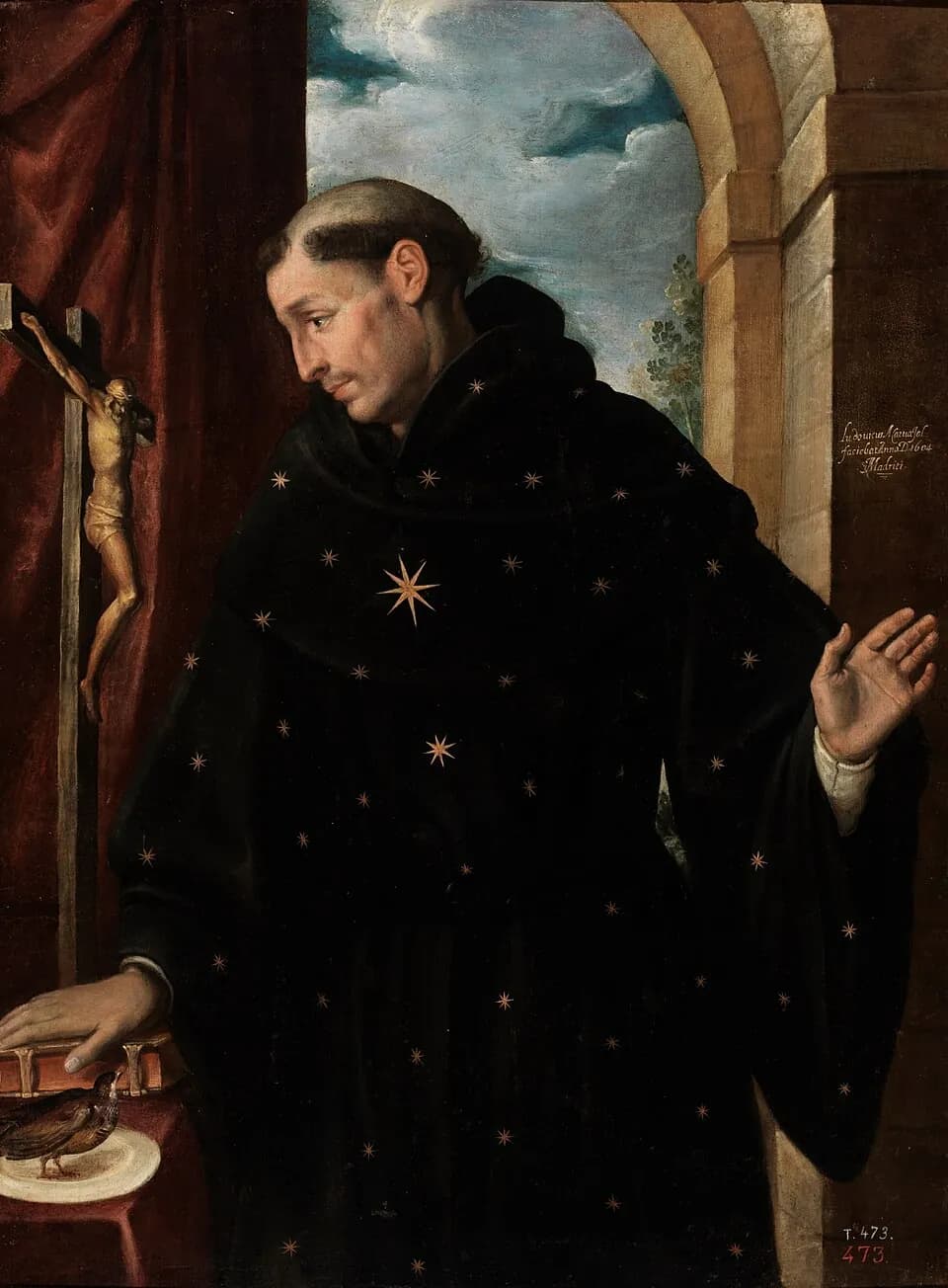
The bread is also in his pictures. The encyclopedia lists his usual emblems as a star above him or on his breast, a lily, or a crucifix wound with lilies, and notes that sometimes "instead of the lily, he holds a vial filled with money or bread." 1
The souls in purgatory
His best-known patronage also comes from a story the Chicago Augustinians introduce with "another story relates." 3 As they tell it, Nicholas heard in his sleep the voice of a friar he had known who had died. The friar said he was in purgatory and urged Nicholas to celebrate the Eucharist for him and the other souls there. Nicholas did so for seven days, and the friar came back to thank him and to tell him that a great number of souls were now with God. 3 "Because of this," they write, "Nicholas was proclaimed patron of the souls in Purgatory." 3
AugNet links to a description of him by the same Chicago province as "remarkable for his spirit of prayer, penance, and devotion to the Holy Souls." 4 None of the sources tie the story to a particular year or name the friar.
Illness, death and canonization
His last years were hard. The encyclopedia says illnesses "tried his patience" near the end, though he kept up his penances almost to the hour of his death. 1 FaithND says he spent his final year sick and got out of bed only once, to hear the confession of a man who would speak to no one else. 5
He died at Tolentino on September 10. 13 Vatican News and the Chicago Augustinians give the year as 1305; the encyclopedia gives 1306. 123 Both readings are recorded here.
Pope Eugene IV canonized him in 1446. 13 The Chicago Augustinians call him the first Augustinian friar canonized after the Grand Union of 1256. 3 His tomb at Tolentino is still venerated, and his remains are kept at the shrine there. 13 AugNet records that the young Raphael painted "The Triumph of Saint Nicholas of Tolentino" around 1503, a work that was later lost in the sixteenth century. 4
What is Saint Nicholas of Tolentino the patron saint of?
Saint Nicholas of Tolentino's feast day
Praying with Saint Nicholas of Tolentino
Most of his life was spent in one place, doing the same things over and over: preaching most days, sitting in the confessional, visiting the sick. 15 The sources record no great office or journey. What they record is thirty years of ordinary pastoral work in a town that FaithND describes as torn by civil discord. 15
The two stories that made him known are both about intercession. One is about bread given to the weak, the other about Masses offered for the dead. 3 The Augustinians have kept his name attached to both, so that when a parish blesses Saint Nicholas Bread or prays for the souls in purgatory, it is doing something he is remembered for doing. 3
Healings and conversions were attributed to him in Tolentino, and FaithND gives what he would say after one of them: "Say nothing of this. Give thanks to God, not to me. I am only an earthen vessel, a poor sinner." 5
His last year was spent ill in bed. 5 The one time he got up, it was to hear one more confession, for someone who would not go to anyone else. 5
Saint Nicholas of Tolentino, pray for us.
Sources
- 1.Edward Garesché, "St. Nicholas of Tolentino," The Catholic Encyclopedia, Vol. 11 (New York: Robert Appleton Company, 1911).
- 2."St. Nicholas da Tolentino, Agostinian," Saint of the Day, 10 September, Vatican News.
- 3."Saint Nicholas of Tolentine," Augustinian Saints and Blesseds, Province of Our Mother of Good Counsel of the Augustinian Order (Midwest Augustinians), Chicago.
- 4."Nicholas of Tolentino," Augustinian Saints, AugNet, Augustinians of the Province of Australasia.
- 5."St. Nicholas of Tolentino," Explore the Saints, FaithND, University of Notre Dame.
Saints to turn to next
Others in this collection who are turned to for some of the same things.
- Saint Charles de FoucauldSeptember 15, 1858 - December 1, 1916ConversionPrayerPoverty and simplicity
- Saint Francis of Assisic. 1181 - October 3, 1226Poverty and simplicityConversionPrayer
- Saint Francis of PaolaMarch 27, 1416 - April 2, 1507PrayerPoverty and simplicity
- Saint Jerome Emiliani1481 or 1486 - February 8, 1537ConversionPoverty and simplicity