Saint Jerome Emiliani
1481 or 1486 - February 8, 1537
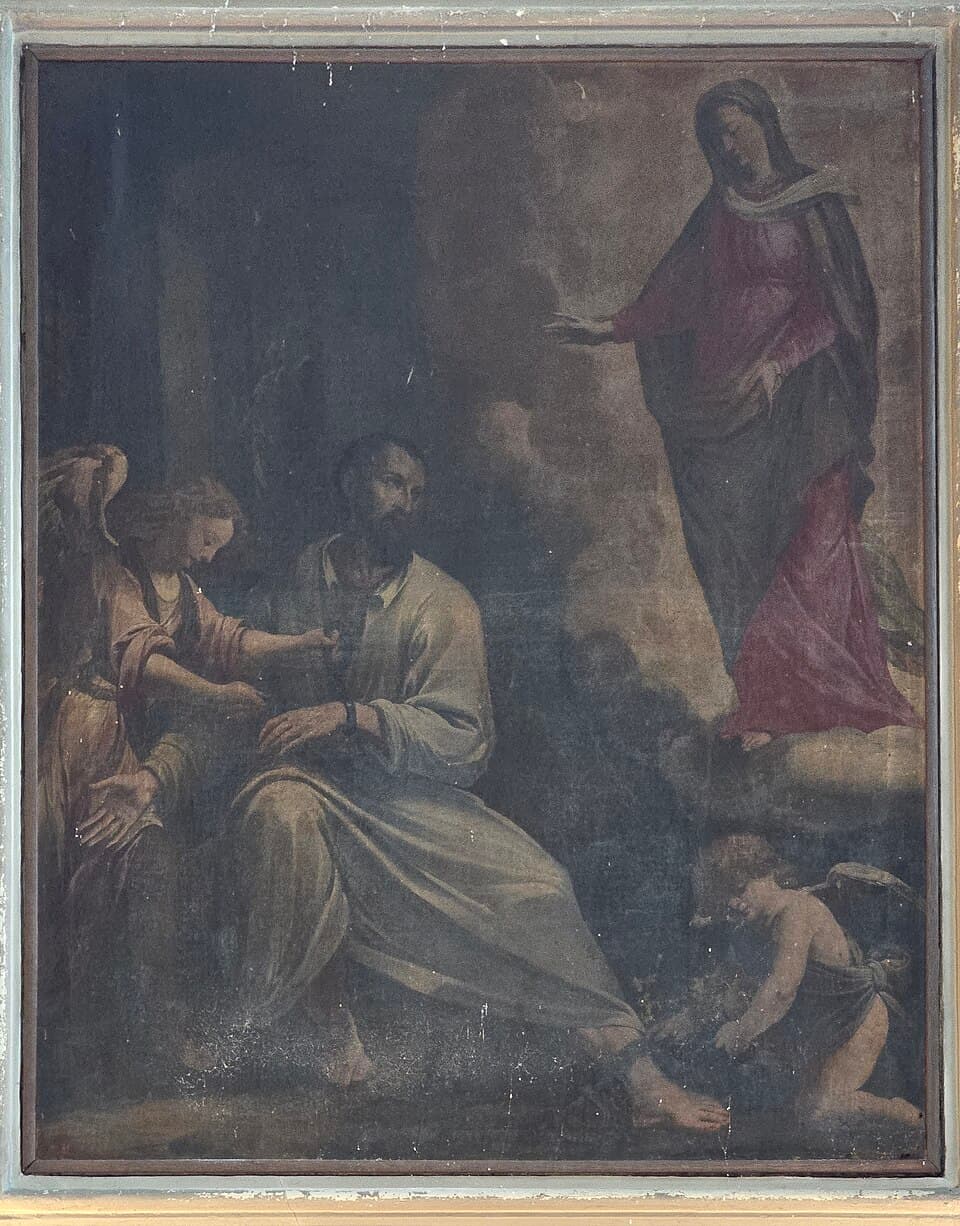
- Patron saint of
- Orphans and abandoned children, named so by Pius XI in 1928 2
- Feast day
- February 8, shared with Saint Josephine Bakhita. The 1913 encyclopedia gives 20 July, since superseded 12
- Before his conversion
- A soldier, and by Franciscan Media's account "careless and irreligious" 2
- What changed him
- Capture and imprisonment in 1508, after defending Castelnuovo against the League of Cambray 12
- Founded
- Orphanages at Brescia and Bergamo, a hospital at Verona, a refuge for former prostitutes, and the Clerks Regular of Somasca in 1532 12
- Canonized
- Beatified by Benedict XIV in 1747; canonized by Clement XIII in 1767 1
Saint Jerome Emiliani was, in Franciscan Media's words, "a careless and irreligious soldier" until he was captured in a skirmish and chained in a dungeon. 2 "In prison Jerome had a lot of time to think, and he gradually learned how to pray." 2 He came out and spent the rest of his life on orphans - houses at Brescia and Bergamo, a hospital at Verona, a refuge for women leaving prostitution - and died of a disease he caught nursing the sick. 12
The dungeon
He was born at Venice, son of Angelo Emiliani - popularly called Miani - and Eleonore Mauroceni. 1 Mershman gives the year as 1481; Franciscan Media's dates put it at 1486, and this page prints both. 12
He joined the army of the Venetian republic, and in 1508 he was defending Castelnuovo against the forces of the League of Cambray. 1 Franciscan Media describes what he was at the time without softening it: "A careless and irreligious soldier for the city-state of Venice, Saint Jerome Emiliani was captured in a skirmish at an outpost town and chained in a dungeon." 2
What happened there is the whole hinge of his life, and it is remarkably undramatic. "In prison Jerome had a lot of time to think, and he gradually learned how to pray." 2 Gradually. No vision, no voice - a bored, frightened soldier with nothing to do, working out how to pray over a period of weeks.
How he got out is where the sources part. Mershman: "Taken prisoner and miraculously liberated, he made a pilgrimage to the shrine of Our Lady of Treviso, in fulfillment of a vow." 1 Franciscan Media says only "When he escaped." 2 A miracle or a jailbreak. What both agree on is that he went straight to a shrine to keep a promise he had made inside.
Ten quiet years
Nothing spectacular followed. He was appointed podesta - the civil governor - of Castelnuovo, and after a short time returned to Venice "to supervise the education of his nephews." 1 Franciscan Media says the same, adding that he "began his own studies for the priesthood." 2
Mershman describes how he spent the rest of his time: "All his spare time was devoted to the study of theology and to works of charity." 1 A man running a household and tutoring his brother's children, reading theology in the evenings, for about a decade.
He was ordained in 1518, and the change in his habits is recorded in a single phrase: "the hospitals and the hovels of the poor were his favourite resorts." 1
The year everything broke
1528 brought plague and famine to northern Italy together. 12 Mershman: "In the year of plague and famine, he seemed to be everywhere." 1 Franciscan Media: "Jerome began caring for the sick and feeding the hungry at his own expense." 2
And the specific thing he noticed was the children. Mershman: he "showed his zeal especially for the orphans, whose number had so greatly increased. He rented a house for them near the church of St. Rose and, with the assistance of some pious laymen, ministered to their wants." 1 An epidemic produces orphans faster than anything else, and he rented a house.
He was also given charge of the hospital for incurables that Cajetan had founded - the two men knew each other, and Cajetan's own profile in this library records the same Venice. 1
Then he resolved, in Franciscan Media's words, "to devote himself and his property solely to others, particularly to abandoned children." 2 The list of what followed is worth setting out city by city, because it is not vague. In 1531 he went to Verona and persuaded the citizens to build a hospital. At Brescia he set up an orphanage. At Bergamo he founded one for boys and another for girls - "Here also he founded the first home for fallen women who wished to do penance." 1 Franciscan Media counts "three orphanages, a shelter for penitent prostitutes and a hospital." 2
Somasca
Two priests, Alessandro Besuzio and Agostino Bariso, joined the work, and in 1532 Jerome founded a religious society with its motherhouse at Somascha, "a secluded hamlet between Milan and Bergamo." 1 It is the Clerks Regular of Somasca, "dedicated to the care of orphans and the education of youth." 2
The rule he wrote says what he thought mattered. Mershman: "Jerome puts down as the principal work of the community the care of orphans, poor, and sick, and demands that dwellings, food and clothing shall bear the mark of religious poverty." 1 The houses were to look like what they were for.
It nearly did not survive him. After his death "his community was about to disband, but was kept together by Gambarana, who had been chosen superior", who obtained Paul III's approval in 1540. 1 In 1547 the members "vainly sought affiliation with the Society of Jesus", then spent eight years united with the Theatines before Pius IV approved them independently in 1563 and Pius V raised them to a religious order. 1 Charles Borromeo was among their patrons and gave them a church at Pavia. 1
Jerome himself did not see any of it. "Jerome fell a martyr to his zeal; contracting a disease at Bergamo, he died at Somascha" on 8 February 1537. 1 Franciscan Media: "Jerome died in 1537 from a disease he caught while tending the sick." 2 He was about fifty.
What is Saint Jerome Emiliani the patron saint of?
Saint Jerome Emiliani is the patron saint of orphans and abandoned children. 2 It is one of the few patronages in this library with a date attached: "In 1928, Pius XI named him the patron of orphans and abandoned children." 2 Not a devotion that grew from below but a formal appointment, four hundred years after his death.
The fit is exact. He did not take up orphans as one work among many; after 1528 it was the work, and the rule he wrote for his order puts the care of orphans first. 12 Anyone running a children's home, fostering, or working in child protection has a patron who did exactly that and organized other people to keep doing it.
He has an unofficial claim on prisoners as well, and on anyone whose life turned in a bad place. Whatever happened in that dungeon, he went in one kind of man and came out another. 12
Saint Jerome Emiliani's feast day
The feast of Saint Jerome Emiliani is February 8, the day he died at Somasca in 1537. Franciscan Media states it precisely: he "shares the celebration of his liturgical feast with St. Josephine Bakhita on February 8." 2
A reader consulting older books will find a different date, and it is worth knowing why. Mershman, writing in 1910, gives "feast, 20 July" in his opening line. 1 That was the date before the calendar reform of 1969 moved him to the anniversary of his death. Both are recorded here; the February date is the one kept now.
The birth year is a genuine disagreement rather than a reform. Mershman gives 1481 and Franciscan Media's dates give 1486, a difference of five years that neither source explains. 12
Praying with Saint Jerome Emiliani
The conversion is the useful part and it is useful because of how ordinary it is. He was not a searching young man; he was a careless soldier who got captured. 2 What changed him was time - weeks in a cell with nothing to do, during which, Franciscan Media says, he "gradually learned how to pray." 2 Gradually. Anyone who has ever concluded that they are not the sort of person to whom anything happens should notice that nothing happened to him either.
Then ten years of nothing much: governing a small town, tutoring his nephews, reading theology in his spare hours, getting ordained at around thirty-five. 12 The dramatic part of his life came twenty years after the dungeon, when the plague arrived. He had spent those twenty years becoming the kind of man who would rent a house for orphans rather than merely feel sorry for them.
What he actually did is worth keeping concrete, because "he helped the poor" evaporates on contact. He got the citizens of Verona to build a hospital. He opened an orphanage at Brescia, two at Bergamo - one for the boys, one for the girls - and a house for women trying to leave prostitution. 1 He wrote a rule requiring that the buildings, the food and the clothing be poor, so that the institution could not drift upward away from the people in it. 1
And he died of the work, at about fifty, of something he caught from somebody he was nursing. 12 His order nearly collapsed immediately afterward and was held together by one man. 1 Four hundred years later a pope handed him every orphaned and abandoned child in the world. 2 He had no way of knowing any of that would hold, and rented the house anyway.
Saint Jerome Emiliani, pray for us.
Sources
Saints to turn to next
Others in this collection who are turned to for some of the same things.
- Saint Charles de FoucauldSeptember 15, 1858 - December 1, 1916ConversionPoverty and simplicitySuffering and illness
- Saint Mary MacKillopJanuary 15, 1842 - August 8, 1909Poverty and simplicitySuffering and illness
- Saint CajetanOctober 1480 - August 7, 1547Poverty and simplicityConversion
- Saint John Francis RegisJanuary 31, 1597 - December 1640Poverty and simplicityConversion