Saint Mary MacKillop
January 15, 1842 - August 8, 1909
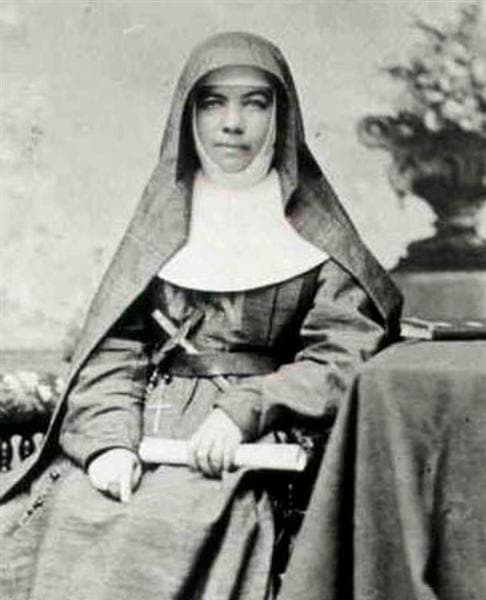
- Feast day
- August 8, the day she died 1
- Born
- Melbourne, 1842, to parents who had emigrated from Scotland, into constant financial struggle 1
- Founded
- The Sisters of St. Joseph of the Sacred Heart - the first women's religious community of that country 12
- Excommunicated
- By her bishop, charged with disobedience. Fifty of her sisters were dispensed from their vows 1
- The real cause
- "The bishop's quarrel was about power and who had authority over whom" 1
Saint Mary MacKillop was excommunicated by her own bishop, who also dispensed fifty of her sisters from their vows. 1 Franciscan Media states what the dispute was actually about: "the bishop's quarrel was about power and who had authority over whom." 1 He rescinded it. She went on to found the first community of religious women in Australia and became its first saint. 12
A school for children nobody was schooling
She was born in Melbourne in 1842 to Scottish emigrants and "grew up in a family that faced constant financial struggles." 1 Drawn to religious life as a young woman, she "could not find an existing order of Sisters that met her needs", so in 1860 she and Father Julian Woods founded one. 1
The Sisters of St. Joseph of the Sacred Heart - the Josephites - were "to staff schools especially for poor children, as well as orphanages, and do other works of charity." 1 Benedict XVI calls it "the first women's community of religious sisters of that country." 2
His description of the work is worth having in full: "She dedicated herself as a young woman to the education of the poor in the difficult and demanding terrain of rural Australia, inspiring other women to join her... She attended to the needs of each young person entrusted to her, without regard for station or wealth, providing both intellectual and spiritual formation." 2
Without regard for station or wealth is not a pious formula here. Franciscan Media records what it meant on the ground: "They served Protestants and Catholics alike. They worked among the aborigines. They taught in schools and orphanages and served unmarried mothers." 1 In nineteenth-century Australia each of those was a separate decision with a cost.
The excommunication
"As the congregation grew, so did Mary MacKillop's problems." 1 Woods "proved unreliable in many ways and his responsibilities for direction of the Sisters were removed." 1 Some local bishops backed her.
One did not. "The bishop in South Australia, aging and relying on others for advice, briefly excommunicated Mary - charging her with disobedience - and dispensed 50 of her Sisters from their vows." 1
Franciscan Media does not leave the charge standing. "In truth, the bishop's quarrel was about power and who had authority over whom. He ultimately rescinded his order of excommunication." 1
What she had refused to concede was structural: "Mary MacKillop insisted that her congregation should be governed by an elected mother general answerable to Rome, not to the local bishop." 1 There were also disputes over whether the congregation could own property. 1
She was right, and it took a long time to be established. "In the end, Rome proved to be Mary's best source of support. After a long wait official approval of the congregation - and how it was to be governed - came from Pope Leo XIII." 1
Begging door to door
"Despite her struggles with Church authorities, Mary MacKillop and her Sisters were able to offer social services that few, if any, government agencies in Australia could." 1 The colony did not have the institutions; the Josephites were them.
"Money, actually the lack of it, was a constant worry. But the Sisters who begged from door to door, were bolstered by faith and by the conviction that their struggles were opportunities to grow closer to God." 1
Benedict XVI names what held her together through the years of conflict: "Despite many challenges, her prayers to St Joseph and her unflagging devotion to the Sacred Heart of Jesus, to whom she dedicated her new congregation, gave this holy woman the graces needed to remain faithful to God and to the Church." 2
Faithful to the Church is the phrase to notice in a paragraph about a woman the Church had excommunicated.
She died in 1909 at sixty-seven, with the congregation thriving. 1 John Paul II beatified her in 1995; Benedict XVI canonized her in 2010, "she became Australia's first saint." 1
What is Saint Mary MacKillop the patron saint of
She belongs to teachers and to Australia. Benedict XVI puts the reach of it plainly: "For many years countless young people throughout Australia have been blessed with teachers who were inspired by the courageous and saintly example of zeal, perseverance and prayer of Mother Mary MacKillop." 2
She also belongs, specifically, to people in conflict with their own institution who intend to stay inside it. That is the hardest position in her story and the one she held.
Saint Mary MacKillop's feast day
Praying with Saint Mary MacKillop
She was excommunicated for disobedience by a bishop whose actual objection was jurisdictional. 1 Fifty of her sisters were released from their vows - not disciplined, released, which is the most effective way to dissolve a congregation without dissolving it. She was in her twenties.
What she did not do is the instructive part. She did not leave, did not found something outside the Church, and did not concede the point. She held that the Josephites answered to Rome rather than to a local bishop, and she waited, and Leo XIII eventually said so. 1 Being right and staying is much harder than being right and going.
Benedict XVI credits Joseph and the Sacred Heart for what got her through. 2 It is worth noticing that neither of those is a strategy. The dispute was about canon law and property and authority, and what she is recorded as doing about it was praying to a carpenter.
And the begging. 1 Sisters going door to door for money, in a colony that had no welfare system, so that children whose parents could pay nothing could go to school. Benedict XVI's phrase for how she taught is the one to keep: "without regard for station or wealth." 2 That is what the money was for.
Saint Mary MacKillop, pray for us.
Sources
Saints to turn to next
Others in this collection who are turned to for some of the same things.
- Saint LawrenceDied August 10, 258CouragePoverty and simplicitySuffering and illness
- Saint Louis de MontfortJanuary 31, 1673 - April 28, 1716Poverty and simplicityCourageSuffering and illness
- Saint BarnabasFirst centuryCourageWork and vocationPoverty and simplicity
- Saint Marianne CopeJanuary 23, 1838 - August 9, 1918CourageSuffering and illnessWork and vocation