Saint Barnabas
First century
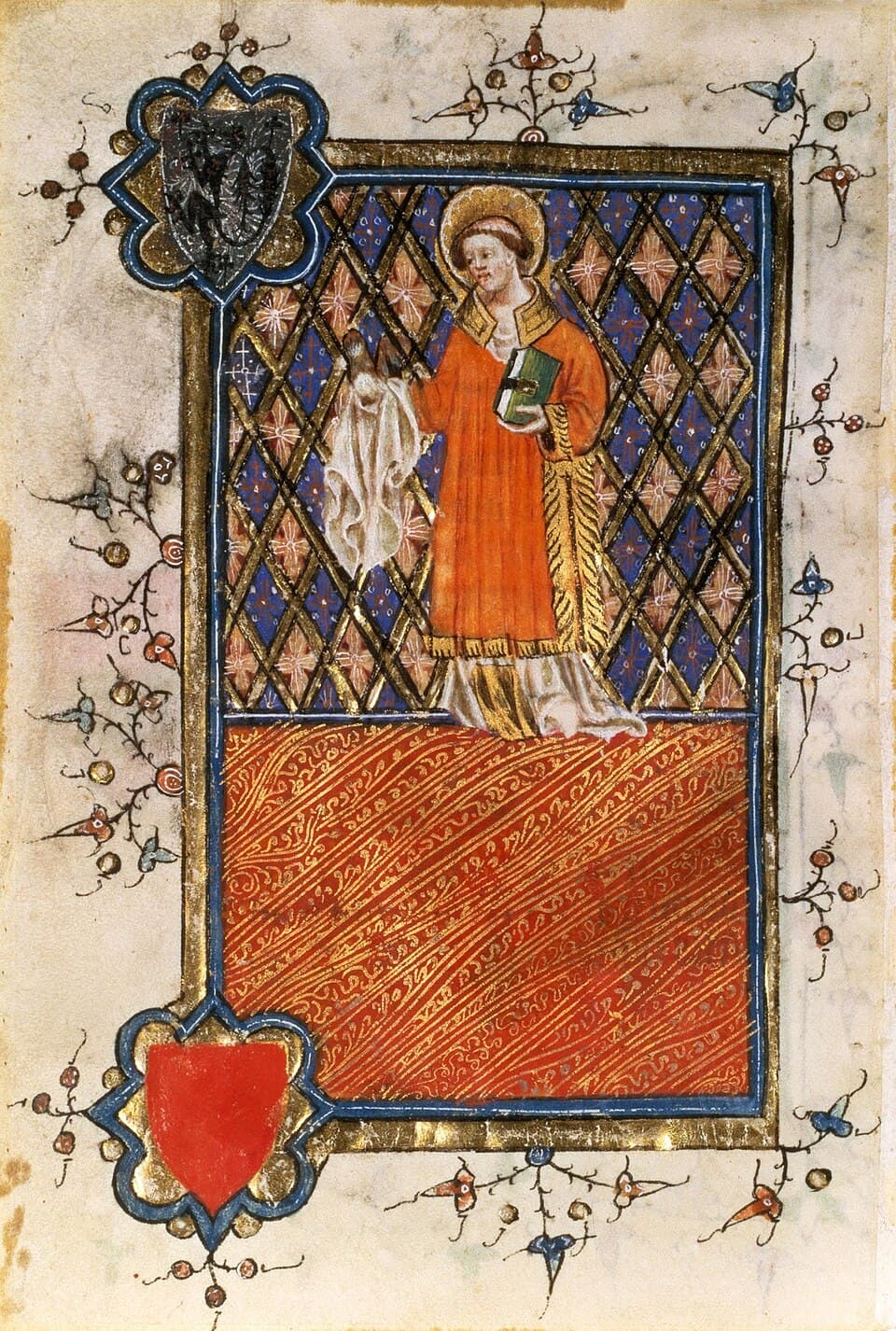
- Feast day
- June 11 1
- Name
- Originally Joseph. Barnabas was a surname the Apostles gave him, read as "son of exhortation" or "consolation" - an etymology Fenlon notes is disputed 12
- Rank
- Fenlon: "styled an Apostle in Holy Scripture, and, like St. Paul, ranked by the Church with the Twelve, though not one of them" 1
- Later traditions
- First Bishop of Milan, preaching at Alexandria and Rome, martyrdom in Cyprus. Fenlon: "all late and untrustworthy" 1
Saint Barnabas is the reason the Church has Saint Paul. When the Jerusalem community would not believe the man who had been hunting them was converted, Barnabas vouched for him; when Paul had withdrawn to Tarsus and gone quiet for years, Barnabas went and got him. 12 They later fell out so badly over a young cousin that they separated - and Benedict XVI says he finds that comforting. 2
A Levite who sold his field
He was born Joseph, of Jewish parents in Cyprus, about the beginning of the Christian era, and he was a Levite. 1 Fenlon infers from that a good deal of time in Jerusalem, probably even before the Crucifixion, and notes he seems to have settled there - where the family of Mark the Evangelist, his relatives, also lived - and to have owned land nearby. 1
There is a tradition, recorded by Clement of Alexandria and Eusebius, that he was one of the seventy disciples. Fenlon calls it "rather late" and says Acts favors a different account: that he was converted shortly after Pentecost, about A.D. 29 or 30, "and immediately sold his property and devoted the proceeds to the Church." 1 Benedict gives the same act in warmer terms: "With immense generosity, he sold a field which belonged to him, and gave the money to the Apostles for the Church's needs." 2
The name came from the Apostles, probably because he could preach - he is later placed first among the prophets and teachers of Antioch. 1 It was read as "son of exhortation" or "son of consolation," though Fenlon adds a caution most retellings drop: "The real etymology, however, is disputed." 1
Fenlon is careful about his standing too, and the distinction is worth keeping. Barnabas is "styled an Apostle in Holy Scripture, and, like St. Paul, ranked by the Church with the Twelve, though not one of them." 1
Standing surety for the persecutor
The episode everything else depends on takes a single verse in Acts and would have been easy to refuse. Saul, who had been hunting Christians, came to Jerusalem after his conversion, and the Church there, Fenlon says, "remembering his former fierce spirit, was slow to believe in the reality of his conversion." 1
Barnabas stood sponsor for him and had him received. 1 Benedict's phrasing puts the risk in it: "It was he who vouched for the sincerity of Saul's conversion before the Jerusalem community that still feared its former persecutor." 2 If he had been wrong, he had introduced an informer to the leadership of a hunted movement.
Then Saul went home to Tarsus and disappeared for years, while Barnabas stayed at Jerusalem. 1 What brought them back together, Fenlon notes with some relish, was an indirect result of Saul's own persecution: in the scattering after Stephen's death, "some Disciples from Cyprus and Cyrene, obscure men," began preaching to Greeks at Antioch. 1
Fenlon draws out what that meant. Those obscure men "inaugurated the real" mission to the Greeks, and it was the scattering caused by Saul's own persecution that produced it. 1 The persecutor drove the Church out of Jerusalem, the Church took the Gospel to Antioch, and Antioch is where Barnabas went to fetch the persecutor and put him to work. The whole sequence turns on consequences nobody intended.
Barnabas was sent to Antioch, and Benedict describes what he did next as the decisive act of his life. He went to Tarsus to find Paul, brought him back, and spent a whole year with him evangelizing the city. 2 "Barnabas realized that Saul's hour had come... Thus, at that important moment, Barnabas, as it were, restored Paul to the Church; in this sense he gave back to her the Apostle to the Gentiles." 2
Whose missionary journey was it?
The Church of Antioch sent the two of them out on what everyone now calls Paul's first missionary journey, through Cyprus and central and southern Anatolia - Attalia, Perga, Antioch of Pisidia, Iconium, Lystra, Derbe. 2
Benedict corrects the label. "In fact, it was Barnabas' missionary voyage since it was he who was really in charge of it and Paul had joined him as a collaborator." 2 The senior man was the one who is now remembered as the assistant.
They went together to the Council of Jerusalem, where the Apostles and elders decided that circumcision would no longer be required. 2 Benedict states what that settled: "It was only in this way that, in the end, they officially made possible the Church of the Gentiles, a Church without circumcision; we are children of Abraham simply through faith in Christ." 2
The quarrel
At the start of the second journey they fell out. Barnabas was determined to bring John Mark; Paul refused, because the young man had abandoned them on the previous trip. 2 Neither gave way, and they separated.
Benedict does not tidy it. "Hence there are also disputes, disagreements and controversies among saints. And I find this very comforting, because we see that the saints have not 'fallen from Heaven'." 2 Two men who had each risked a great deal for the other, unable to agree about a cousin.
Fenlon suggests it came out well, and he is looking at the later evidence. Paul, writing from prison, mentions Mark as a fellow worker, and Fenlon judges that the reconciliation "seems probable." 1 His summary of Barnabas is that the tenderness toward John Mark "seems to have had its reward in the valuable services later rendered by him to the Church." 1 The man Paul would not travel with wrote a Gospel.
Fenlon's estimate of Barnabas overall is striking from a writer usually so dry: "With the exception of St. Paul and certain of the Twelve, Barnabas appears to have been the most esteemed man of the first Christian generation." 1 He notes that Luke, "breaking his habit of reserve, speaks of him with affection, 'for he was a good man, full of the Holy Ghost.'" 1
What is Saint Barnabas the patron saint of?
Neither source used here states a patronage for Saint Barnabas, and this profile does not supply one. 12 Cyprus is the answer usually given, on the strength of the tradition that he was martyred there - and that is one of the traditions Fenlon calls late and untrustworthy, so it is not a foundation this page will build a claim on. 1
Saint Barnabas's feast day
The feast of Saint Barnabas is June 11. 1 Fenlon prints the date in 1907 and it is still the day, which cannot be assumed of an article that old - this batch of profiles has had to correct four pre-reform feast days against a current source. 1 Fenlon also notes two writings attached to his name and is careful about both: Tertullian credits him, "probably falsely," with the Epistle to the Hebrews, and the so-called Epistle of Barnabas "is ascribed to him by many Fathers." 1 Neither is claimed here as his.
Praying with Saint Barnabas
His whole significance is that he was willing to be wrong about somebody. The Jerusalem church had excellent reasons for refusing Saul, and Barnabas overrode them with nothing better than his own judgment of a man. 12 Everything Paul later wrote came through that decision. It is a strange thing to be remembered for and a rare thing to be good at.
He did it twice, which is the part usually missed. Vouching for a convert in a room is one act; going to Tarsus years later to fetch a man who had gone quiet and bringing him back into the work is another. 2 Benedict calls the second one giving the Church back her Apostle to the Gentiles. 2 Nobody asked him to go.
Then he lost the argument about Mark and left. 2 The sources do not present this as a fall or a lesson; Benedict presents it as evidence that sanctity and disagreement are compatible, and says he finds it comforting. 2 Anyone who has fallen out with someone they respect, over something that mattered and could not be split, is in decent company.
What he is not is well documented. Fenlon lists the later traditions and dismisses them in five words, and the famous epistle bearing his name is only ascribed. 1 What remains is a Levite who sold his land, a surname meaning encouragement that may not mean that at all, a judgment about a dangerous man that turned out right, and Luke setting aside his reserve to call him good. 1
Saint Barnabas, pray for us.
Sources
Saints to turn to next
Others in this collection who are turned to for some of the same things.