Saint John Chrysostom
c. 347 - September 14, 407
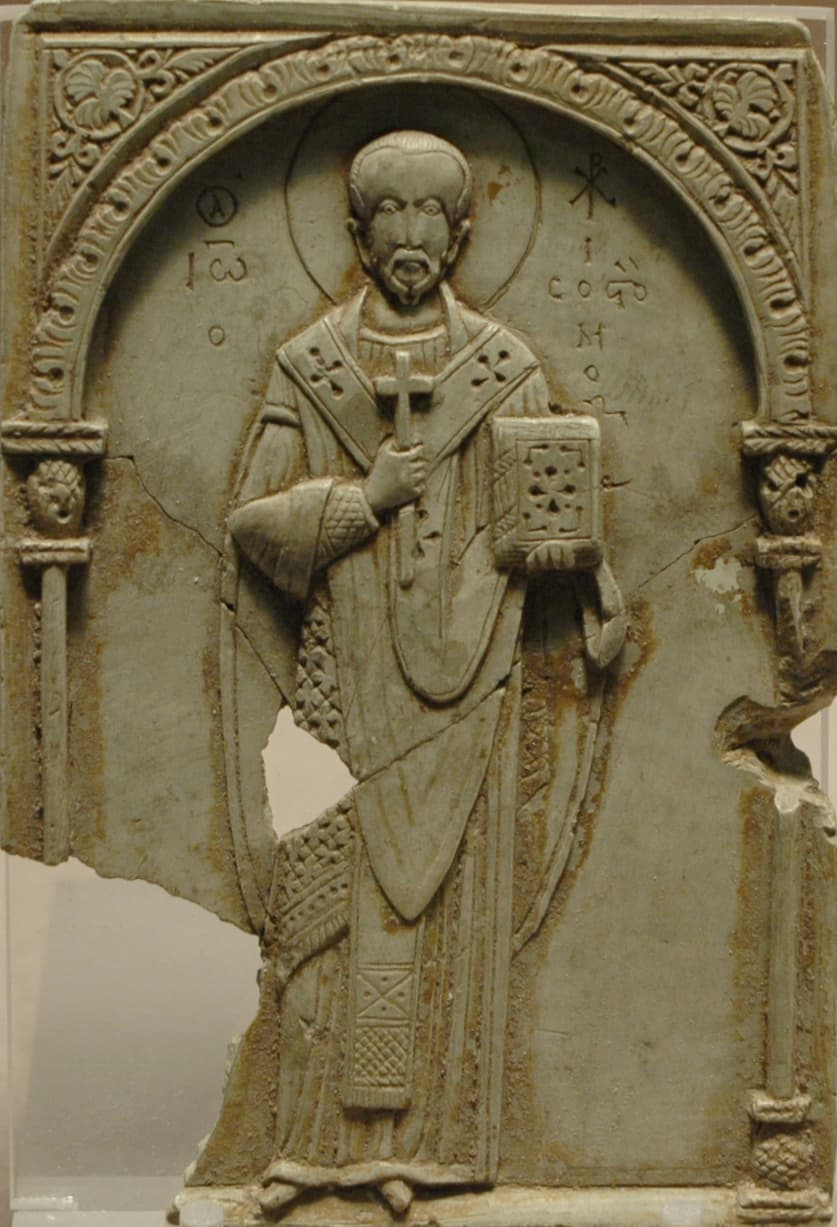
- Feast day
- September 13. He died on September 14, which was already the feast of the Triumph of the Holy Cross 23
- Name
- Chrysostomos, "golden-mouthed," for his eloquence; Baur says the surname first appears in 553 12
- Bishop of Constantinople
- From 397, after about eleven years as a priest at Antioch 2
- Wrote
- 17 treatises, more than 700 authentic homilies, commentaries on Matthew and Paul, and 241 letters 2
- Proclaimed
- Patron of the Second Vatican Council by Blessed John XXIII 3
Saint John Chrysostom was the greatest preacher the Greek Church produced, and he was killed by a walk. 12 Sentenced to exile at the far edge of the empire, he was marched from Cucusus toward Pityus, a place he never reached, on a journey Benedict XVI calls what it was: "his condemnation to exile was a true death sentence." 3 He got as far as Comana, was carried into a martyr's chapel, and died there on September 14, 407. 3
Antioch, and how he learned to talk
He was born at Antioch, then the second city of the Eastern empire and a place where, as Baur describes it, pagans, Manichaeans, Gnostics, Arians, Apollinarians and Jews were all actively making converts. 1 His father Secundus, a high-ranking officer in the Syrian army, died soon after the birth, and his mother Anthusa was widowed at twenty with two children. 1 Baur says she was a woman of intelligence and character who sent him to the best schools in the city. 1 Benedict credits her with instilling "exquisite human sensitivity and a deep Christian faith." 2
His teacher was Libanius, a pagan and the most famous rhetorician of the age, under whom Benedict says John became "the greatest orator of late Greek antiquity." 2 The nickname came later and stuck harder than his name: Chrysostomos, golden-mouthed, which Baur notes appears for the first time in a document of Pope Vigilius in 553, nearly a century and a half after his death. 1
Before any of the preaching, he tried to leave. Baptized in 368 and trained by Bishop Meletius, he withdrew for four years to the hermits on Mount Silpius and then spent two more alone in a cave under an old hermit, giving himself to the Gospels and above all to the letters of Paul. 2 It ruined his health. He fell ill, could not care for himself, and had to come back to Antioch. 2 His biographer Palladius reads the illness as providential, and Benedict agrees that it returned him to his actual vocation - John wrote later that if forced to choose between the troubles of Church government and the quiet of monastic life he would have taken pastoral service "a thousand times." 2
The year 387 is the one Benedict calls his heroic year. The people of Antioch, protesting a tax, pulled down the emperor's statues, and the city waited through Lent for the reprisal everybody expected. 2 John preached the 22 Homilies on the Statues into that fear. 2 Ten quieter years of pastoral work followed, and then in 397 he was made Bishop of Constantinople, which ended the quiet permanently. 2
What a bishop can be disliked for
He began by reforming his own household. The austerity of the episcopal residence was meant as an example to clergy, monks, courtiers and the rich, and Benedict notes the predictable result: "many of those he criticized distanced themselves from him." 3 He was an effective administrator who built charitable institutions and was called "the Almoner" for his attention to the poor. 3 To some people, Benedict says, these initiatives "made him a dangerous rival." 3
The charges accumulated from several directions at once, and it is worth listing them because the popular version reduces the whole affair to one quarrel with an empress. He removed six bishops in Asia in 401 who had been improperly appointed, and was accused of exceeding his jurisdiction. 3 He sheltered Egyptian monks whom Patriarch Theophilus of Alexandria had excommunicated. 3 He criticized the Empress Eudoxia and her courtiers, who answered with slander. 3 He objected to festivities in her honor as sumptuous pagan celebrations, and expelled the priests responsible for the baptisms at the Easter Vigil in 404. 3 Theophilus organized the synod that condemned him in 403, and after a brief first exile and a return, the persecution of Chrysostom and his followers began in earnest. 3
He wrote to Innocent I, Bishop of Rome, and Benedict records the outcome without softening it: "it was already too late." 3 The pope was convinced of his innocence and powerless to help. 3 The council Rome wanted, to make peace between the two halves of the empire and their Churches, never happened. 3 In 406 he was exiled again, to Cucusus in Armenia, and then moved on toward Pityus - a journey designed, Benedict says, to prevent the faithful from visiting him and to break a worn-out man. 3 It worked.
He was buried at Comana beside the martyr Basiliscus in whose chapel he died, "one martyr next to the other." 3 Theodosius II rehabilitated him in 438. 3 His relics went to the Church of the Apostles in Constantinople, were taken to Rome in 1204, and now rest in the chapel of the Choir of the Canons in St Peter's; in 2004 John Paul II gave a large part of them back to the Patriarch of Constantinople. 3 His last recorded words were "Glory be to God for all things." 3
The preaching itself
Benedict is clear about what kind of theologian he was, which is the kind that does not usually get called one. "He was not a speculative theologian." 2 What he was instead is a witness to the Church's tradition during the Arian controversy, and a pastor whose entire concern was the fit between what is said and how it is lived. 2 Near death he wrote that the value of a human being lies in "exact knowledge of true doctrine and in rectitude of life" - and Benedict's gloss is that the two go together, because knowledge has to be expressed in a life. 2
A surprising amount of it is about families. He treated a person's growth as a series of seas in one ocean, beginning with childhood: "it is precisely at this early age that inclinations to vice or virtue are manifest," so God's law should be impressed on the soul from the outset "as on a wax tablet." 2 Adolescence he called the sea "where violent winds blow." 2 When the first child arrives, the child is "like a bridge," and the three become "a family, a Church in miniature." 2 Benedict comments that his teaching on the lay faithful in family and society "is still more timely than ever today." 2
In Constantinople the preaching turned structural. Commenting on Acts, he held up the primitive community as a pattern for the city, and Benedict says the point was not more almsgiving but a new social model: "it is not enough to give alms, to help the poor sporadically, but it is necessary to create a new structure." 3 Against the Greek idea of the polis, where whole populations had no access to citizenship, he set a city in which all are brothers and sisters with equal rights, and upheld the primacy of the individual person "even of the slave and the poor person." 3 Benedict concludes that Chrysostom "truly became one of the great Fathers of the Church's social doctrine." 3
What is Saint John Chrysostom the patron saint of?
Neither the encyclopedia nor Benedict XVI states a patronage for Saint John Chrysostom, and this profile does not invent one. 12 He is commonly named as patron of preachers and orators, which fits the man but is not in these sources. What is sourced is a different sort of patronage: Benedict records that Blessed John XXIII proclaimed him Patron of the Second Vatican Council. 3 Baur calls him "generally considered the most prominent doctor of the Greek Church and the greatest preacher ever heard in a Christian pulpit." 1
Saint John Chrysostom's feast day
The feast of Saint John Chrysostom is September 13. 3 He died on September 14, and the one-day gap has a reason: that date was already the feast of the Triumph of the Holy Cross. 3 Benedict XVI gives the death date and the memorial date within a few lines of each other, which is the clearest warning available that a death date and a feast day are different things. 3
Praying with Saint John Chrysostom
He is easy to admire from a distance and would have been difficult to live with. He cut the household budget, told the rich what they were, removed bishops, and would not attend the empress's parties. 3 Every one of those is defensible and every one made an enemy, and together they got him walked to death across Asia Minor. The sources do not present this as a miscalculation, and they do not present it as costless either.
What he actually preached about, most of the time, was ordinary life. How to raise a small child, what marriage is for, why a family is a church in miniature, what to do with money. 23 The man remembered for golden eloquence spent it on the household rather than on abstractions, and Benedict thinks that is the part still worth having.
His late writing has a quality that is hard to fake. From exile at what he called "the most remote place in the world," he returned to the theme he had begun with in 386: that God's plan for humanity is "indescribable and incomprehensible" and certainly guided by love. 3 He could not unravel the details of what was happening to him. He said the plan was loving anyway, and that God desires the salvation of everyone. 3
Then there is the last sentence. Carried into a chapel at Comana at the end of a march meant to kill him, John Chrysostom said "Glory be to God for all things," and died. 3 Benedict calls it his last testament. 3 It is not a summary of a comfortable life, and it is not offered here as one.
Saint John Chrysostom, pray for us.
Sources
Saints to turn to next
Others in this collection who are turned to for some of the same things.