Saint Martin of Tours
c. 316 - 397
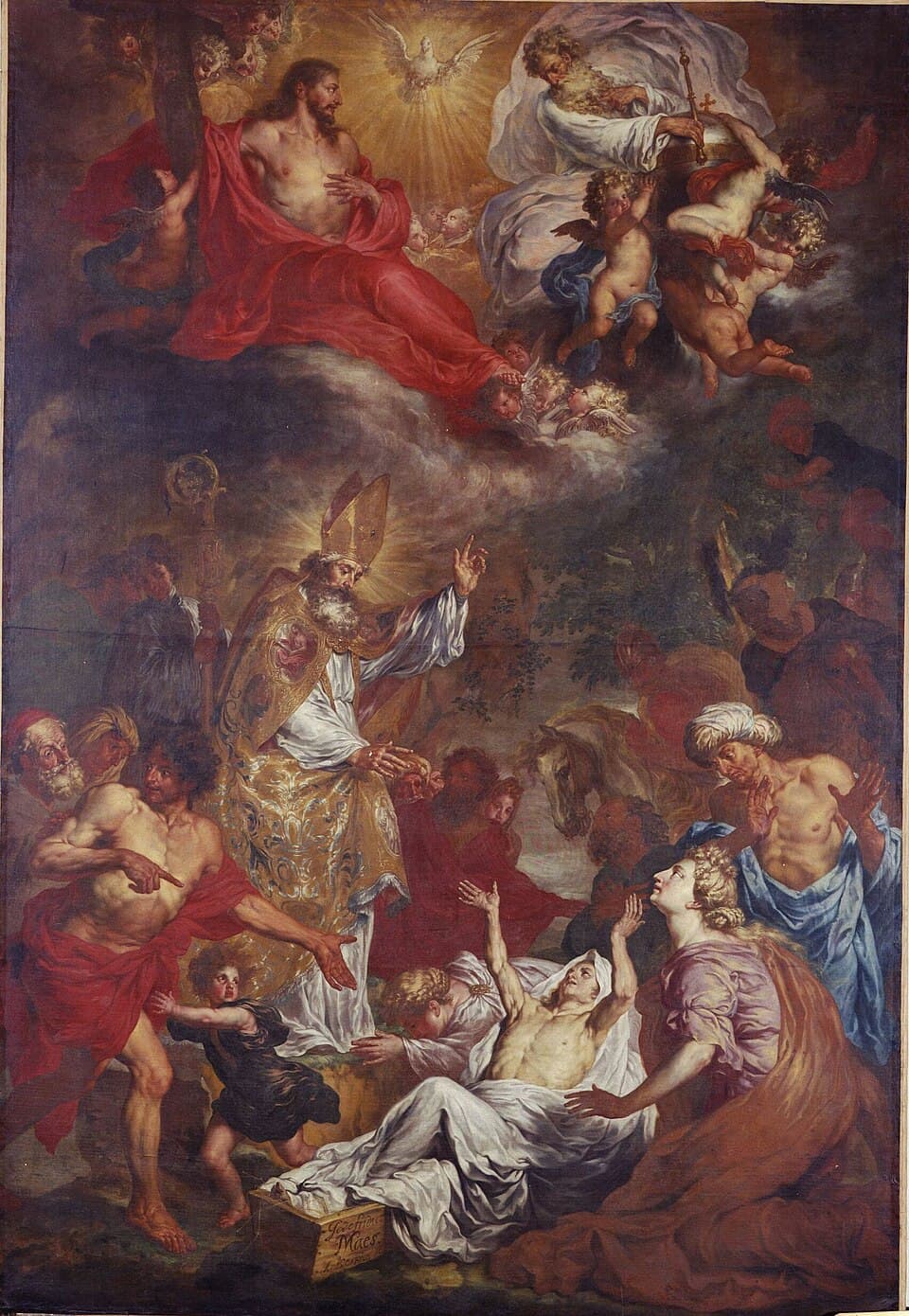
- Patron saint of
- Neither source assigns a patronage. He is patron of soldiers, of beggars and of France 12
- Died
- At Candes in Touraine, most probably in 397 1
- Refused to fight
- At twenty-three, and was discharged "after great difficulties" 2
Saint Martin of Tours was conscripted at fifteen because his father was a soldier, and at twenty-three he told his commander to give his bonus to the men who were going to fight, because he would not. 12 He wanted to be a monk and was tricked into a bishopric. 1 As bishop he argued that heretics should not be executed, was accused of heresy for it, and lost - the man he was defending was killed anyway. 2
The cloak, before he was even baptized
He was born at Sabaria in Pannonia - modern Szombathely, in Hungary - about 316, to pagan parents, and was brought up at Pavia in Italy where his father, a military tribune, had been posted. 12 "When he reached adolescence [he] was, in accordance with the recruiting laws enrolled in the Roman army." 1 Franciscan Media says he "was forced at the age of 15 to serve." 2 He did not choose the career; he inherited it by law.
He was drawn to Christianity early, "which had been in favour in the camps since the conversion of Emperor Constantine." 1 Franciscan Media: "It was said that he lived more like a monk than a soldier." 2
His regiment was sent to Amiens, and Clugnet gives the episode plainly: "At the gates of the city, one very cold day, Martin met a shivering and half-naked beggar. Moved with compassion, he divided his coat into two parts and gave one to the poor man." 1
The detail that matters is when. "Martin, who was still only a catechumen, soon received baptism." 1 He was not yet a Christian when he cut the cloak. He was baptized at eighteen. 2
The half he kept became "the famous relic preserved in the oratory of the Frankish kings under the name of 'St. Martin's cloak'." 1 Half a soldier's coat, cut in the road at Amiens by a man who was not yet baptized, ended up as the most venerated relic of the Frankish monarchy.
The refusal
At twenty-three he was offered a war bonus, and Franciscan Media preserves what he said.
"I have served you as a soldier; now let me serve Christ. Give the bounty to those who are going to fight. But I am a soldier of Christ and it is not lawful for me to fight." 2
Note what he did not say. He did not condemn the other soldiers or refuse the pay out of contempt; he asked that it go to the men who were staying. It is a refusal without a sneer in it.
"After great difficulties, he was discharged", and Clugnet records that he was "finally freed from military service at Worms on the Rhine." 12 The phrase "after great difficulties" is doing a lot of work - a man refusing to fight in a Roman army was not simply released.
Franciscan Media's own summary of him opens on this note: "A conscientious objector who wanted to be a monk; a monk who was maneuvered into being a bishop; a bishop who fought paganism as well as pleaded for mercy to heretics - such was Martin of Tours, one of the most popular of saints and one of the first not to be a martyr." 2
Hilary, exile, and a Gallic Thebaid
Free at last, "he hastened to set out to Poitiers to enrol himself among the disciples of St. Hilary." 1 Hilary of Poitiers has his own page in this library, and this is where the two lives cross.
Wanting to see his parents, Martin crossed the Alps into Lombardy, where Arianism was entrenched. He "did not conceal his faith" and "was very badly treated by order of Bishop Auxentius of Milan, the leader of the heretical sect in Italy." 1 Then, learning that Hilary had himself been exiled to the East, Martin took shelter on the island of Gallinaria in the Tyrrhenian Sea. 1 Both men were driven out of their countries in the same controversy.
When an imperial decree let Hilary come home, Martin went straight to him at Poitiers in 361 and asked permission to live as a solitary nearby, at a place now called Liguge. 1
It did not stay solitary. "His example was soon followed, and a great number of monks gathered around him. Thus was formed in this Gallic Thebaid a real laura, from which later developed the celebrated Benedictine Abbey of Liguge." 1 Franciscan Media calls it "what may have been the first French monastery." 2
He stayed about ten years, and kept leaving. He went out "to preach the Gospel in the central and western parts of Gaul, where the rural inhabitants were still plunged in the darkness of idolatry." 1 Clugnet adds an observation worth keeping: "The memory of these apostolic journeyings survives to our day in the numerous local legends of which Martin is the hero and which indicate roughly the routes that he followed." 1 The folklore of the French countryside is a map of where he walked.
Tricked into a bishopric
When the Bishop of Tours died in 371 or 372, the clergy wanted the hermit of Liguge. "But, as Martin remained deaf to the prayers of the deputies who brought him this message, it was necessary to resort to a ruse to overcome his resistance." 1
A rich citizen named Rusticius "went and begged him to come to his wife, who was in the last extremity, and to prepare her for death. Without any suspicions, Martin followed him in all haste, but hardly had he entered the city when, in spite of the opposition of a few ecclesiastical dignitaries, popular acclamation" made him bishop. 1
Franciscan Media identifies what the objecting dignitaries objected to: "Some of the consecrating bishops thought his rumpled appearance and unkempt hair indicated that he was not dignified enough for the office." 2 He had come straight from a hermitage and looked like it.
Priscillian
The hardest episode of his life is the one that reads most strangely to a modern reader, because he was on the side that lost.
Franciscan Media: "Along with Saint Ambrose, Martin rejected Bishop Ithacius's principle of putting heretics to death - as well as the intrusion of the emperor into such matters." 2 Two bishops, in the fourth century, arguing both that heresy should not be a capital matter and that the state had no business judging it.
"He prevailed upon the emperor to spare the life of the heretic Priscillian. For his efforts, Martin was accused of the same heresy, and Priscillian was executed after all." 2
He won the argument, extracted the promise, was smeared for it, and the man died regardless. Then "Martin then pleaded for a cessation of the persecution of Priscillian's followers in Spain." 2 Having failed, he went back and asked again for the next people in line.
And Franciscan Media records the compromise honestly. "He still felt he could cooperate with Ithacius in other areas, but afterwards his conscience troubled him about this decision." 2 He kept working with the man who had pushed for the executions, and it bothered him for the rest of his life.
He died at Candes in Touraine, most probably in 397. 1 His followers begged him not to leave them, and Franciscan Media gives the prayer he made: "Lord, if your people still need me, I do not refuse the work. Your will be done." 2
What is Saint Martin of Tours the patron saint of?
Neither Clugnet nor Franciscan Media assigns Saint Martin a patronage in these entries. 12 He is in practice the patron of France, of soldiers, and of beggars - and the last two together are the whole of him.
The soldiers have him because he was one, conscripted, and served until he could not. The beggars have him because of the cloak. 12 It is worth noticing that both patronages come from the same afternoon at the gate of Amiens: the man on the horse and the man in the road.
He is also a reasonable patron for conscientious objectors, and for anyone who has taken a position on principle, been accused of bad faith for it, and watched the thing they were trying to prevent happen anyway. 2
Saint Martin of Tours's feast day
The feast of Saint Martin of Tours is November 11. 12 Martinmas was for centuries one of the great markers of the northern European year - the end of the harvest, the start of the winter fast, the day rents fell due - and the date is older and more deeply embedded in European life than almost any other in this library.
Clugnet places his death at Candes "most probably in 397" and declines to be more precise. 1 The birth is given as "about 316." 1
He is one of the earliest saints venerated as a saint who was not a martyr, which Franciscan Media notes: "one of the first not to be a martyr." 2 Before him, holiness in the calendar had largely meant being killed.
Praying with Saint Martin
The cloak is famous and half-remembered. What is usually left out is that he was not yet baptized when he did it. 1 He was a catechumen, a man under instruction, who had not finished becoming a Christian - and the act everyone remembers came before the membership. It is worth telling anyone who feels they must be fully sorted out before they are allowed to do any good.
The refusal at twenty-three is the model of how to say no. He did not denounce the army, he did not keep the money and complain, and he did not claim to be better than the men around him. He asked that his bonus go to the people who were staying to fight, and said what he was instead. 2 Then he took whatever "great difficulties" meant, for as long as it took.
Priscillian is the part to sit with, because it does not resolve. Martin was right, argued well, got a promise from an emperor, and a man was killed anyway - and Martin was called a heretic for trying. 2 He did not withdraw in disgust; he immediately started pleading for the next group. And then he went on cooperating with the bishop who had wanted the executions, which troubled his conscience afterward, and Franciscan Media does not pretend otherwise. 2 Most moral failures look exactly like that: not a betrayal, a continued working relationship that you cannot later feel clean about.
His last recorded words are the least dramatic imaginable and the most useful. "Lord, if your people still need me, I do not refuse the work. Your will be done." 2 Not a request to stay and not a request to go. A man of eighty offering to keep going if required, and leaving the decision alone.
Saint Martin of Tours, pray for us.
Sources
Saints to turn to next
Others in this collection who are turned to for some of the same things.