Saint Andrew
First century
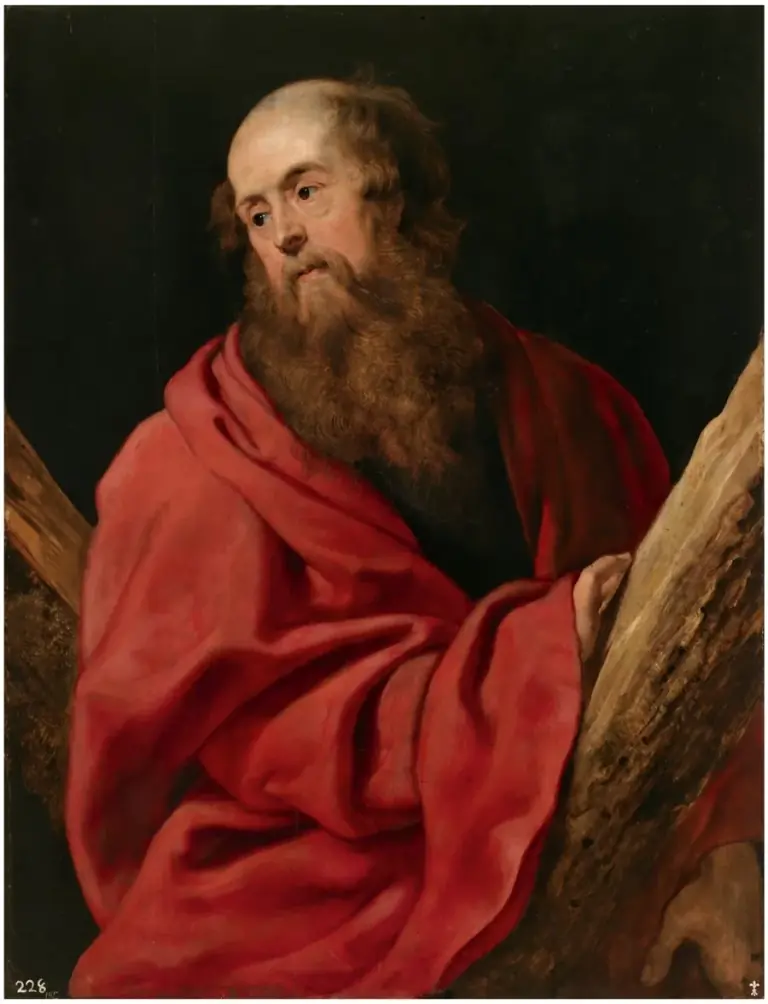
- Patron saint of
- Fishermen, Greece, Russia, and Scotland 3
- Known as
- The Protoclete, the first called 1
- Brother
- Simon Peter, whom Andrew brought to Jesus 1
- Trade
- A fisherman of Bethsaida, on the Sea of Galilee 1
- Died
- Crucified at Patras in Achaia by the governor Aegeas 2
Andrew heard John the Baptist point at Jesus and call him the Lamb of God, and he went. Then he found his brother Simon and brought him along. Everything the Church has built on Peter began with Andrew fetching him, which is a strange kind of importance to have, and it is the kind most people actually get.
The first one called
Andrew was a fisherman from Bethsaida, east of the Sea of Galilee, working the lake with the family of Zebedee. 1 His name is Greek, which Benedict XVI reads as a sign that the household was open to the wider world around it.
He had been a disciple of John the Baptist first. When John identified Jesus as the Lamb of God, Andrew followed, and the tradition calls him Protoclete, the first called. 1 Almost immediately he went and found Simon, told him they had found the Messiah, and brought him. 1
The small offering
When the crowd needed feeding, it was Andrew who noticed the boy with five barley loaves and two fish, and who pointed out that it was not going to be enough. 1 He was right about the arithmetic. He brought it forward anyway.
Later, when some Greeks asked to see Jesus, they came to Philip, and Philip went to Andrew. 1 Twice in the Gospel he is the one who carries somebody else toward Christ, which is the pattern of his whole life.
Patras
After Pentecost, while Peter went to Rome, Andrew preached among the Greek-speaking peoples. 1 He was crucified at Patras in Achaia on the order of the governor Aegeas. 2
Tradition has it that his cross was the diagonal one now called Saint Andrew's, though the 1913 encyclopedia notes the evidence for that detail is no older than the fourteenth century. 2 What the tradition also preserves is what he is supposed to have said to it: take me, carry me far from men, and give me back to my Teacher. 1
What is Saint Andrew the patron saint of?
Andrew is the patron saint of fishermen, and of Greece, Russia, and Scotland. 3 The 1913 encyclopedia notes that Russia and Scotland honor him as their chief patron. 2
The fishermen belong to him and not to Peter, which is worth saying because the two are constantly swapped. Both brothers worked the same boat. Only one of them got the patronage.
Saint Andrew's feast day
His feast falls on November 30 in both the Latin and the Greek calendars. 2 In the Western Church it usually opens the run-up to Advent.
Praying with Saint Andrew
Andrew is the one who fetched Peter. 1 Everyone knows what became of Peter; almost nobody thinks about who walked him over. If your part in something turns out to be the introduction rather than the work, that is not a smaller part, and Andrew is the evidence.
He brought forward five loaves knowing perfectly well they would not stretch. 1 He did not wait until he had enough to be worth offering. That is most of what anybody has to give on any given day.
Twice he appears in the Gospels doing the same thing: carrying somebody toward Jesus. 1 Not arguing them there. Walking them over.
He died a long way from home, on the wrong side of the empire, while his brother was in Rome. 12 Not every vocation gets the visible half.
Saint Andrew, pray for us.
Sources
Saints to turn to next
Others in this collection who are turned to for some of the same things.