Saint Paul
First century
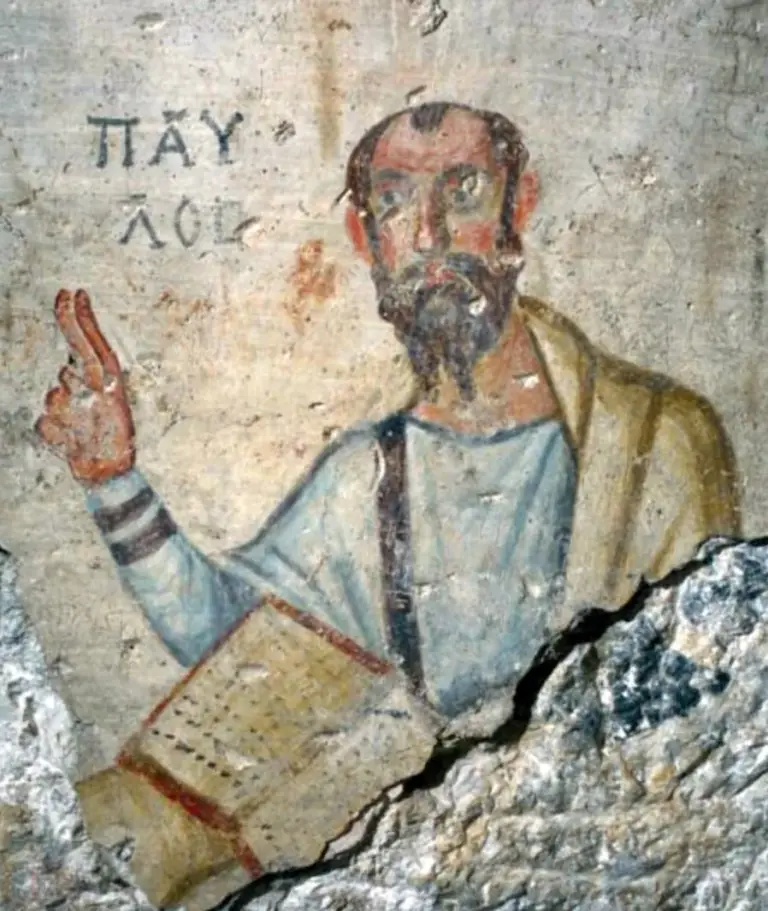
- Patron saint of
- Greece 3
- Feast day
- June 29, with Saint Peter 2
- From
- Tarsus, between Anatolia and Syria; a Jew of the diaspora 1
- Trained
- In the Mosaic Law at Jerusalem, under Rabbi Gamaliel 1
- Trade
- Tent-making 1
- Died
- Martyred at Rome under Nero 1
Saint Paul spent the first part of his adult life hunting down Christians and the rest of it as the most consequential missionary in the history of the Church. He did not drift toward the faith or reason his way in. He was stopped on a road, and he described what happened not as a decision he made but as something done to him: Christ, he wrote, "made me his own."
Tarsus, Jerusalem, and a trade
Paul came from Tarsus, on the crossing between Anatolia and Syria - a Jew of the diaspora, raised outside Palestine and formed by both worlds. 1 He studied the Mosaic Law at Jerusalem under the great Rabbi Gamaliel, and he learned to make tents. 1
The trade matters. It is why he could arrive in a strange city with nothing and support himself while he preached, and it is the reason the greatest theologian of the New Testament spent his working hours doing manual labor.
The persecutor
He found the Christian message unacceptable, and as a zealous Jew he "felt the duty to persecute the followers of Christ even outside of Jerusalem." 1 This was not indifference or casual hostility. It was conviction, acted on with energy - which is exactly what he later brought to the other side.
Damascus
Around A.D. 30, on the road to Damascus, he met the risen Christ. 1 Paul's own way of describing it is not the language of conversion as a choice: Christ, he says, "made me his own." Benedict XVI calls it "an unforeseeable, divine grace" that redirected his entire life. 1
Franciscan Media puts the consequence plainly - that encounter became the force behind everything that followed, the missionary work and the willingness to be killed for it. 2
The journeys, and the letters
He traveled from Antioch to Cyprus, through Asia Minor and into Europe, working in Ephesus, Philippi, Thessalonica and Corinth, and hoping to reach Spain, "the Far West." 1 He was building churches in cities that had never heard of Christ, at the pace of a man who thought the time was short.
His letters are the earliest Christian writing we have, and they give more direct access to his personality than we have to almost anyone else in the ancient world. 1 The sentence that carries the whole of him: "The love of Christ impels us... so that those who live might live no longer for themselves but for him." 1
He was martyred at Rome under Nero, giving what Benedict XVI calls "the supreme witness of blood," and stands as "the greatest model of perseverance." 1
What is Saint Paul the patron saint of?
Franciscan Media names Paul patron of Greece, and lists Peter and Paul together for the same. 3 Beyond that, no individual patronage is stated by the sources cited here, which is worth saying rather than filling in.
Saint Paul's feast day
Paul is honored with Saint Peter on June 29, the Solemnity of the Holy Apostles Peter and Paul. 2
Praying with Saint Paul
Paul persecuted the Church out of real conviction, not indifference. 1 Being sincere turns out to be no protection at all against being wrong, and his life is the evidence that finding it out need not finish a person.
He never described his conversion as a decision. Christ made me his own, he wrote, and Benedict XVI calls it an unforeseeable grace that turned his whole life around. 1 If your faith does not feel like a conclusion you reasoned your way to, Paul never claimed his was either.
He made tents to pay for the mission. 1 The apostle to the Gentiles had a day job, and it is in Scripture.
Benedict XVI calls him the greatest model of perseverance, and they killed him at the end of it. 1 He is not a saint for people who expect endurance to be rewarded promptly. The love of Christ impels us, he wrote, so that we live no longer for ourselves. 1 Pushed from behind by something he had not generated.
Saint Paul, pray for us.
Sources
Saints to turn to next
Others in this collection who are turned to for some of the same things.
- Saint Ansgar801 - February 865CourageConversionWork and vocation
- Saint Bonifacec. 675 - June 5, 754CourageWork and vocationConversion
- Saint Francis SolanoMarch 10, 1549 - July 14, 1610Work and vocationCourageConversion
- Saint Gaspar del BufaloJanuary 6, 1786 - December 28, 1837CourageConversionWork and vocation