Saint Ansgar
801 - February 865
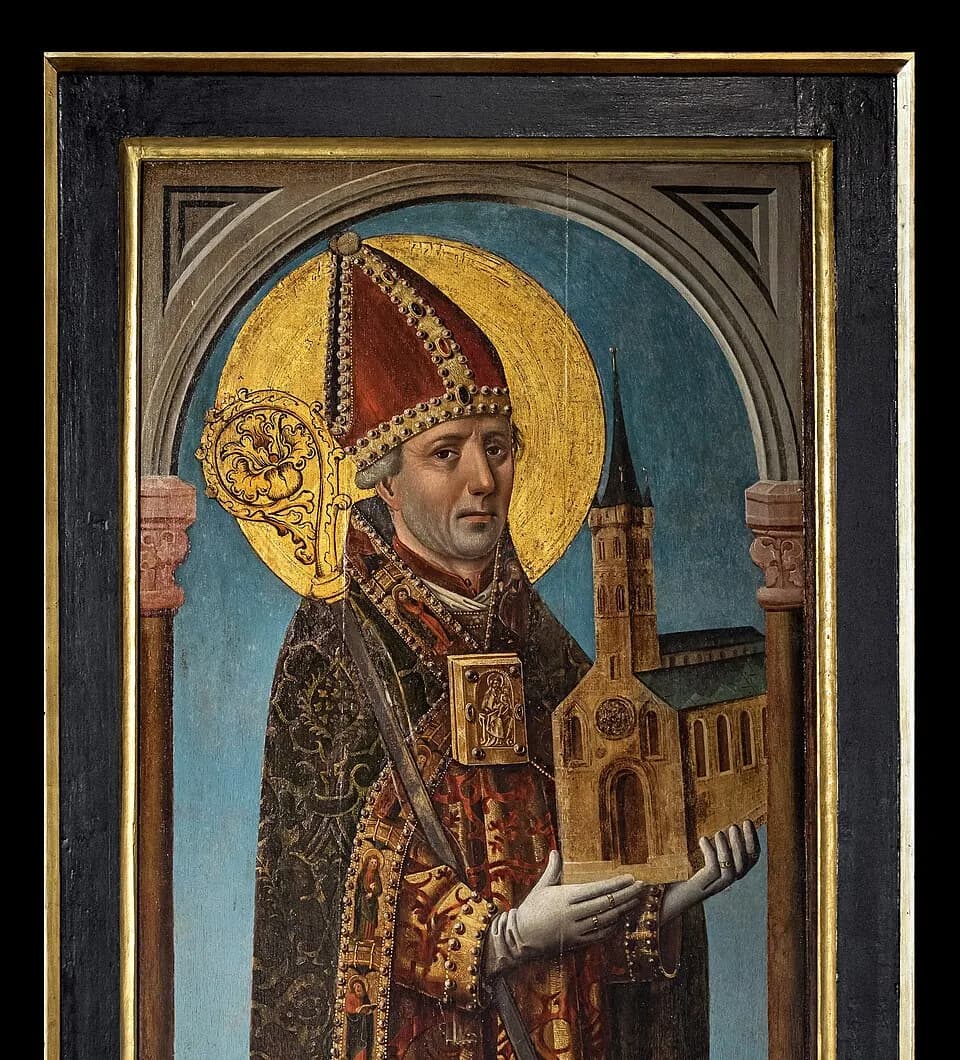
- Patron saint of
- Denmark 4
- Born
- 801; the 1913 encyclopedia gives Picardy and September 8, which Robinson says was a later translation date 124
Saint Ansgar was a Benedictine monk of Corbie who, in the 820s, volunteered for a mission nobody else at the emperor's court would take, and spent the rest of his life trying to plant the Church in Denmark and Sweden. 12 He became the first archbishop of Hamburg, lost the city to raiders in 845, and died at Bremen in 865 with both missions still fragile; Franciscan Media calls him the "apostle of the north." 124 His feast, shared with Saint Blaise, is February 3. 456
A boy at Corbie
He was born in 801. 12 The 1913 encyclopedia places his birth in Picardy on September 8; the translator of Rimbert's life, Charles Robinson, says September 8 was really the date his relics were moved in Bremen, and that both his birthday and birthplace are unknown. 12
Rimbert, his disciple and successor, wrote his life soon after his death; the 1912 Catholic Encyclopedia praises it for "a faithful character sketch." 3 He says Ansgar's mother died when he was about five. 1 He was a playful pupil until he dreamed that he was stuck in a miry place while his mother passed by in the company of a woman he took to be the Virgin Mary, who told him that to join them he must "flee from every kind of vanity." 1 Cardinal Pietro Parolin, preaching in Copenhagen in 2026, said he entered Corbie "still a child" and moved at twenty to the new monastery of Corvey. 7 Robinson dates the move to 822, and Rimbert makes him the first master of its school. 1
Rimbert records one vision at length. Ansgar dreamed he had died and been led by Saint Peter and Saint John the Baptist into an unending light, where a voice told him, "Go and return to Me crowned with martyrdom." 1 He spent the rest of his life expecting to be killed for the faith. 12
Denmark and Sweden
The opening came through politics. Harald Klak, an exiled Danish king, was baptized at the court of the Emperor Louis the Pious, and Louis wanted a monk to go home with him. 17 Rimbert says nobody at court would volunteer until Wala, abbot of Corbie, named Ansgar, who accepted at once; the abbot would order no one to go, and only the monk Autbert offered to join him. 1 Ansgar and Autbert founded a school for twelve or more boys, and after about two years Autbert fell ill and died. 1 The encyclopedia says Harald's "intemperate zeal" ended in his second expulsion and the missionaries' return. 2 Franciscan Media sums up the Danish years as three years of work "without noticeable success." 4
Around 829 Swedish envoys told the emperor that many of their people wanted Christian priests, and Ansgar went. 1 On the way pirates took their ships, the royal gifts and nearly forty books, and some wanted to turn back; Ansgar, Rimbert says, would not. 1 The king at the trading town of Birka let them preach, and Herigar, the town's prefect and a royal counselor, was baptized and built a church on his own land. 12 They returned after a year and a half. 12
Hamburg, and losing it
Louis then founded a see at Hamburg, on the far side of the Elbe, as a base for the northern missions, and Gregory IV made Ansgar his legate to the Swedes, Danes and Slavs. 12 The sources differ on his title. Rimbert says he was consecrated archbishop from the start; the encyclopedia calls Hamburg a bishopric and makes him "the first archbishop" only once its union with Bremen was confirmed in 857. 12 To support the poor new see, the emperor gave it the abbey of Turholt in Flanders, where Ansgar trained Danish and Slav boys he had bought or ransomed. 1 Franciscan Media adds that he was made abbot of New Corbie. 4
In 845 Hamburg was sacked. Rimbert calls the attackers pirates; the encyclopedia names Eric, King of Jutland, with 600 ships. 12 His church, monastery and books burned, and he escaped, Rimbert says, without even a cloak, repeating Job: "The Lord gave, the Lord has taken away." 1 By then Louis had died, Charles the Bald had taken Turholt, and Ansgar's monks drifted away for lack of money, while Sweden and Denmark, Franciscan Media says, fell back into paganism. 124 Louis the German eventually gave him the vacant see of Bremen, and over the objections of the bishop of Cologne, Pope Nicholas I joined Hamburg and Bremen into one archdiocese; Robinson dates the decree to 858. 12
Starting again
With Bremen's income he went back north. Rimbert says he won the friendship of Horic, king of the Danes, by serving repeatedly as the German king's envoy, and was allowed to build a church at Schleswig. 12 Around 852 he sailed to Birka again, carrying Horic's word that he had "never before in his life seen so good a man." 1 The Swedish king would not decide without the gods and the people; Rimbert reports that lots were cast and fell for the Christians, and two assemblies agreed. 1 The encyclopedia says "the oracles" gave a favorable answer, "probably due to the prayers of the saint"; Franciscan Media calls it "the strange device of casting lots." 24
A younger Horic later allowed the church a bell, which, Rimbert notes, the pagans had held to be unlawful, and gave land for a church at Ribe. 1 The encyclopedia credits Ansgar with introducing the use of bells and with persuading the king to mitigate the slave trade. 2 When Christians in his own diocese sold fugitive captives, Rimbert says, he went in person and had them traced and freed. 1 Parolin, preaching in 2026, said that the first thing Ansgar did in the north was to redeem the freedom of some slaves. 7
The bishop at home
Rimbert describes a man who wore sackcloth, measured his bread and water, made nets while he sang the psalms, and wrote a short prayer for each psalm. 12 He founded a hospital for the poor at Bremen, gave a tenth of his income to the poor, carried coins in his belt so no one had to wait for an almoner, and washed the feet of the poor. 124 When people spoke in his presence of the healings attributed to him, Rimbert reports, he answered: "Were I worthy of such a favour from my God, I would ask that he would grant to me this one miracle, that by His grace He would make of me a good man." 1
A death in bed
In 864 he fell ill with dysentery. 1 Rimbert says the illness grieved him, because he had expected martyrdom and took its absence as a judgment on his sins; his closest disciple argued with him about it again and again without comforting him, until, standing at Mass, he heard a voice rebuke him for doubting God's promise. 1 He asked to die on the feast of the Purification, had three candles set before the altars of Mary, Peter and John the Baptist, and on the morning after the feast, repeating "Into Thy hands, O Lord, I commend my spirit," died at Bremen. 14 Robinson dates it to February 3, 865, as does Franciscan Media. 14 The encyclopedia's article on Ansgar gives February 5, and its article on Rimbert February 2. 23
Rimbert ends by arguing that his master was a martyr after all, because "there are two kinds of martyrdom," one hidden and one seen, and Ansgar "desired both kinds of martyrdom, but one only did he attain." 1 Franciscan Media notes that Sweden was pagan again for two centuries after he died. 4
What is Saint Ansgar the patron saint of?
Franciscan Media names one patronage for Saint Ansgar: Denmark. 4 In January 2026 Cardinal Parolin, as papal legate, celebrated Mass in Copenhagen's cathedral for the twelfth centenary of his Danish mission. 7 In Sweden, John Paul II, preaching at Vadstena in 1989, said he wished "to mention some of the first apostles and missionaries in Scandinavia," and in the Swedish passage that followed named Sankt Ansgar among them. 8 None of the sources consulted names Sweden or Scandinavia as a formal patronage, so this page does not.
Saint Ansgar's feast day
Praying with Saint Ansgar
By any count he could have kept, most of his work failed. The first Danish mission ended in an expulsion, his first Swedish church lost its priests, his cathedral burned, his income was taken away, and Sweden went back to its old gods after he died. 124 Parolin put it plainly in Copenhagen: he "faced enormous opposition and seemed to fail, but success was not what he sought." 7 Rimbert's record is of a man who started again each time with what he had left.
He also went because he was asked. Rimbert is careful to say that his abbot would order no one to live among pagans, and that Ansgar said yes twice, to Denmark and then to Sweden. 1 What followed was mostly diplomacy and waiting: years as an envoy, gifts to kings, assemblies and lots. 12
His prayer, in Rimbert's picture, was ordinary and constant: psalms sung over his nets, a prayer for each psalm, Mass several times a day. 1 The line people remember from him is a request, made while others talked about his miracles, to be made a good man. 1
And he did not get the death he had wanted. He spent his last months grieving that he would die of an illness rather than for the faith, and Rimbert does not hide it. 1 What brought him peace, in his biographer's telling, was not an argument from a friend but being told to trust a promise he could no longer see a way to. 1
Saint Ansgar, pray for us.
Sources
- 1.Rimbert, Life of Anskar, the Apostle of the North, 801-865, translated with notes by Charles H. Robinson (London: SPCK, 1921), Internet Medieval Sourcebook, Fordham University.
- 2.Thomas Campbell, "St. Anschar," The Catholic Encyclopedia, vol. 1 (New York: Robert Appleton Company, 1907).
- 3.Klemens Löffler, "St. Rimbert," The Catholic Encyclopedia, vol. 13 (New York: Robert Appleton Company, 1912).
- 4."Saint Ansgar," Saint of the Day, Franciscan Media.
- 5.Saint of the Day, February 3: "St. Blaise, Bishop of Sebaste and Martyr" and "St. Ansgar, Bishop of Hamburg and Bremen, Apostle of Scandinavia," Vatican News.
- 6.Liturgical Calendar for the Dioceses of the United States of America 2025, Committee on Divine Worship, United States Conference of Catholic Bishops (February 3).
- 7.Lorena Leonardi, "Cardinal Parolin in Denmark: Church's credibility is not from power, but witness," Vatican News, January 27, 2026.
- 8.John Paul II, Homily at Holy Mass in the courtyard of Vadstena Castle, Sweden, June 10, 1989.
Saints to turn to next
Others in this collection who are turned to for some of the same things.
- Saint Bonifacec. 675 - June 5, 754CourageWork and vocationConversion
- Saint Francis SolanoMarch 10, 1549 - July 14, 1610Work and vocationCourageConversion
- Saint John EudesNovember 14, 1601 - August 19, 1680Work and vocationConversionCourage
- Saint John of Capistrano1385 or 1386 - October 23, 1456CourageConversionWork and vocation