Saint Boniface
c. 675 - June 5, 754
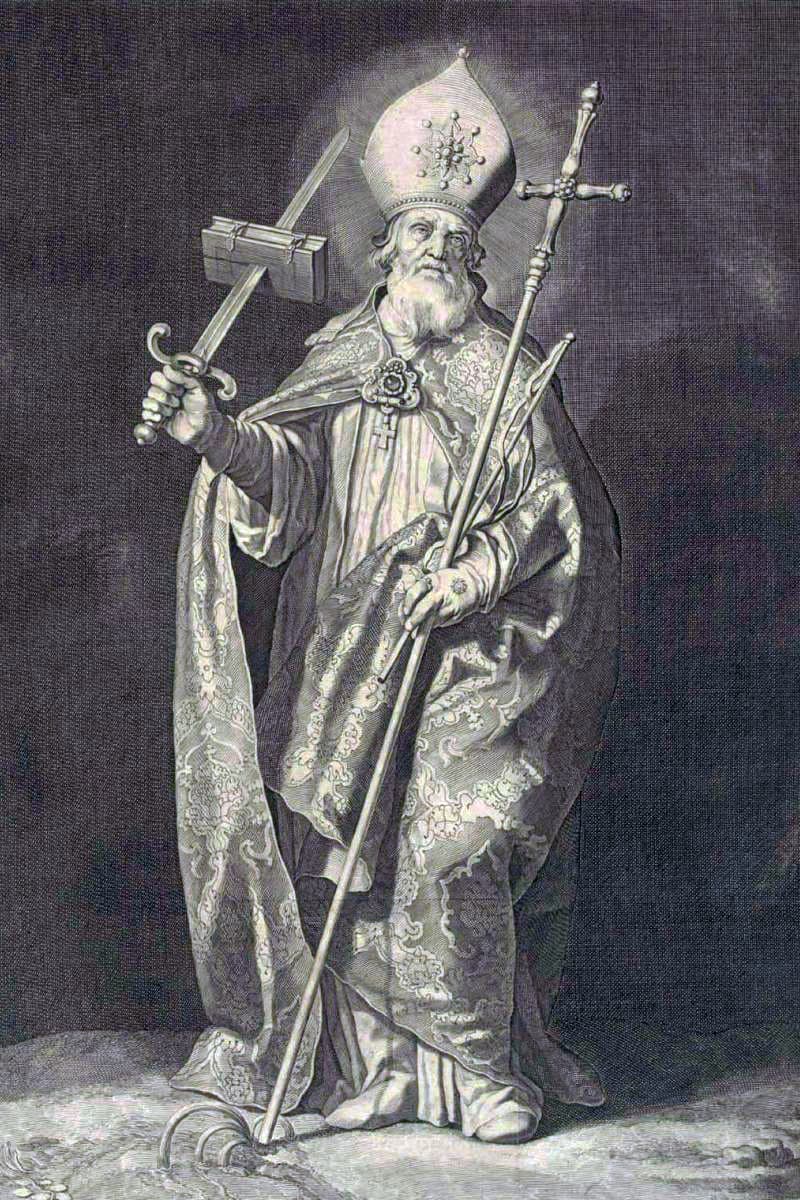
- Born
- England, probably Wessex - Crediton in Devon, by later authors. His name was Winfrid 1
- Refused
- His own abbey in 717, and the see of Utrecht, because the pope had sent him to preach 1
- Sent
- By Gregory II on 15 May 719, to the heathens of Germany east of the Rhine 1
- Died
- With fifty-three companions in Frisia, while preparing converts for confirmation 2
- His emblems
- The oak, the axe, and a book pierced by a sword 1
Saint Boniface was an English monk with a career in front of him - a scholar, a schoolmaster, elected abbot of his own house at about forty - and he turned all of it down to go and preach to pagans in Germany. 1 He is remembered for cutting down Thor's sacred oak at Geismar, and the point of that story is what did not happen next. 1 Thirty years later he was killed in Frisia with fifty-three companions. 2
Winfrid of Wessex
He was born Winfrid in England, probably in south-western Wessex; Mershman notes that "Crediton (Kirton) in Devonshire is given by more modern authors", and that the year is equally uncertain - "not born before 672 or 675, or as late as 680." 1
His family was noble and meant him for the world. What changed it was visitors: he was "inspired with higher ideals by missionary monks who visited his home", and "after much difficulty he obtained his father's permission" to enter religion. 1
He turned out to be a scholar. At Nutshalling under Abbot Winbert he lived "an austere and studious life", excelling "especially in the profound understanding of scriptures, of which he gives evidence in his letters", and was also well taught in history, grammar, rhetoric and poetry. 1 He was put in charge of the monastic school and ordained priest at thirty. 1
And then Mershman states the thing that makes him unusual: "With every prospect of a great career and the highest dignities in his own country, he had no desire for human glory, for the thought of bringing the light of the Gospel to his kindred, the Old Saxons, in Germany, had taken possession of his mind." 1
He went to Frisia in 716 and had to come back almost at once because of a war. 1 Then, at the end of 717, his abbot died and the monks elected Winfrid to succeed him. He "declined and induced Daniel, Bishop of Winchester, to influence the monks to elect another." 1 Franciscan Media: he "gave up being elected abbot to devote his life to the conversion of the Germanic tribes." 2
A commission, and what he found
He went to Rome in the autumn of 718 with an open letter of recommendation. Gregory II received him, questioned him "in various conferences as to the orthodoxy of Winfrid, his morals, and the purity of his motives", and on 15 May 719 gave him "full authority to preach the Gospel to the heathens in Germany to the right of the Rhine" - with two conditions: keep to Roman practice in baptism, and consult the Holy See when in difficulty. 1
What he found was worse than pagan. Franciscan Media: "Paganism was a way of life. What Christianity he did find had either lapsed into paganism or was mixed with error. The clergy were mainly responsible for these latter conditions since they were in many instances uneducated, lax and questionably obedient to their bishops. In particular instances their very ordinations were questionable." 2
Mershman fills in the detail. In Thuringia, which Rome believed to be Christian, Kilian "had laboured with energy, but without success"; two converted dukes had been murdered; and "great numbers of their rebellious subjects had lapsed into heathenism, or a mixture of Christianity and idolatry." 1 Some of the clergy he met had never been ordained at all, and others had been ordained by bishops outside the Church. 1
He spent three years in Frisia first, under the aged Willibrord, "travelling about with tireless energy and preaching fearlessly", and thousands were reconciled or baptized. 1 Willibrord, feeling his age, tried to make Winfrid his successor at Utrecht. He refused, "giving as his main reason that the pope had sent him for missionary work." 1
He took one thing from that period: a boy of fourteen or fifteen named Gregory, from an abbey near Trier, who traveled with him and later became abbot at Utrecht. 1
The oak at Geismar
Summoned back to Rome, he was consecrated a regional bishop on 30 November 722 and given the name Boniface. 1 Mershman is careful even about the name: some say he took it at his profession, others at his first visit to Rome, and the derivation is disputed - "perhaps it is only an approximate Latinization of Wyn-frith." 1 Gregory II sent letters demanding obedience for the new bishop, and one to Charles Martel asking his protection. 1
That letter mattered more than the sermons. Franciscan Media records Boniface's own view: he "later admitted that his work would have been unsuccessful, from a human viewpoint, without a letter of safe-conduct from Charles Martel, the powerful Frankish ruler, grandfather of Charlemagne." 2 The apostle of Germany knew what was keeping him alive.
Then the episode everyone remembers. "To show the heathens how utterly powerless were the gods in whom they placed their confidence, Boniface felled the oak sacred to the thunder-god Thor, at Geismar, near Fritzlar." 1
The argument was not the axe. It was the silence afterward: "The heathens were astonished that no thunderbolt from the hand of Thor destroyed the offender, and many were converted." 1 He had staked his life on an absence, in front of a crowd, and nothing happened.
"He had a chapel built out of the wood and dedicated it to the prince of the Apostles." 1 Mershman's verdict: "The fall of this oak marked the fall of heathenism." 1
Building something that would hold
What he did next is less famous and mattered more. He was not trying to win arguments; he was trying to leave behind a church that could run without him.
He founded a monastic cell at Amoneburg "as a kind of missionary centre in which native clergy were to be educated" - German priests, trained in Germany. 1 Franciscan Media names the two principles behind everything: "to restore the obedience of the clergy to their bishops in union with the pope of Rome", and "the establishment of many houses of prayer which took the form of Benedictine monasteries." 2
Gregory III sent him the pallium and made him an archbishop, "but still without a fixed see" - a metropolitan with no cathedral, which is an unusual arrangement and exactly suited to a man building dioceses. 1 After a year in Rome he came back "invested with the authority of a legate of the Holy See." 1 Fulda, the greatest of his foundations, was established under his supervision. 1
He also had to clean up. At Mainz the bishop, Gewilieb, "led a very irregular life and had killed the slayer of his father, who was his predecessor in the episcopal office" - and was deposed. 1 A bishop who had avenged his father, who had been bishop before him.
And he brought people. "A great number of Anglo-Saxon monks and nuns followed him to the continent, where he introduced the Benedictine nuns to the active apostolate of education." 2 English women crossing to Germany to teach.
Frisia, again
At the end of his life he went back to the place he had failed in first. Frisia had defeated him in 716; he returned to it as an old man.
Franciscan Media: "During a final mission to the Frisians, Boniface and 53 companions were massacred while he was preparing converts for confirmation." 2 He was killed mid-service, with his catechumens around him.
Mershman dates it 5 June, and puts the year in brackets that acknowledge the dispute: "martyred 5 June, 755 (754)." 1 Franciscan Media gives 754. 2
He was buried at Fulda, and "his grave soon became a sanctuary, to which the faithful came in crowds especially on his feast and during the Octave." 1 Portions of his relics went to Louvain, Mechlin, Prague, Bruges and Erfurt. 1
Mershman lists his emblems: "the oak, axe, book, fox, scourge, fountain, raven, sword." 1 The book and the sword are usually shown together - a gospel-book with a blade driven through it, which is how Cornelis Bloemaert engraved him.
What is Saint Boniface the patron saint of?
Saint Boniface is the patron saint of Germany, whose apostle he is called in the opening line of his encyclopedia entry. 12
He is also a natural patron for missionaries, and for teachers - he was a schoolmaster before he was anything else, and the first thing he built in Germany was a place to train local clergy rather than a place to preach at them. 1
And he belongs to people who turn down promotion. He refused his own abbey and a bishopric, both times to keep doing the work he had been sent to do. 1
Saint Boniface's feast day
The feast of Saint Boniface is June 5, the day he was killed in Frisia. 12
The year is not settled between the sources. Mershman writes "martyred 5 June, 755 (754)", carrying both possibilities in a single line, and Franciscan Media gives 754. 12 Both are recorded here. The day is not in doubt.
His birth cannot be dated at all. Mershman will say only that he was "not born before 672 or 675, or as late as 680", which is why this page gives it as about 675. 1
Praying with Saint Boniface
He is the patron of people who leave a good position to do something harder and less distinguished. Boniface was a scholar with a school, in a settled country, elected abbot by men who knew him - and he arranged for somebody else to have it. 1 Then he was offered a bishopric by a dying saint and refused that too, on the grounds that he had already been given a job. 1 Twice, the honorable thing on offer was not the thing he had been sent to do.
The oak is worth understanding properly, because it is usually told as a display of nerve. The nerve is real, but the argument he was making is subtler: he was betting publicly that nothing would happen. 1 He did not out-argue the worshippers of Thor. He gave them an experiment, and then stood in the silence with them.
What he built afterward is the part to imitate and the part nobody remembers. A training center for local clergy before anything else; Benedictine houses as the infrastructure; English nuns brought over to teach; a corrupt bishop removed. 12 He assumed he would not be there forever and built for the version of the Church that would have to continue without him.
And he was honest about the scaffolding. He knew the mission ran on a Frankish warlord's letter of protection and said so - from a human viewpoint, it would have failed without it. 2 There is no pretense in him that the work was floating free of politics and power. He used what was available and went back, in the end, to the country that had beaten him the first time, and died there.
Saint Boniface, pray for us.
Sources
Saints to turn to next
Others in this collection who are turned to for some of the same things.
- Saint Francis SolanoMarch 10, 1549 - July 14, 1610Work and vocationCourageConversion
- Saint John EudesNovember 14, 1601 - August 19, 1680Work and vocationConversionCourage
- Saint John of Capistrano1385 or 1386 - October 23, 1456CourageConversionWork and vocation
- Saint PaulFirst centuryConversionCourageWork and vocation