Saint Francis Solano
March 10, 1549 - July 14, 1610
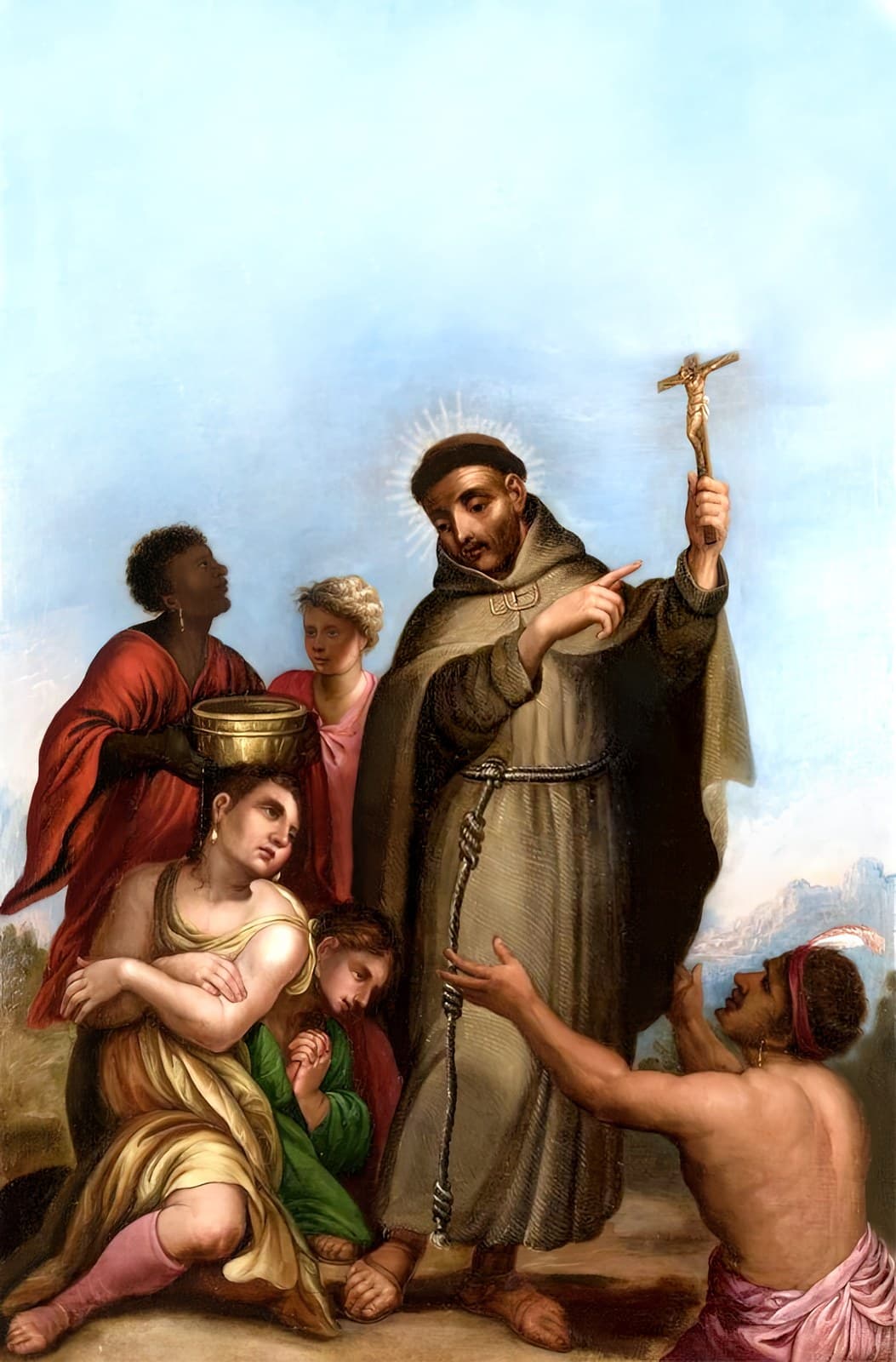
- Born
- Montilla, in the diocese of Cordova, March 10, 1549 1
- Asked to go
- To the African missions. He was sent to South America instead 2
- Carried
- A violin, and played for the sick when he visited them 2
- Preached against
- The Spanish colonists, in Lima, from about 1601 2
Saint Francis Solano was so admired for nursing the sick through an epidemic that he became embarrassed and asked to be sent to Africa to get away from it. 2 He was sent to South America instead, and spent twenty years in what is now Argentina, Bolivia and Paraguay, learning the languages and playing his violin for people who were ill. 12 Then he was called to Lima, where the job was the other way round: telling the Spanish colonists to live as though they had been baptized. 2
Embarrassed into the missions
He came from a leading family in Andalusia, and the first thing Franciscan Media records about him is an act of nerve in adolescence: "Perhaps it was his popularity as a student that enabled Francis Solano in his teens to stop two duelists." 2 Donovan gives the parents' names and says they were "distinguished no less for their noble birth than for their virtue and piety." 1
He entered the Franciscans at twenty and was later master of novices. 12 Then an epidemic, and the response to how he handled it: "His care for the sick during an epidemic drew so much admiration that he became embarrassed and asked to be sent to the African missions." 2
The request was granted and redirected. "Instead he was sent to South America in 1589." 2 He sailed from Spain, landed at Panama, crossed the isthmus on foot and took another ship down to Peru. 1
Twenty years, and the languages
Donovan summarizes the two decades in one sentence built entirely out of negatives: "he spared no fatigue, shrank from no sacrifice however great, and feared no danger that stood in the way of evangelizing the vast and savage regions of Tucuman and Paraguay." 1 The adjective is his, and belongs to 1909.
Franciscan Media describes the reception differently and more specifically: "While working in what is now Argentina, Bolivia, and Paraguay, Francis quickly learned the local languages and was well received by the indigenous peoples." 2 He learned the languages, and then he was welcome.
Donovan makes a larger claim about the same ability and flags it as report rather than fact: "Notwithstanding the number and difficulty of the dialects spoken by the Indians, he learned them all in a very short time, and it is said that he often addressed tribes of different tongues in one language and was understood by them all." 1 Note the "it is said". The plain version - that a man who arrived at forty learned several unrelated languages well enough to preach in them - is remarkable on its own.
The detail everybody remembers is smaller and is only in the modern source. "His visits to the sick often included playing a song on his violin." 2 He carried an instrument around South America for twenty years so that he would have something to give people who were ill.
He was not only a missionary. He served as custos of his order's houses in Tucuman and Paraguay and was later elected guardian of the convent at Lima - administration, on top of everything else. 1
Lima, and who he was preaching at
Around 1601 he was called to Lima, and the task changed. Franciscan Media: he "tried to recall the Spanish colonists to their baptismal integrity." 2 He had spent twelve years persuading Indigenous people to become Christians and was now spending his time telling the Christians to behave like it.
And the second half of that work followed from the first: "Francis Solano also worked to defend the indigenous peoples from oppression." 2 The people he was rebuking were the ones doing the oppressing.
Franciscan Media's own reflection draws the conclusion without softening it: "Francis Solano knew from experience that the lives of Christians sometimes greatly hinder the spread of the gospel of Jesus Christ. Francis lived an exemplary life himself, and urged his fellow Spaniards to make their lives worthy of their baptisms." 2
Donovan records a different kind of preaching from the same last years. At Truxillo in 1610 "he foretold the calamities that were to befall that city, which was destroyed by an earthquake eight years later, most of the inhabitants perishing in the ruins." 1 He also, Donovan says, foretold his own death. 1
What they said at the funeral
He died at Lima on July 14, 1610, and "the cause of general grief throughout Peru." 1 Donovan calls him, in the article's only flourish, "the Thaumaturgus of the New World" - its wonder-worker. 1
The estimate from the funeral is quoted, and it is worth noticing who gave it. Father Sebastiani, a Jesuit, preaching at the burial of a Franciscan, said "Divine Providence had chosen Father Francis Solanus to be the hope and edification of all Peru, the example and glory of Lima and the splendour of the Seraphic Order." 1
He was beatified in 1675 and canonized in 1726, a hundred and sixteen years after his death. 12
What is Saint Francis Solano the patron saint of?
Neither source cited here gives him a patronage. 12 Donovan's article ends with the canonization and Franciscan Media's with a reflection; neither names a cause he is invoked for, and this page does not supply one.
What he is called instead is a description of the work: the wonder-worker of the New World. 1
Saint Francis Solano's feast day
The feast of Saint Francis Solano is July 14, the day he died. Franciscan Media states it outright: "His liturgical feast is celebrated on July 14." 2
Two other dates attach to him and neither is wrong. The 1909 encyclopedia gives the Franciscans' own: "His feast is kept throughout the Franciscan Order on the twenty-fourth of July." 1 And Franciscan Media's page itself is headed with a third - "Saint of the Day for July 17" - which is the day their column ran him, not a feast at all. 2
The heading and the sentence are three days apart on the same page, which is a useful thing for a reader to know about how these dates travel.
Praying with Saint Francis Solano
He is the saint for wanting to get away from your own good reputation. He nursed people through an epidemic, was admired for it, found the admiration unbearable, and asked to be posted to Africa. 2 It is not false modesty - it is the recognizable wish to be somewhere nobody is watching you be impressive. He was sent to South America, where the admiration followed him anyway and they ended up calling him the wonder-worker of the New World. 1
The violin is the detail worth keeping. 2 Twenty years of walking around Tucuman and Paraguay, and the thing he brought to a sick person's house was music. Not a sermon or a relic - a tune. It is the most ordinary possible way to be kind and it required carrying an instrument across an ocean and a continent.
The hardest and best part of him is Lima. He had spent his life persuading people to accept a religion, and then spent his last decade telling the people who had brought that religion that they were the problem - preaching at the colonists while defending the people they were oppressing. 2 Franciscan Media says he knew from experience that Christians' lives can hinder the gospel. He had watched it happen and said so to their faces.
And he learned the languages first. 12 Everything he was able to do afterward rested on having taken the trouble to be understood in somebody else's words rather than requiring them to learn his.
Saint Francis Solano, pray for us.
Sources
Saints to turn to next
Others in this collection who are turned to for some of the same things.