Saint John of Capistrano
1385 or 1386 - October 23, 1456
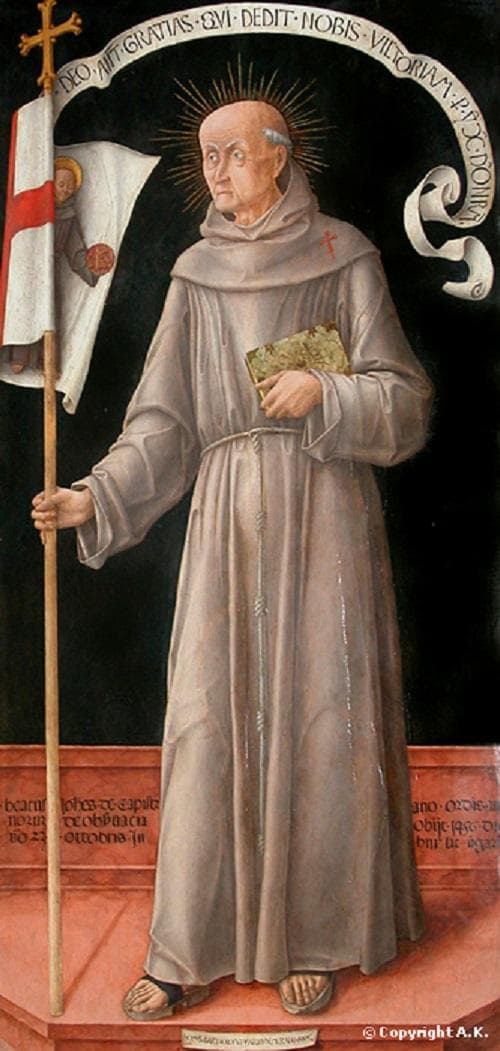
- Decided to become a friar
- In a Malatesta prison, after being jailed while serving as a peace envoy 1
- Was tried
- For heresy in 1429, and defended his companions himself. They were acquitted 1
- Preached
- To a crowd of 126,000 at Brescia, by the encyclopedia's count 1
Saint John of Capistrano was a lawyer and the governor of Perugia who was sent to negotiate peace and thrown in prison instead, and decided there to become a friar. 1 He had married a week or two earlier; the marriage was unconsummated and he got a dispensation. 1 He then spent forty years preaching to crowds the encyclopedia counts in six figures, was himself tried for heresy, and at seventy led the left wing of an army at Belgrade. 1 He died of an infection a few months later. 2
The century he was born into
Franciscan Media sets the scene before the man, and the scene is grim. "Imagine being born in the 14th century. One-third of the population and nearly 40 percent of the clergy were wiped out by the bubonic plague. The Western Schism split the Church with two or three claimants to the Holy See at one time. England and France were at war. The city-states of Italy were constantly in conflict. No wonder that gloom dominated the spirit of the culture and the times." 2
Against that it offers a thesis about him: "It has been said the Christian saints are the world's greatest optimists. Not blind to the existence and consequences of evil, they base their confidence on the power of Christ's redemption." 2
His father died early "and John owed his education to his mother." 1 She had him taught at home and then sent him to Perugia to study law, "where he achieved great success under the eminent legist, Pietro de Ubaldis." 1 The legal training is not incidental - it is what he was used for, repeatedly, for the rest of his life.
Prison, and a dream
He was made governor of Perugia in 1412, at twenty-six, and Hess records what he did with it: "As governor he set himself against civic corruption and bribery." 1
Four years later Perugia went to war with the Malatesta, and John was sent to negotiate. "John was sent as ambassador to propose peace to the Malatesta, who however cast him into prison." 1 An envoy under a flag of truce, jailed.
"It was during this imprisonment that he began to think more seriously about his soul." 1 Franciscan Media: "Imprisoned after a battle against the Malatestas, he resolved to change his way of life completely." 2 Hess adds the immediate cause - a dream in which Francis warned him to enter the order. 1
And then the complication that both sources handle differently. Hess: "John had married a wealthy lady of Perugia immediately before the war broke out, but as the marriage was not consummated he obtained a dispensation to enter religion, which he did 4 October, 1416." 1 Franciscan Media does not mention the marriage at all. 2
He was taught theology by Bernardine of Siena, with James of the Marches as a fellow student, and traveled with Bernardine to study his preaching before being allowed to preach himself. 1
The crowds
From 1425 he preached across the whole of Italy and the numbers Hess gives are extraordinary. "So great were the crowds who came to listen to him that he often had to preach in the public squares. At the time of his preaching all business stopped. At Brescia on one occasion he preached to a crowd of one hundred and twenty-six thousand people, who had come from all the neighbouring provinces." 1
And: "On another occasion during a mission, over two thousand sick people were brought to him that he might sign them with the sign of the Cross, so great was his fame as a healer of the sick." 1
Franciscan Media places it in context: "John of Capistrano's preaching attracted great throngs at a time of religious apathy and confusion. He and 12 Franciscan brethren were received in the countries of central Europe as angels of God. They were instrumental in reviving a dying faith and devotion." 2
Both sources describe those central European campaigns only in terms of their success. Hess adds one named target - during his nunciature he traveled the empire "preaching and combatting the heresy of the Hussites" - and neither source examines what the campaigns meant for the communities he preached against. 12 This page reports what they report.
Tried for heresy, then trusted with everything
He and Bernardine promoted devotion to the Holy Name of Jesus, and "together with that saint, was accused of heresy because of this devotion." 1
In 1429 he and other Observant friars "was cited to Rome on the charge of heresy, and he was chosen by his companions to defend their cause; the friars were acquitted by the commission of cardinals." 1 A lawyer-turned-friar defended himself and his brothers before a panel of cardinals and won.
After that he was used constantly. He was central to the attempt to reunite the two branches of the Franciscans - a union was effected at Assisi in 1430 and "did not last long" - and to getting Bernardine made vicar-general in 1438. 1 Franciscan Media credits his legal expertise with two outcomes at once: "the heretical Fraticelli were suppressed and the 'Spirituals' were freed from interference in their stricter observance." 2
Then the embassies. Legate to Milan and Burgundy in 1439 against an antipope; a mission to the king of France in 1446; apostolic nuncio to Austria in 1451; Poland at a king's request. 1 Franciscan Media adds that he "helped bring about a brief reunion with the Greek and Armenian Churches." 2
And somewhere in there, visiting France, he met Colette, "the reformer of the Second Franciscan Order or Poor Clares, with whose efforts he entirely sympathized." 1
Belgrade
Constantinople fell in 1453 and John, then about sixty-eight, was commissioned to preach a crusade for the defense of Europe. 2
Franciscan Media is honest about how that went at first: "Gaining little response in Bavaria and Austria, he decided to concentrate his efforts in Hungary." 2 He was summoned to the Diet at Frankfurt in 1454 to help its deliberations, "and here, too, he was the leading spirit." 1
Then he went with the army. Hess: "When the crusade was actually in operation John accompanied the famous Hunyady throughout the campaign: he was present at the battle of Belgrade, and led the left wing of the Christian army against the Turks." 1 Franciscan Media: "He led the army to Belgrade. Under the great General John Hunyadi, they gained an overwhelming victory, and the siege of Belgrade was lifted." 2
A friar in his seventies commanded a wing of a battle line.
He did not survive it long. "Worn out by his superhuman efforts, Capistrano was an easy prey to an infection after the battle. He died on October 23, 1456." 2 He was beatified in 1694 and canonized in 1724. 1
What is Saint John of Capistrano the patron saint of?
Neither source cited here gives him a patronage. 12 Hess ends with his canonization and his books; Franciscan Media with a reflection. Neither names a cause he is invoked for, and this page does not supply one.
Franciscan Media's closing note is the nearest thing to a summary: a biographer recalls a Brussels organization named after him whose motto was "Initiative, Organization, Activity." As the entry says, "He was not one to sit around." 2
Saint John of Capistrano's feast day
The feast of Saint John of Capistrano is October 23, the day he died in 1456. 12
Hess's 1910 article states no feast day at all - it gives the death date in its opening line and the canonization at the end, and never names a day in the calendar. 1 October 23 is the date both the General Roman Calendar and the calendar for the dioceses of the United States keep.
Praying with Saint John of Capistrano
He is the saint for a career that begins again at thirty. He had already succeeded - law degree, senior office, a rich marriage - and the whole of it ended in a cell belonging to people he had been sent to make peace with. 1 The dispensation, the habit, and the fact that he started over as a student under Bernardine of Siena are all downstream of being double-crossed at work.
What he did with the second life is mostly organizational. The crowds and the healings are what get quoted, but the load-bearing work was legal: defending his brothers against a heresy charge, brokering a union between two branches of an order, sitting on embassies, drafting and arguing. 12 He brought the lawyer with him into religion and the Church used him for it for forty years.
The heresy trial is the detail worth keeping. He was prosecuted for a devotion, defended the case himself, and was acquitted - and then spent decades on the other side of that machinery. 1 Having been accused did not make him cautious about accusing.
And at nearly seventy he rode with an army and commanded a wing of it, having failed to raise any enthusiasm in Bavaria or Austria and having gone to Hungary because that was where anyone would listen. 12 He died a few months later of an infection. Both his sources are Catholic, both admire him, and neither asks what his preaching campaigns cost the people they were aimed at - which is worth knowing before reading further about him.
Saint John of Capistrano, pray for us.
Sources
Saints to turn to next
Others in this collection who are turned to for some of the same things.