Saints Peter and Paul
Both died at Rome, under Nero, between 64 and 68
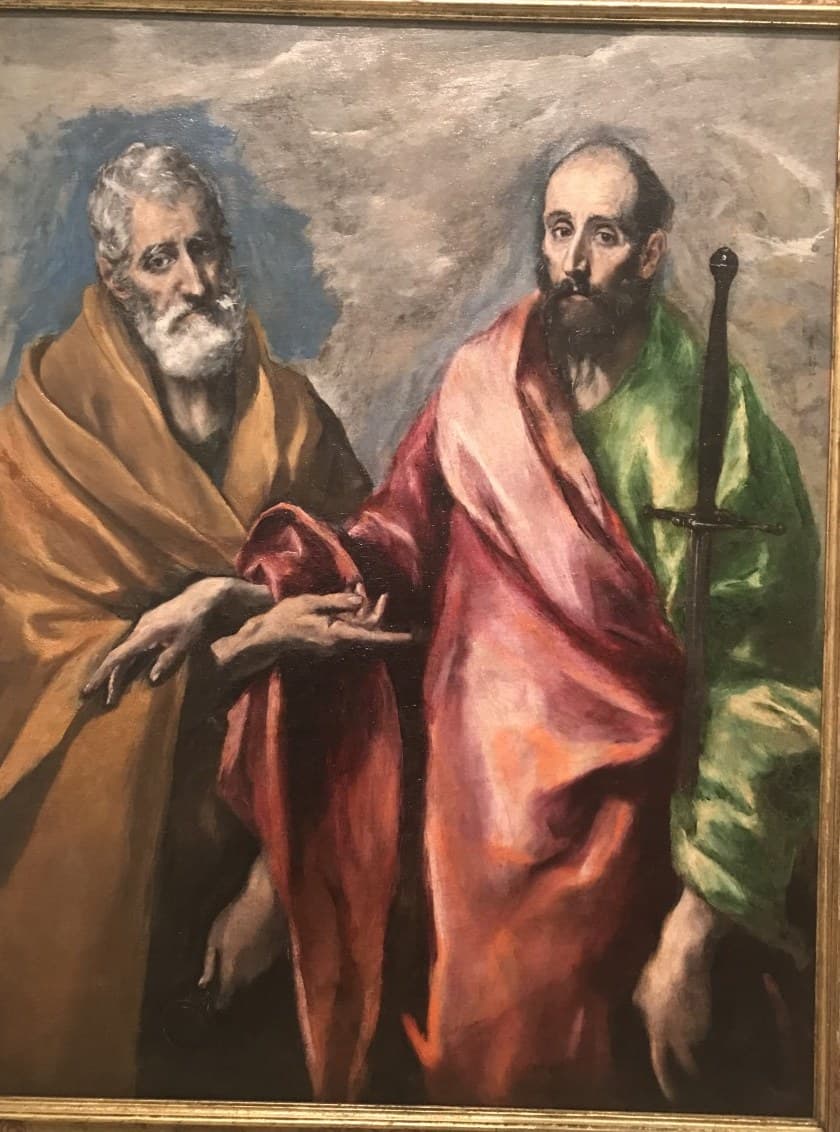
- Peter died
- Crucified, head downwards, most probably in the Neronian Gardens on the Vatican 1
- Paul died
- At Aquae Salviae, now Tre Fontane, east of the Ostian Way 2
- The date is not certain
- The encyclopedia leaves open July 64 to early 68, and says June 29 cannot be proved to be the day 1
- Attested early
- Ignatius of Antioch names them together before 117; Clement refers to both martyrdoms 1
Saints Peter and Paul share one solemnity because they died in the same city under the same emperor, and the Church has kept them together since the fourth century. 1 They had almost nothing else in common. One was a fisherman who denied he knew Jesus; the other was a Pharisee who had been hunting Christians. 3 The encyclopedia is careful to say that June 29 "cannot be proved to be the day" either of them died. 1
Peter, with the unflattering details left in
Franciscan Media makes an argument from the Gospels' own embarrassment: "the Gospels prove their own trustworthiness by the unflattering details they include about Peter. He clearly had no public relations person." 3
The list is long and the article gives it without softening. He gave up everything, and then asked "What are we going to get for all this?" 3 He took the full force of Christ's anger for objecting to a suffering Messiah - "Get behind me, Satan!" 3 He accepted the doctrine of forgiveness and then proposed a cap of seven times. "He walks on the water in faith, but sinks in doubt. He refuses to let Jesus wash his feet, then wants his whole body cleansed." 3
And then the worst of it: "He swears at the Last Supper that he will never deny Jesus, and then swears to a servant maid that he has never known the man." 3 He drew a sword for Jesus and cut off Malchus's ear, "but in the end he runs away with the others." 3
What follows is the reason the list is there. "In the depth of his sorrow, Jesus looks on him and forgives him, and he goes out and sheds bitter tears." 3 And afterward, the Risen Jesus "told Peter to feed his lambs and his sheep." 3 The man who had denied him three times was given the flock.
Paul, who was on the other side
Franciscan Media reaches for a modern comparison to convey how Paul's preaching landed: imagine the most famous preacher alive suddenly announcing that the country should abandon its constitution. 3 "He had been the most pharisaic of Pharisees, the most legalistic of Mosaic lawyers. Now he suddenly appears to other Jews as a heretical welcomer of Gentiles, a traitor and apostate." 3
His conviction is summarized in one line: "Only God can save humanity. No human effort - even the most scrupulous observance of law - can create a human good which we can bring to God as reparation for sin and payment for grace." 3
The article is equally clear that this did not make him an enemy of his own people. "Paul never lost his love for his Jewish family, though he carried on a lifelong debate with them about the uselessness of the Law without Christ. He reminded the Gentiles that they were grafted on the parent stock of the Jews, who were still God's chosen people, the children of the promise." 3
Vatican News gives him a title that follows from the arguing: "bringing the faith to those, who heard him, would make him the first Christian theologian." 4
What Rome remembers, and what it does not know
They were named together within living memory. Clement of Rome refers to both martyrdoms "among us", speaking of the Neronian persecution. 1 Before 117, Ignatius of Antioch - himself being taken to Rome to die - wrote to the Roman Christians: "I issue you no commands, like Peter and Paul: they were Apostles, while I am but a captive." 1
For Peter's death the tradition is attested by Tertullian at the end of the second century and by Origen, whom Kirsch quotes: "Peter was crucified at Rome with his head downwards, as he himself had desired to suffer." 1 The place "may be accepted with great probability" as the Neronian Gardens on the Vatican, where Tacitus says the persecution's worst scenes took place, and he was buried nearby at the foot of the Vatican hills. 1
Paul died "near Rome at a place called Aquae Salviae (now Tre Fontane), somewhat east of the Ostian Way, about two miles from" the basilica that marks his grave. 2 The year is given variously as the twelfth, thirteenth or fourteenth of Nero's reign, by Epiphanius, Euthalius and Jerome respectively - "according to the most common opinion, Paul suffered in the same year and on the same day as Peter." 2
For a time the two were in one place. "For a time the remains of Peter lay with those of Paul in a vault on the Appian Way at the place ad Catacumbas", where the Church of St. Sebastian now stands - a church that was dedicated to both apostles when it was built in the fourth century. 1
And then the sentence that keeps this page honest. The day of Peter's martyrdom "is also unknown; 29 June, the accepted day of his feast since the fourth century, cannot be proved to be the day of his death." 1 The encyclopedia will not close the year either, leaving open July 64 to the beginning of 68. 1
What are Saints Peter and Paul the patron saints of
Peter belongs to fishermen, which is what he was when he was called "from his nets along the Sea of Galilee to become a fisher of men". 3 Vatican News calls him "Apostle of the City of Rome" and gives the plain facts underneath the title: "His name was Simon; Jesus called him Peter. Simon was born in Bethsaida, and lived in Capernaum where was a fisherman on the Sea of Tiberias." 4
Franciscan Media names Paul the patron of Greece. 3 He belongs more broadly to missionaries and to anyone who travels for the work, having done more of it than anyone in the New Testament.
Together they are the patrons of the city of Rome, which is why their day is a solemnity there and not merely a feast.
Saints Peter and Paul's feast day
The solemnity of Saints Peter and Paul is June 29. 14 It has been kept on that day since the fourth century. 1 Vatican News carries both entries on its day page for June 29, and notes of Paul that "his martyrdom is remembered on June 29, together with that of St. Peter." 4
It is worth knowing what the date is and is not. It is the day the Church has commemorated them for some sixteen hundred years. It is not, on the evidence, demonstrably the day either of them died - Kirsch says so outright. 1 A feast can be ancient, certain and universal without the underlying date being recoverable, and this is the clearest example in the calendar.
Praying with Saints Peter and Paul
The pairing is the point, and it is not a natural one. Peter knew Jesus and failed him in person. Paul never met him and had been arresting his followers. 3 Neither came to the work with anything like a clean record, and the Church put them on the same day and built its cathedral city around their two graves.
Franciscan Media is right that Peter is the approachable one: "We would probably go to confession to Peter sooner than to any of the other apostles." 3 The catalogue of his failures is in the Gospels because nobody removed it, and it is the strongest evidence we have that the people who wrote them were not managing a reputation.
Paul's life after Damascus is described in the same unsentimental way. "But persecution, humiliation, and weakness became his day-by-day carrying of the cross, material for further transformation." 3 Not obstacles to the mission. Material.
And then the honest gap at the center of the feast. We do not know the day. 1 We do not even know the year within four. 1 What the fourth century had, and handed on, was the conviction that these two belonged together and that Rome was where they ended - and sixteen centuries later the Church still keeps the day it was given rather than the day it can prove. There is something in that worth taking into prayer: most of what is handed to us we did not verify, and some of it is nonetheless true.
Saints Peter and Paul, pray for us.
Sources
- 1.Johann Peter Kirsch, "St. Peter, Prince of the Apostles," The Catholic Encyclopedia, Vol. 11 (New York: Robert Appleton Company, 1911).
- 2.Ernest Jacquier, "St. Paul," The Catholic Encyclopedia, Vol. 11 (New York: Robert Appleton Company, 1911).
- 3."Saints Peter and Paul," Saint of the Day, Franciscan Media.
- 4."Saint Peter, Apostle of the City of Rome" and "Saint Paul," Saint of the Day, 29 June, Vatican News (Dicastery for Communication).
Saints to turn to next
Others in this collection who are turned to for some of the same things.