Saint John XXIII
November 25, 1881 - June 3, 1963
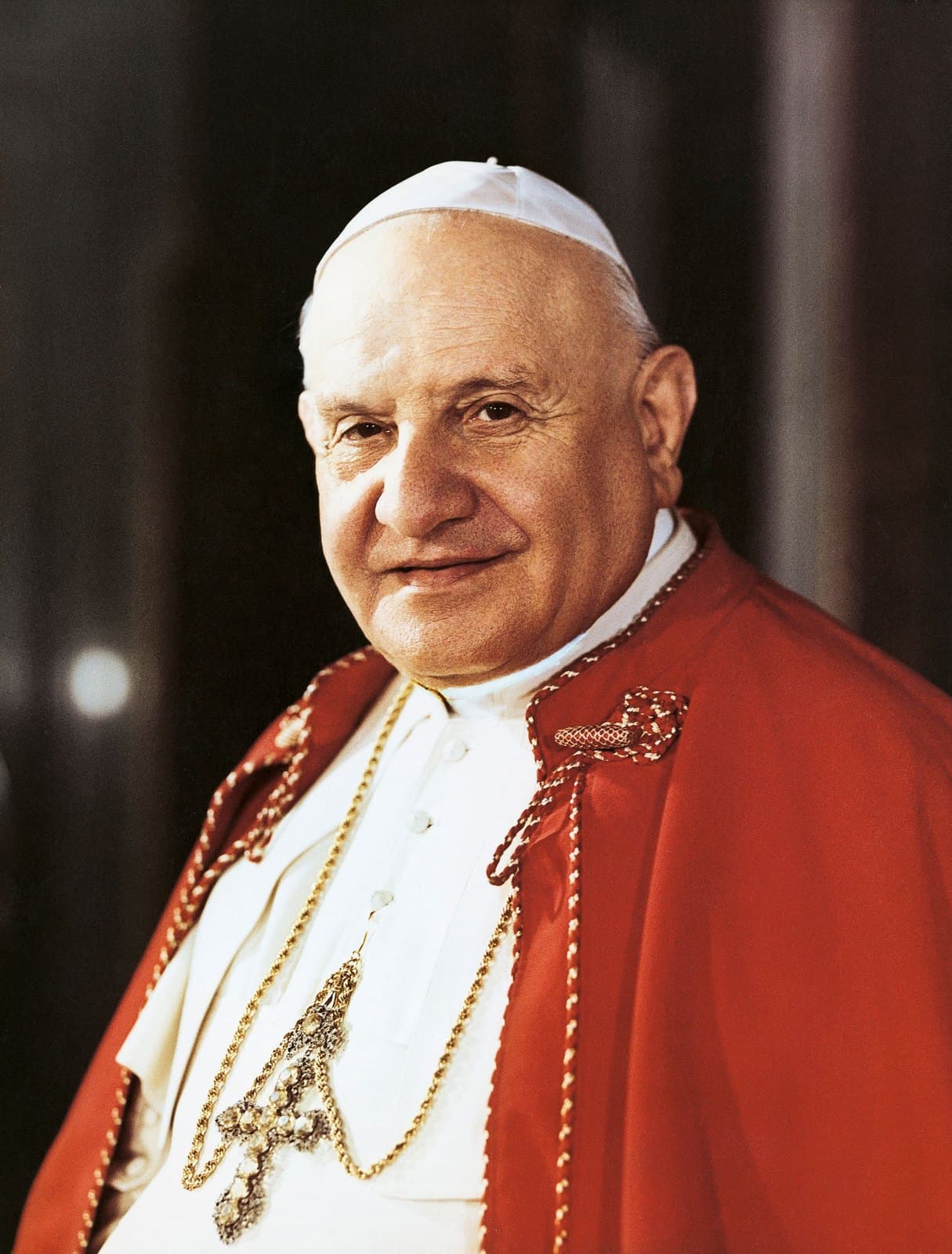
- Born
- Angelo Giuseppe Roncalli, firstborn of a farming family at Sotto il Monte 1
- In the First World War
- A stretcher-bearer for the Italian army 1
- In the Second
- As a diplomat in Turkey he helped save an estimated 24,000 Jewish people 1
- Elected pope
- A month short of his seventy-eighth year 1
- Encyclicals
- Mother and Teacher (1961) and Peace on Earth (1963) 1
Saint John XXIII was elected at seventy-seven by cardinals who expected very little to happen, and he called an ecumenical council. 1 Opening it, he criticized "the prophets of doom" who "in these modern times see nothing but prevarication and ruin." 1 Franciscan Media notes that one writer found his "ordinariness" to be "one of his most remarkable qualities." 1
A stretcher-bearer and a diplomat
Angelo Giuseppe Roncalli was the firstborn son of a farming family at Sotto il Monte, near Bergamo, and "was always proud of his down-to-earth roots." 1 In the diocesan seminary he joined the Secular Franciscan Order. 1
After ordination in 1904 he studied canon law, then served as his bishop's secretary, taught Church history in the seminary and published the diocesan paper. 1 "His service as a stretcher-bearer for the Italian army during World War I gave him a firsthand knowledge of war." 1 He carried the wounded.
In 1921 he was made national director in Italy of the Society for the Propagation of the Faith, and found time to teach patristics. 1 From 1925 he was a papal diplomat - Bulgaria, then Turkey, then France. 1
Two lines cover the Second World War and they are worth reading slowly. "During World War II, he became well acquainted with Orthodox Church leaders. With the help of Germany's ambassador to Turkey, Archbishop Roncalli helped save an estimated 24,000 Jewish people." 1
He was named a cardinal and patriarch of Venice in 1953, "finally a residential bishop" at seventy-one, after nearly thirty years abroad. 1
The name, and the joke
"A month short of entering his 78th year, Cardinal Roncalli was elected pope, taking the name John after his father and the two patrons of Rome's cathedral, St. John Lateran." 1 He chose a name that pointed at a parish church and a farmer.
Franciscan Media's summary of his manner is the best sentence in the article: "Pope John took his work very seriously but not himself. His wit soon became proverbial." 1 He met political and religious leaders from around the world, and in 1962 "he was deeply involved in efforts to resolve the Cuban missile crisis." 1
He enlarged the College of Cardinals and made it more international. 1 His encyclicals Mother and Teacher and Peace on Earth are the ones remembered. 1
The medicine of mercy
At the opening of the Second Vatican Council he set the tone in two sentences that were aimed at people inside the room.
First, against the pessimists: he criticized "the prophets of doom" who "in these modern times see nothing but prevarication and ruin." 1
Then the line that decided the Council's register: "The Church has always opposed... errors. Nowadays, however, the Spouse of Christ prefers to make use of the medicine of mercy rather than that of severity." 1
He did not live to see it finish. On his deathbed he said: "It is not that the gospel has changed; it is that we have begun to understand it better. Those who have lived as long as I have... were enabled to compare different cultures and traditions, and know that the moment has come to discern the signs of the times, to seize the opportunity and to look far ahead." 1
"Good Pope John" died on June 3, 1963. 1 John Paul II beatified him in 2000 and Francis canonized him in 2014. 1
What is Saint John XXIII the patron saint of
He belongs to diplomats and to anyone whose work is talking to people their institution does not talk to. Franciscan Media makes exactly that case: "His sense of God's providence made him the ideal person to promote a new dialogue with Protestant and Orthodox Christians, as well as with Jews and Muslims." 1
Vatican News lists him simply as "St. John XXIII, Pope". 2
Saint John XXIII's feast day
The feast of Saint John XXIII is October 11. 12 Vatican News keeps his day page there. 2
It is not the day he died - that was June 3, 1963. October 11 is the anniversary of the day he opened the Second Vatican Council in 1962. Most saints are kept on their dies natalis; he is kept on the day he started the thing he is remembered for.
Praying with Saint John XXIII
He was seventy-seven. Nobody elects a man of seventy-seven expecting a program. He had been a diplomat in Bulgaria and Turkey, out of Rome for decades, and was patriarch of Venice for five years before the conclave. And within ninety days of his election he announced an ecumenical council.
The 24,000 is the sentence to sit with. 1 It is one line in a short article, it required working with the German ambassador, and it happened while he held no position of any weight. Most of what he did that mattered he did without authority.
The prophets of doom were not outside the Church. 1 He was addressing bishops, at a council he had called, and telling them that a habit of seeing only ruin was itself a failure. The alternative he offered was not optimism but mercy - "the medicine of mercy rather than that of severity" - which is a method, not a mood. 1
And the deathbed line, which is the most careful thing he ever said. "It is not that the gospel has changed; it is that we have begun to understand it better." 1 He was dying in the middle of a council whose outcome he could not see, and that is the distinction he wanted on the record.
Saint John XXIII, pray for us.
Sources
Saints to turn to next
Others in this collection who are turned to for some of the same things.
- Saint BartholomewFirst centuryDiscernmentConversionCourage
- Saint John Paul IIMay 18, 1920 - April 2, 2005CourageDiscernmentConversion
- Saints Peter and PaulBoth died at Rome, under Nero, between 64 and 68ConversionCourageDiscernment
- Saint Vincent FerrerJanuary 23, 1350 - April 5, 1419DiscernmentCourageConversion