Saint Vincent Ferrer
January 23, 1350 - April 5, 1419
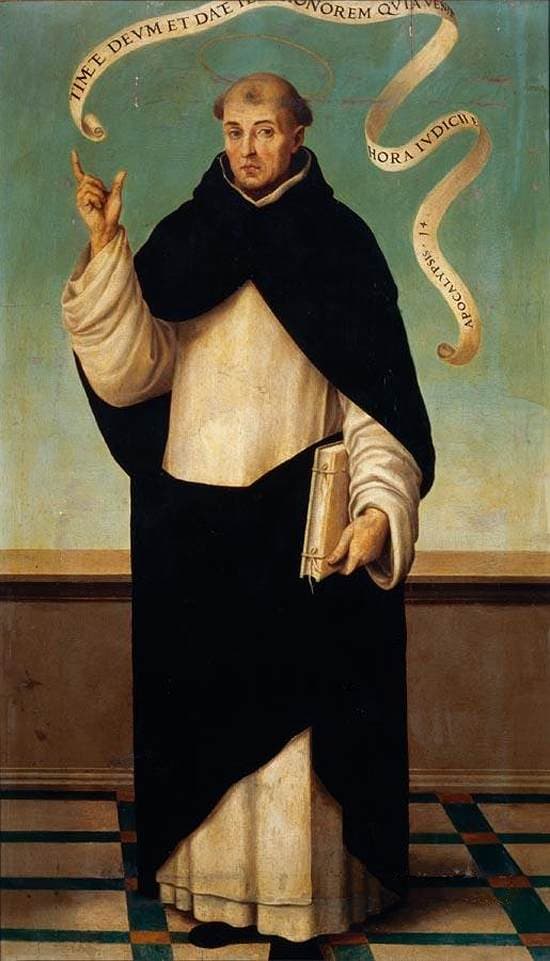
- Feast day
- April 5, the day he died at Vannes in Brittany in 1419 1
- Born
- Valencia, January 23, 1350. He finished philosophy at fourteen 1
- Backed
- The Avignon claimant through the Western Schism, against Catherine of Siena on the other side 2
- Refused
- The cardinalate, and every other honor offered him 1
- Was called
- The "Angel of the Judgment" 2
- Was followed by
- A traveling body of penitents that at times numbered ten thousand 1
Saint Vincent Ferrer spent his life convinced that the pope at Avignon was the real one, and he was wrong. 2 He served the man who became Benedict XIII, was ordained by him, defended him in writing, and spent years trying to persuade him to resign for the good of a Church split in three. 12 When he finally broke with him it cost him more than anyone: "he was deeply attached to Benedict." 1 For twenty years in between he walked across western Europe preaching judgment, followed by a crowd of penitents that sometimes reached ten thousand people. 1
A tornado, not a breeze
Franciscan Media opens with the comparison that puts the century in proportion: "The polarization in the Church today is a mild breeze compared with the tornado that ripped the Church apart during the lifetime of this saint." 2
The Western Schism "divided Christianity first between two, then three, popes. Clement VII lived at Avignon in France, Urban VI in Rome." 2 Vincent took the Avignon side and never doubted it: "Vincent was convinced the election of Urban was invalid, though Catherine of Siena was just as devoted a supporter of the Roman pope." 2 Two canonized saints, on opposite sides, each certain.
He entered the Dominicans against his parents' wishes - at nineteen, Franciscan Media says; Reinhart dates the entry to 1367, when he was seventeen. 12 He had finished philosophy at fourteen. 1 Of his years at Toulouse he left a description of his own routine: "study followed prayer, and prayer succeeded study." 1
The cardinal who became the problem
From 1379 he was attached to Cardinal Pedro de Luna, then working to bring Aragon into the Avignon obedience. 1 Franciscan Media flags the relationship at the start: he was ordained "by Cardinal Peter de Luna - who would figure tragically in his life." 2
De Luna protected him. Vincent was cited before the Inquisition for preaching publicly "that Judas had done penance" - and de Luna, by then elected at Avignon as Benedict XIII, "cited the case before his tribunal and burned the papers." 1 He then made Vincent his confessor and apostolic penitentiary. 1 Vincent "steadfastly refused the honours, including the cardinalate, which were offered to him." 1
Then the promise Benedict had made was broken. Franciscan Media: "the new pope did not resign as all candidates in the conclave had sworn to do. He remained stubborn, despite being deserted by the French king and nearly all of the cardinals." 2 France withdrew obedience in 1398 and royal troops besieged Avignon. 1
It broke Vincent. "Vincent became disillusioned and very ill." 2 Reinhart: "An attack of fever at this time brought Vincent to death's door", and he reports that during an apparition of Christ with Dominic and Francis he was cured "and sent to preach penance and prepare men for the coming judgment." 1 Franciscan Media describes what he did next in the plainest possible terms - he "finally took up the work of simply 'going through the world preaching Christ'" - while still believing "that any renewal in the Church depended on healing the schism." 2
Twenty years on foot
Benedict released him to preach in November 1399 with the powers of a legate. 1 From then until near his death he covered Provence, Dauphiny, Savoy, the Alps, Lombardy, Switzerland, Lyons, Genoa, Flanders, northern France, and most of Spain. 1 Franciscan Media's summary: "An eloquent and fiery preacher, he spent the last 20 years of his life spreading the Good News in Spain, France, Switzerland, the Low Countries and Lombardy, stressing the need of repentance and the fear of coming judgment. He became known as the 'Angel of the Judgment.'" 2
The crowds were too big for churches: "he was obliged to preach in squares and open places, such were the numbers that flocked to hear him." 1 And a permanent body formed around him - "an army of penitents drawn from every rank of society, who desired to remain under his guidance." Reinhart adds a detail that reads as careful rather than pious: "Vincent was ever watchful of his disciples, and never did the breath of scandal touch this strange assemblage, which numbered at times 10,000." 1
There is a problem with all this, and Reinhart raises it himself. "It would be difficult to understand how he could make himself understood by the many nationalities he evangelized, as he could speak only Limousin, the language of Valencia. Many of his biographers hold that he was endowed with the gift of tongues, an opinion supported by Nicholas Clemangis, a doctor of the University of Paris, who had heard him preach." 1 That is the explanation his sources give, and it is given here as theirs.
His own life was severe. "The floor was his usual bed; perpetually fasting, he arose at two in the morning to chant the Office, celebrating Mass daily, afterwards preaching, sometimes three hours, and frequently working miracles. After his midday meal he would tend the sick children; at eight o'clock he prepared his sermon for the following day. He usually travelled on foot, poorly clad." 1
At Alexandria in Lombardy he picked a young man out of the audience who would go on to preach Italy: Bernardine of Siena. 1
Spain, and what the source says about how the conversions happened
From 1408 to 1416 he worked almost continuously in Spain, and Reinhart says it "would be difficult to overestimate the influence which he exercised in the Iberian peninsula." 1
On the conversion of Spanish Jews, the article says two things in succession. First: "At different times in Spanish history strenuous attempts had been made to convert the Jewish people, baptism or spoliation being the alternatives offered to them." Then: "This state of affairs existed when Vincent began to work among them; multitudes were won over by his preaching." 1
The first sentence describes a choice between baptism and being stripped of your property. The second describes persuasion. Reinhart sets them beside each other and does not explain how they fit together, and this page will not do it for him. The number he gives comes from Vincent's earliest biographer: "Ranzano, his first biographer, estimates the number of Jews converted at 25,000." 1 Franciscan Media does not mention this part of his work at all. 2
He was also a political figure. He announced to the king of Aragon the death of his only heir, and after that king died he was made one of the judges appointed to determine the succession - "At the judgment, known as the Compromise of Caspe, he took the leading part and helped to elect Ferdinand of Castile." 1 A friar chose a king.
Perpignan, where the sources part
He tried twice to make Benedict stand down. Franciscan Media dates the attempts to 1408 and 1415. 2 At Genoa in 1408, a meeting had been arranged between the two claimants: "Vincent again urged Benedict to have pity on the afflicted Church, but in vain. Disappointed, he returned to Spain." 1
What happened in January 1416 at Perpignan is told two different ways, and the difference is not small.
Franciscan Media: "He finally concluded that Benedict was not the true pope. Though very ill, he mounted the pulpit before an assembly over which Benedict himself was presiding, and thundered his denunciation of the man who had ordained him a priest. Benedict fled for his life, abandoned by those who had formerly supported him." 2
Reinhart: on January 6, preaching at Perpignan, "he declared anew to the vast throng gathered around his pulpit that Benedict XIII was the legitimate pope, but that, since he would not resign to bring peace to the Church, Ferdinand had withdrawn his states from the obedience of Avignon." 1 In this version he never stops believing Benedict is pope; he announces a withdrawal of political obedience, and does it because "it was thought that Vincent was the only person sufficiently esteemed to announce such a step to the Spanish races." 1
One account is a renunciation and the other is an announcement. They agree on the cost. Reinhart: "This act must have caused Vincent much sorrow, for he was deeply attached to Benedict." 1
And then he was absent from the ending. "Strangely, Vincent had no part in the Council of Constance, which ended the schism." 2 Reinhart says only that he did not go, and kept preaching in France, spending his last two years in Brittany. 1 He died at Vannes on April 5, 1419, and was canonized in 1455. 1
What is Saint Vincent Ferrer the patron saint of?
Neither source cited here states a formal patronage. 12 Franciscan Media comes closest, and does it as a judgment rather than a title: "If any saint is a patron of reconciliation, Saint Vincent Ferrer is." 2 This page records that as the claim it is.
What he is called instead is the "Angel of the Judgment", which is not a patronage but a description of what he preached. 2
Saint Vincent Ferrer's feast day
The feast of Saint Vincent Ferrer is April 5, the day he died at Vannes in Brittany in 1419. 1
Reinhart's article states no feast day - it gives the death date in its opening line and the canonization at the end, and never names a day in the calendar. 1 April 5 is the date both the General Roman Calendar and the proper calendar for the United States keep.
Praying with Saint Vincent Ferrer
He is the saint for having committed yourself to the wrong side in good faith. He believed the Avignon claim was valid, and he was not a fool about it - he was a trained theologian who had studied the question and written a book defending it. 1 Catherine of Siena, equally holy, believed the opposite. 2 The Church has canonized them both, which is worth noticing: being on the losing side of a question that mattered enormously did not disqualify either of them.
The harder thing is what he did once his own side stopped being defensible. He did not flip quickly. He spent years pressing Benedict privately, was ill and disillusioned, and went off to preach in the meantime because the work in front of him was still work. 2 When the break came it was late, it was under pressure from a king, and by one of the two accounts here he still believed Benedict was pope even as he announced the withdrawal. 1 That is not a clean conversion story and the sources do not make it one.
The part of his life that will not sit comfortably is Spain. His own encyclopedia records that Jews there were being offered "baptism or spoliation" and then reports twenty-five thousand conversions under his preaching, without connecting the two. 1 A reader is entitled to both sentences, and to the fact that the source leaves the space between them empty.
And then the ordinary detail that survives all of it: the floor was his bed, he got up at two, he preached for three hours, and in the afternoon he went and looked after sick children. 1 Twenty years of that, on foot, poorly dressed, in a language most of his hearers did not speak.
Saint Vincent Ferrer, pray for us.
Sources
Saints to turn to next
Others in this collection who are turned to for some of the same things.
- Saint BartholomewFirst centuryDiscernmentConversionCourage
- Saint John Paul IIMay 18, 1920 - April 2, 2005CourageDiscernmentConversion
- Saint John XXIIINovember 25, 1881 - June 3, 1963DiscernmentCourageConversion
- Saints Peter and PaulBoth died at Rome, under Nero, between 64 and 68ConversionCourageDiscernment