Saint Lawrence
Died August 10, 258
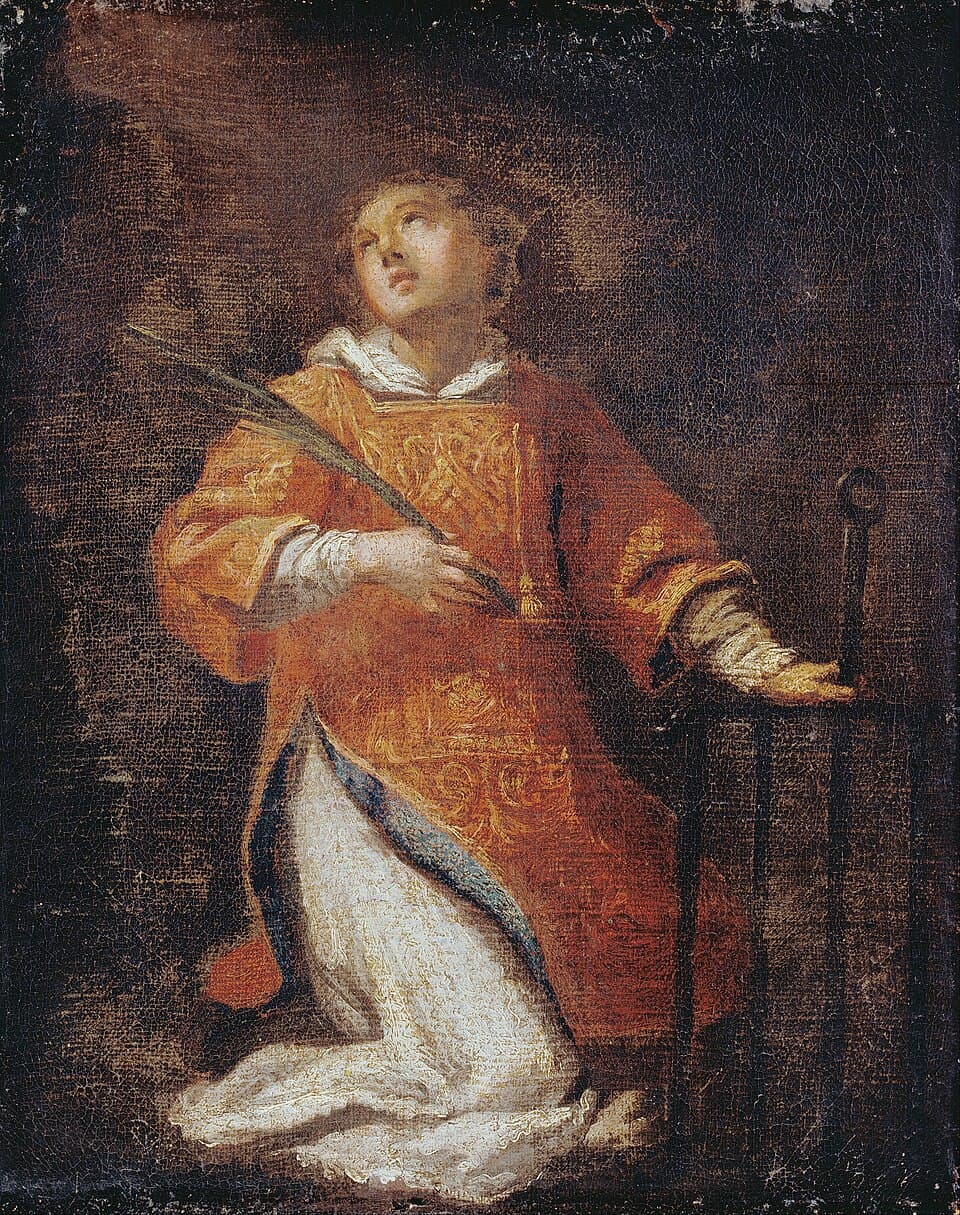
- Patron saint of
- Neither source assigns a patronage. He is invoked by cooks, firefighters and the poor 12
- Feast day
- August 10, the date of his death, recorded in a calendar of 354 1
- Died
- 10 August 258, four days after Pope Sixtus II, in the persecution of Valerian 1
- Office
- Deacon of the Roman Church - Kirsch calls him "the last of the seven deacons" 1
- Buried
- In the Catacomb of Cyriaca on the Via Tiburtina, where San Lorenzo stands 1
- The gridiron
- Doubted. Kirsch: the manner of execution "gives rise to grave doubts" and rests on oral tradition 1
Saint Lawrence was a deacon of Rome killed on 10 August 258, four days after his pope, under an imperial edict ordering the immediate execution of every bishop, priest and deacon. 1 That much is documented by a man writing at the time. 1 The gridiron, the prefect, and "turn me over" come from a hundred years later, and the Catholic Encyclopedia says they give rise to grave doubts. 12
What the record shows
Kirsch builds the certain part out of contemporary documents, and it is worth following because it is unusually good evidence for a third-century death.
At the beginning of August 258 the emperor Valerian issued an edict "commanding that all bishops, priests, and deacons should immediately be put to death." 1 Kirsch quotes the Latin from a letter of Cyprian, who was writing while it was happening - and who would himself be executed the following month.
It was carried out at once. "On 6 August Pope Sixtus II was apprehended in one of the catacombs, and executed forthwith", along with four deacons; two more, Felicissimus and Agapitus, died the same day. 1 Cyprian names them.
"Four days later, on the 10th of August of that same year, Lawrence, the last of the seven deacons, also suffered a martyr's death." 1
The date and the grave are both attested. The Almanac of Philocalus, compiled in 354, lists his anniversary on that day "and it also mentions the street where his grave is to be found, the Via Tiburtina." 1 Seventh-century itineraries for pilgrims visiting the martyrs' graves place him in the Catacomb of Cyriaca. 1
And the buildings tell the rest. Constantine put a small oratory over the grave; Sixtus III built a large three-naved basilica on the hill above it in the fifth century; Pelagius II enlarged the older church; and in the thirteenth century Honorius III joined the two into one - "and so the basilica of San Lorenzo remains to this day." 1 Pope Damasus wrote a panegyric in verse that was cut into marble and set over the tomb. 1
Franciscan Media sums up the standing he had: "He is one of those whose martyrdom made a deep and lasting impression on the early Church. Celebration of his feast day spread rapidly." 2 And, equally frankly: "We know very little about his life." 2
The legend, and what Kirsch thinks of it
The story everybody knows comes from Ambrose and the poet Prudentius, writing in the later fourth century - more than a hundred years after the event.
Ambrose relates two things. First, that when Lawrence was asked for the treasures of the Church "he brought forward the poor, among whom he had divided the treasure, in place of alms." 1 Second, that when Sixtus II was being led away he comforted Lawrence, who wanted to die with him, by telling him he would follow in three days. 1 Ambrose also says Lawrence was burned to death on a gridiron. 1 Prudentius tells it again "with more poetical detail" in a hymn. 1
Then Kirsch does something a reader does not expect. "The meeting between St. Lawrence and Pope Sixtus II, when the latter was being led to execution, related by St. Ambrose, is not compatible with the contemporaneous reports about the persecution of Valerian." 1 Sixtus was seized in a catacomb and killed on the spot; there was no procession to an execution and no farewell.
And then the gridiron: "The manner of his execution - burning on a red-hot gridiron - also gives rise to grave doubts. The narrations of Ambrose and Prudentius are founded rather on oral tradition than on written accounts. It is quite possible that between the year 258 and the end of the fourth century popular legends may have grown up about this" martyr. 1
Under the edict Cyprian describes, deacons were to be executed immediately. A slow burning is not an immediate execution.
The treasure of the Church
Franciscan Media tells the legend in full, and calls it one: "A well-known legend has persisted from earliest times." 2 It is worth having, because it is the reason his name survived in kitchens and parish halls for seventeen centuries.
As deacon, Lawrence was responsible for the Church's property and for distributing alms. Knowing he would be arrested, "he sought out the poor, widows, and orphans of Rome and gave them all the money he had on hand, selling even the sacred vessels of the altar to increase the sum." 2
The prefect of Rome, hearing this, assumed the Christians were sitting on a fortune, and Franciscan Media gives his speech at length. "I am told that your priests offer in gold, that the sacred blood is received in silver cups, that you have golden candlesticks at your evening services. Now, your doctrine says you must render to Caesar what is his. Bring these treasures - the emperor needs them to maintain his forces... Give me the money, therefore, and be rich in words." 2
Lawrence agreed that the Church was rich, and asked for three days to make an inventory. 2 He spent them gathering "a great number of blind, lame, maimed, leprous, orphaned, and widowed persons" and arranging them in rows. 2
When the prefect came, "Lawrence simply said, 'These are the treasure of the Church.'" 2
The prefect answered that he would have his wish to die, "but it would be by inches" - the gridiron, with coals beneath. 2 And after a long time on it, the legend ends with the line that made him famous: "It is well done. Turn me over!" 2
Kirsch will not certify any of it. 1 It has been told for sixteen hundred years anyway, and the sentence about the poor is a better account of what a church's wealth is for than most that have been written since.
What is Saint Lawrence the patron saint of?
Neither Kirsch nor Franciscan Media assigns Saint Lawrence a patronage. 12 What he has acquired follows from the legend rather than the record, and is worth reporting on that footing.
He is the patron of cooks and of those who work with fire - firefighters, and by extension anyone in the kitchen - entirely because of the gridiron and the joke attributed to him on it. 2 It is a patronage built on a detail the encyclopedia doubts, and it has been kept for centuries by people who found something companionable in a martyr who made a joke.
The stronger claim is the poor. Whatever the prefect did or did not say, Lawrence was the deacon responsible for the Church's money and for giving it away, and the tradition remembers him emptying the treasury into the hands of widows and orphans before the authorities could reach it. 2 Deacons, almoners and anyone administering a charity have a patron in him.
Saint Lawrence's feast day
The feast of Saint Lawrence is August 10, the day he died in 258. 12 It is one of the best-attested dates in this library: the Almanac of Philocalus, drawn up in 354 - within a century of the death - already lists it, and lists the road his grave lay on. 1
Franciscan Media notes how the Church ranks him: "The esteem in which the Church holds Lawrence is seen in the fact that today's celebration ranks as a feast." 2 Very few saints who are neither apostles nor evangelists are kept at that rank.
He is not to be confused with Saint Lawrence of Brindisi, the sixteenth-century Capuchin, nor with Saint Lawrence Justinian. This Lawrence is the Roman deacon of 258.
Praying with Saint Lawrence
He is a clean case of a devotion that does not depend on its best story. Strip out the prefect, the inventory, the gridiron and the joke, and what is left is documented better than almost any third-century death: an edict, a date, a street, a grave, and a church still standing over it. 1 Kirsch doubts the famous parts and never once suggests that Lawrence did not die.
The part of the legend worth keeping regardless is the definition. Asked to produce the treasure of the Church, he produced the poor. 2 Whether or not a Roman prefect ever heard that said, it has been the Church's own account of itself ever since, and any parish that has ever had to choose between a building and a hardship fund knows exactly what the sentence costs.
The joke is the other thing people keep. "It is well done. Turn me over." 2 It is almost certainly not what happened, and it has survived sixteen centuries because of what it claims is possible: that a person can be past fear, on the worst day imaginable, and still be himself. The Church has never required anyone to believe the gridiron. It has quietly let the line stand.
And there is the four-day wait. His pope was killed on the sixth and Lawrence knew, under an edict that named deacons explicitly, that he had days at most. 1 Ambrose says he wanted to go with Sixtus and was told to wait. 1 Whether or not that conversation happened, the four days did, and he spent them doing his job with the accounts.
Saint Lawrence, pray for us.
Sources
Saints to turn to next
Others in this collection who are turned to for some of the same things.