Saint Ignatius of Antioch
c. 50 - c. 107
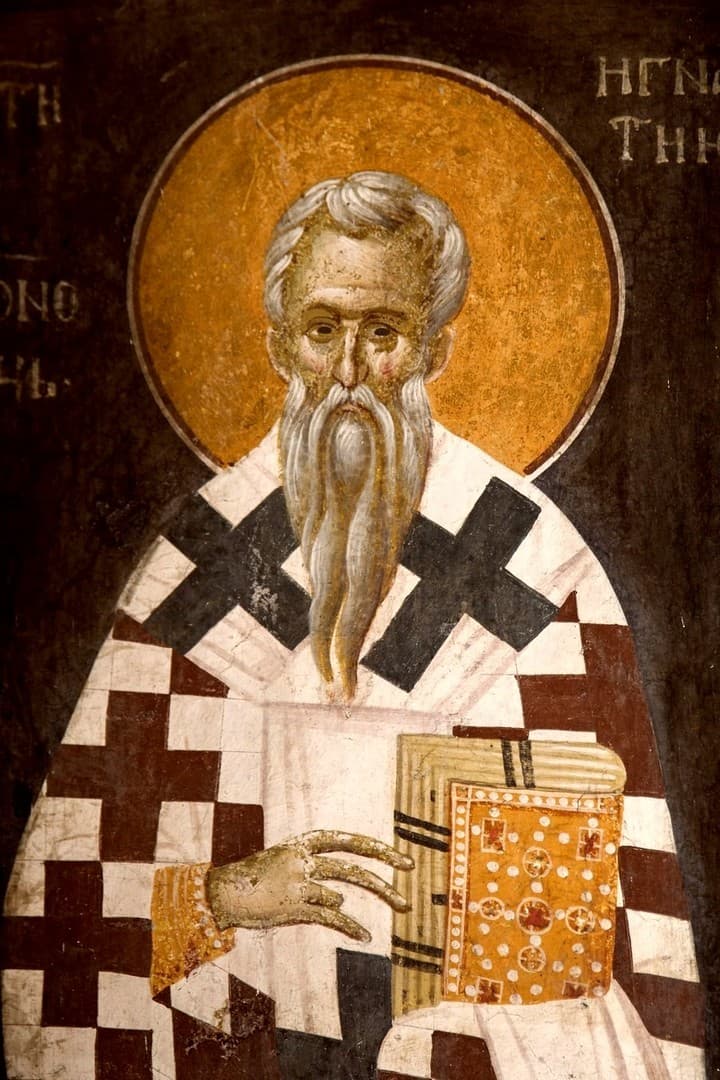
- Patron saint of
- Neither source assigns a patronage. He is invoked by bishops and by the Church in Syria 12
- Born
- Syria, around the year 50. Also called Theophorus, the God-bearer 1
- Bishop of Antioch
- The third, counting Peter. Theodoret says Peter himself appointed him 1
- Heard
- The Apostle John, with his friend Polycarp - O'Connor says this "with great probability" 1
- Left
- Seven letters, written under guard on the road to his own execution 2
Saint Ignatius of Antioch was taken from Syria to Rome under military guard to be killed by animals in the arena, and he spent the journey writing letters. 12 Seven of them survive. The last was sent ahead to the Christians of Rome, who had connections in the city and might have tried to save him, asking them not to: "I am the wheat of the Lord; may I be ground by the teeth of the beasts to become the immaculate bread of Christ." 2
A bishop who had heard an apostle
He was born in Syria around the year 50, and was also called Theophorus, the God-bearer. 1 O'Connor notes an old and attractive explanation of that name - that Ignatius was the child Jesus took up in his arms in the ninth chapter of Mark - and does not accept it: more than one early writer gave it credence, "though apparently without good reason." 1
What he will grant is more valuable. "It is also believed, and with great probability, that, with his friend Polycarp, he was among the auditors of the Apostle St. John." 1 Two boys in Asia Minor who heard John preach, both of whom became bishops and both of whom were martyred. Ignatius would write to Polycarp from the road half a century later. 2
He became bishop of Antioch - the third, counting Peter, and the immediate successor of Evodius, on the authority of Eusebius. 1 Theodoret states that Peter himself appointed him, and Chrysostom "lays special emphasis on the honor conferred upon the martyr in receiving his episcopal consecration at the hands of the Apostles themselves." 1 Antioch was where the disciples were first called Christians, and Ignatius held it within living memory of the men who had started it.
He led it through the persecution of Domitian. O'Connor: he was "unremitting in his vigilance and tireless in his efforts to inspire hope and to strengthen the weaklings of his flock against the terrors of the persecution." 1 Note the phrasing - the weaklings of his flock. He expected some of them to fail and set himself to keeping them from it.
And O'Connor states his private ambition plainly: "the one great and ever-present wish of his chivalrous soul was that he might receive the fullness of Christian discipleship through the medium of martyrdom." 1
Trajan at Antioch
In the ninth year of his reign, Trajan decreed that Christians must join their pagan neighbors in the worship of the gods, "and death was named as the penalty for all who refused to offer the prescribed sacrifice." 1 Franciscan Media dates the confrontation to 107, when "Emperor Trajan visited Antioch and forced the Christians there to choose between death and apostasy." 2
Ignatius did what a bishop does: "Instantly alert to the danger that threatened, Ignatius availed himself of all the means within his reach to thwart the purpose of the emperor." 1 It worked well enough to be noticed. He was arrested and brought before the emperor in person, "accused by the emperor himself of violating the imperial edict, and of inciting others to like transgressions." 1
He would not deny Christ, and was condemned to die in Rome. 2 Not locally - he was to be shipped across the empire and killed in the capital, as an example.
The account of all this comes from the Martyrium Ignatii, and O'Connor is careful about it. It claims to be by eyewitnesses - Philo, a deacon of Tarsus, and Rheus Agathopus, a Syrian, who traveled with him - and "such competent Protestant critics as Pearson and Ussher regard as genuine." 1 But "it is generally admitted, even by those who regarded it as authentic, that this work has been greatly interpolated." 1 Its most reliable form survives in a tenth-century manuscript in Paris. 1
The letters
The journey from Antioch to Rome is the reason we have him at all. Franciscan Media: "Saint Ignatius of Antioch is well known for the seven letters he wrote on the long journey from Antioch to Rome." 2
Five went to churches in Asia Minor, and Franciscan Media gives their burden: they "urge the Christians there to remain faithful to God and to obey their superiors. He warns them against heretical doctrines, providing them with the solid truths of the Christian faith." 2 A man in chains, writing to congregations he would never see, about church order and sound doctrine.
The sixth went to Polycarp, bishop of Smyrna - the friend of his youth, who would himself be martyred. 2
The seventh is the one people remember. It was sent ahead to Rome, and it was not a request for prayers. Franciscan Media quotes it: "The only thing I ask of you is to allow me to offer the libation of my blood to God. I am the wheat of the Lord; may I be ground by the teeth of the beasts to become the immaculate bread of Christ." 2
The Roman Christians had standing in the capital and might have been able to intervene. He wrote to stop them, in an image drawn straight from the Eucharist he had spent his life celebrating: grain, crushed, made into bread.
"Ignatius bravely met the lions in the Circus Maximus." 2 O'Connor places his death at Rome between 98 and 117. 1
What is Saint Ignatius of Antioch the patron saint of?
Neither O'Connor nor Franciscan Media assigns Saint Ignatius of Antioch a patronage, and this page does not supply one. 12
He is invoked in practice by bishops, for whom he is an uncomfortable model, and by the Church in Syria and the Middle East, whose oldest Christian city he governed. 1 He is also, reasonably, the patron of anyone facing something they cannot avoid and would rather not have other people rescue them from.
For a man whose entire surviving output was written under guard over a few weeks, his influence is out of all proportion to it. Seven letters, composed between stops on a prisoner transport, are still being read eighteen centuries later. 2
Saint Ignatius of Antioch's feast day
The feast of Saint Ignatius of Antioch is October 17. 12 The Eastern churches keep him on December 20, and the difference is old rather than disputed; both sources here give the Roman date. 1
On the year of his death the sources differ in precision rather than in substance. Franciscan Media gives 107, following the Martyrium's dating to the ninth year of Trajan; O'Connor declines to be that exact and gives the range "between 98 and 117", which is the span of Trajan's reign. 12 Anyone wanting a single year should know it rests on a document that O'Connor says has been heavily interpolated. 1
He is not to be confused with Saint Ignatius of Loyola, who founded the Jesuits fourteen centuries later and is kept on July 31.
Praying with Saint Ignatius of Antioch
The letter to the Romans is one of the hardest documents in early Christianity, and it should not be softened into bravery. He was not merely willing to die; he wrote ahead to prevent his friends from saving him. 2 A reader who finds that troubling is reading it correctly. It is not a model for anybody to copy, and the Church has never taught that it was.
What can be taken from him is what he did with the time. He was under guard, being moved across an empire toward a certain death, and he spent the weeks writing pastoral letters to congregations about staying faithful and obeying their bishops. 2 Not memoirs, not a defense, not a last testament about himself. Practical letters to other people about their problems. He was still doing his job.
The image he chose says something about how he understood it. Wheat ground into bread is not a metaphor of heroism; it is a metaphor of use. 2 He had spent his life at an altar saying words over bread, and when it came to his own turn he reached for the same picture. Whatever else that is, it is not self-dramatization - it is a man treating his own death as one more instance of the thing he had been teaching.
And there is the small human fact at the start of him: a boy who heard John preach, with a friend named Polycarp who heard the same sermons. 1 Fifty years later one of them wrote to the other from a prison escort, and both of them died for it. The chain from the Apostles to the Church is not an abstraction in his case. It is two boys who were there, and what they did with the rest of their lives.
Saint Ignatius of Antioch, pray for us.
Sources
Saints to turn to next
Others in this collection who are turned to for some of the same things.