Saint Thomas Becket
c. 1118 - December 29, 1170
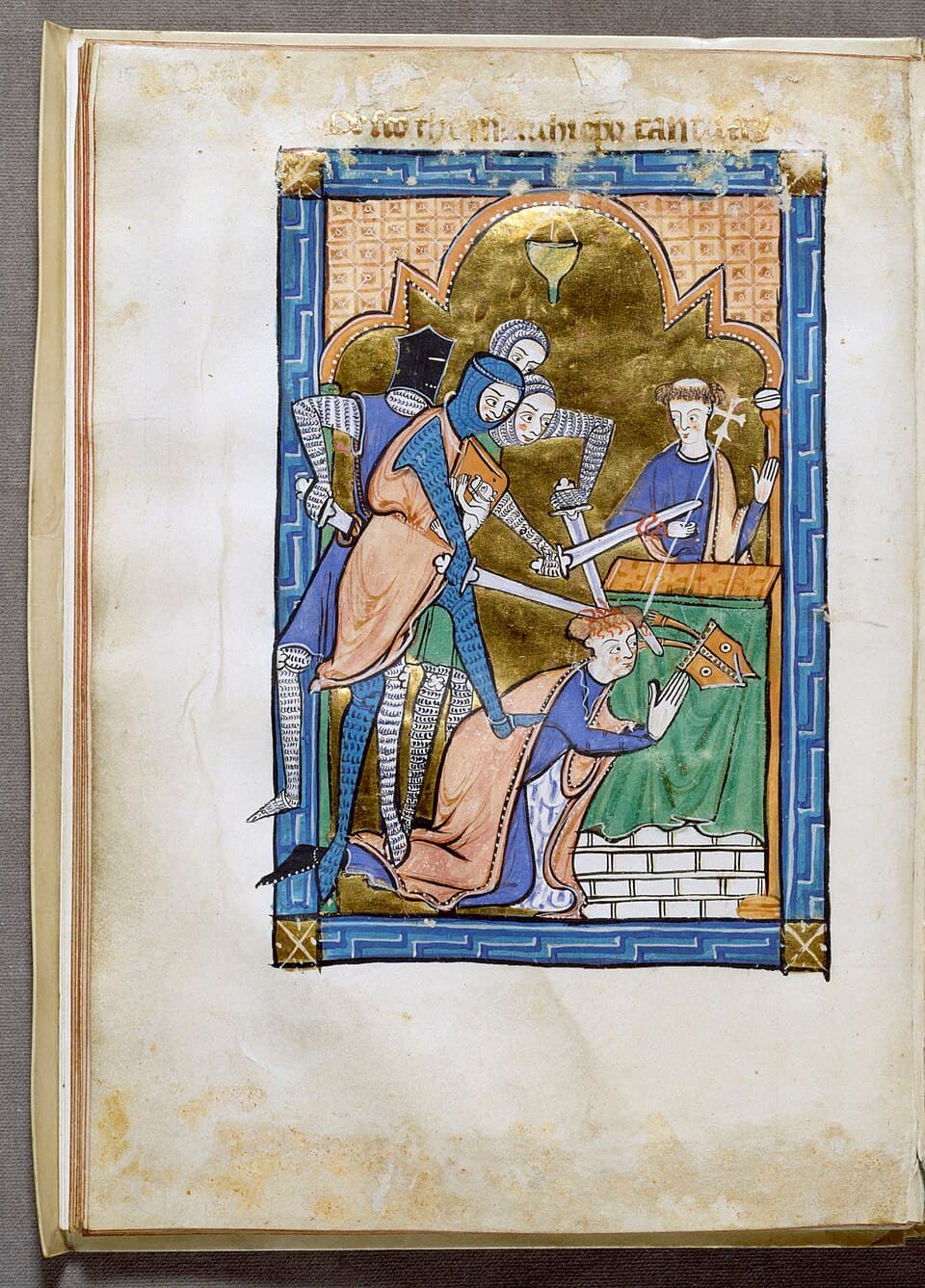
- Born
- London, 21 December 1118 - Thurston adds a question mark - to parents from Normandy 1
- Chancellor of England
- At thirty-six, and "with the possible exception of the justiciar, the most powerful subject" in the kingdom 1
- Consecrated archbishop
- Sunday, 3 June 1162, having been ordained priest only the day before 1
- In exile
- Seven years in France 2
- Killed
- By four knights in Canterbury Cathedral, 29 December 1170 2
Saint Thomas Becket warned Henry II not to make him archbishop. 1 "I know your plans for the Church," he said, "you will assert claims which I, if I were archbishop, must needs oppose." 1 The king - his closest friend, twelve years younger, a man he had hunted and campaigned and worked beside - did it anyway. 1 Eight years later four knights killed him at the altar of his own cathedral. 2
The most powerful man in England but one
He was born in London, Thurston says, on 21 December 1118 - with a question mark - to parents who had come over from Normandy. 1 The tale that his mother was a Saracen is dismissed: "No reliance can be placed upon the legend." 1 His birth was later "made the subject of spiteful comment, though his parents were not peasants, but people of some mark." 1
An Icelandic saga preserves a description of him as a young clerk, and it is the best physical portrait of any saint in this library. "To look upon he was slim of growth and pale of hue, with dark hair, a long nose, and a straightly featured face. Blithe of countenance was he, winning and loveable in his conversation, frank of speech in his discourses, but slightly stuttering in his talk, so keen of discernment and understanding that he could always make difficult questions plain after a wise manner." 1
He stammered, and he could explain anything.
He entered the household of Theobald, Archbishop of Canterbury, about 1141 and became his most trusted clerk; studied law at Bologna and Auxerre; and was ordained deacon in 1154 with the archdeaconry of Canterbury. 1 That same year Henry II came to the throne and took him as chancellor. At thirty-six he was, "with the possible exception of the justiciar, the most powerful subject in Henry's wide dominions." 1
One heart and one mind
What existed between the two men is the thing that makes the rest unbearable, and the chroniclers dwell on it. "People declared that 'they had but one heart and one mind'. Often the king and his minister behaved like two schoolboys at play." 1 Henry was twelve years the younger.
It was not only play. "Both were hard workers, and both, we may believe, had the prosperity of the kingdom deeply at heart", and Thurston notes it cannot now be settled whether the administrative reforms of the reign originated with the king or with his older chancellor. 1
Thomas lived magnificently. Sent to France in 1158 to negotiate a marriage treaty, "he travelled with such pomp that the people said: 'If this be only the chancellor what must be the glory of the king himself?'" 1
He also went to war. Though a deacon, "he led the most daring attacks in person", and Thurston does not excuse what that involved: "in laying waste the enemy's country with fire and sword the chancellor's principles did not materially differ from those of the other commanders of his time." 1 A cleric burning villages like everybody else.
Two things are said in his favor from those years. "No word was ever breathed against his personal purity", and foul conduct, lying and unchastity "were hateful to him, and on occasion he punished them severely." 1 And he already had limits: he opposed a dispensation Henry extorted from the pope, and tried to stop the forced marriage of an abbess. 1
Thurston quotes Tennyson and says he is "true to history": "I served our Theobald well when I was with him: I served King Henry well as Chancellor: I am his no more, and I must serve the Church." 1
The warning
Theobald died in 1161, and Henry decided to install his chancellor at Canterbury "to prepare the way for further schemes of reform." 1
Thomas refused, and the reason he gave is the crux of his whole life. "Our authorities are agreed that from the first Thomas drew back in alarm. 'I know your plans for the Church,' he said, 'you will assert claims which I, if I were archbishop, must needs oppose.'" 1
Franciscan Media puts it the same way: "Thomas gave him fair warning: he might not accept all of Henry's intrusions into Church affairs." 2
"But Henry would not be gainsaid", and Thomas gave in when a cardinal pressed it on him as a service to religion. 1 He was ordained priest on the Saturday of Whit week and consecrated bishop the next day, 3 June 1162. 1 A deacon on Friday, a priest on Saturday, an archbishop on Sunday.
One permanent consequence came out of that weekend. Thurston: "It seems to have been St. Thomas who obtained for England the privilege of keeping the feast of the Blessed Trinity on that Sunday, the anniversary of his consecration, and more than a century afterwards this custom was adopted by the papal Court itself and eventually imposed on the whole world." 1 Trinity Sunday is kept everywhere because of the day Becket was made archbishop.
The change, and the quarrel
"A great change took place in the saint's way of life after his consecration." 1 He had practiced secret austerities even as chancellor; now he took to "fastings and disciplines, hair shirts, protracted vigils, and constant prayers", and before the year was out "he stripped himself of all signs of the lavish display which he had previously affected." 1 On 10 August he walked barefoot to meet the envoy bringing his pallium. 1
Franciscan Media: in 1162 "he was made archbishop, resigned his chancellorship, and reformed his whole way of life! Troubles began." 2
The resignation was itself a provocation - Henry had not wanted it. 1 Then Thomas set about recovering estates alienated from his see, which gave more offense. 1
Then something with consequences beyond the quarrel. Henry proposed that a customary payment to the sheriffs be diverted into the royal treasury, and Thomas opposed it openly. Thurston: "As the first recorded instance of any determined opposition to the king's arbitrary will in a matter of taxation, the incident is of much constitutional importance." 1 The protest succeeded. English constitutional history has a starting point, and it is an archbishop objecting to a tax.
The central fight was over clerics accused of crimes, and whether the king's courts could try them. 1 Franciscan Media: "Henry insisted upon usurping Church rights." 2
The wavering, the exile and the knights
Franciscan Media opens its whole account with the admission most versions leave out: "A strong man who wavered for a moment, but then learned one cannot come to terms with evil." 2
"At one time, supposing some conciliatory action possible, Thomas came close to compromise. He momentarily approved the Constitutions of Clarendon, which would have denied the clergy the right of trial by a Church court and prevented them from making direct appeal to Rome. But Thomas rejected the Constitutions, fled to France for safety, and remained in exile for seven years." 2
He signed, and then unsigned, and then ran. Seven years out of the country.
"When he returned to England he suspected it would mean certain death." 2 He came back anyway, and refused to lift the censures he had imposed on bishops who had taken the king's side. 2
Then the sentence everyone knows. "Henry cried out in a rage, 'Will no one rid me of this troublesome priest!' Four knights, taking his words as his wish, slew Thomas in the Canterbury cathedral." 2 It was 29 December 1170. 12
Whether Henry meant it is the question that has never been settled, and neither source settles it. What is not in doubt is that four men who had heard him say it rode to Canterbury and killed an archbishop at his own altar.
What is Saint Thomas Becket the patron saint of?
Neither Thurston nor Franciscan Media assigns Saint Thomas Becket a patronage in these entries. 12 He is invoked by the secular clergy, by Canterbury, and by the diocesan priests of England.
In practice he belongs to anyone who has told an employer, in advance and in writing, that a particular job would put them in conflict with their conscience - and been given it regardless. 1 The warning he gave Henry is the most quoted thing he ever said, and it was ignored by a man who loved him.
Franciscan Media's closing line is the plainest statement of his standing: "Thomas Becket remains a hero-saint down to our own times." 2 For three centuries Canterbury was one of the great pilgrimage destinations of Europe, and the road there gave English literature the Canterbury Tales.
Saint Thomas Becket's feast day
The feast of Saint Thomas Becket is December 29, the day he was killed in 1170. 12 It falls inside the octave of Christmas, four days after the Nativity - which is itself part of how the murder was remembered. He died with the cathedral still decked for Christmas.
He was canonized with extraordinary speed, in 1173, a little over two years after his death - and Henry did public penance at his tomb the following year. 2
His birth is given by Thurston as 21 December 1118, with a question mark attached to the year. 1 If it is right, he was killed eight days after his fifty-second birthday.
Praying with Saint Thomas Becket
The warning is the thing. He told Henry, before accepting, exactly what would happen: I know what you intend for the Church, and as archbishop I would have to oppose you. 1 He was not naive, he was not ambushed, and he did not discover his principles late. He named the collision in advance and was overruled by a friend who thought affection would hold.
His earlier life is not tidied away by either source, and it should not be. He was a magnificent chancellor who lived in state, led cavalry charges as a deacon, and burned the countryside like any other commander of his century. 1 The change came at his consecration and was abrupt and total - the hair shirt, the barefoot walk to meet the pallium, the resignation the king had not wanted. 12 People who knew him watched a courtier become an ascetic in a matter of months, and a good many of them thought it was theater.
The wavering is what keeps him usable. He approved the Constitutions of Clarendon and then took it back. 2 Franciscan Media does not hide it; it opens with it. A man who has signed something he should not have signed, and has to decide whether to live with it or undo it at enormous cost, has a saint who did both in turn.
And there is the friendship, which is the part that does not resolve. They had been inseparable; people said they had one heart between them; they had behaved like boys together. 1 Then one of them said something in a temper and four men took him at his word. Neither source tells you what to think about Henry. The Church canonized the dead man in under three years, and the king came and was scourged at his tomb.
Saint Thomas Becket, pray for us.
Sources
Saints to turn to next
Others in this collection who are turned to for some of the same things.