Saint Patrick
c. 415 - 493
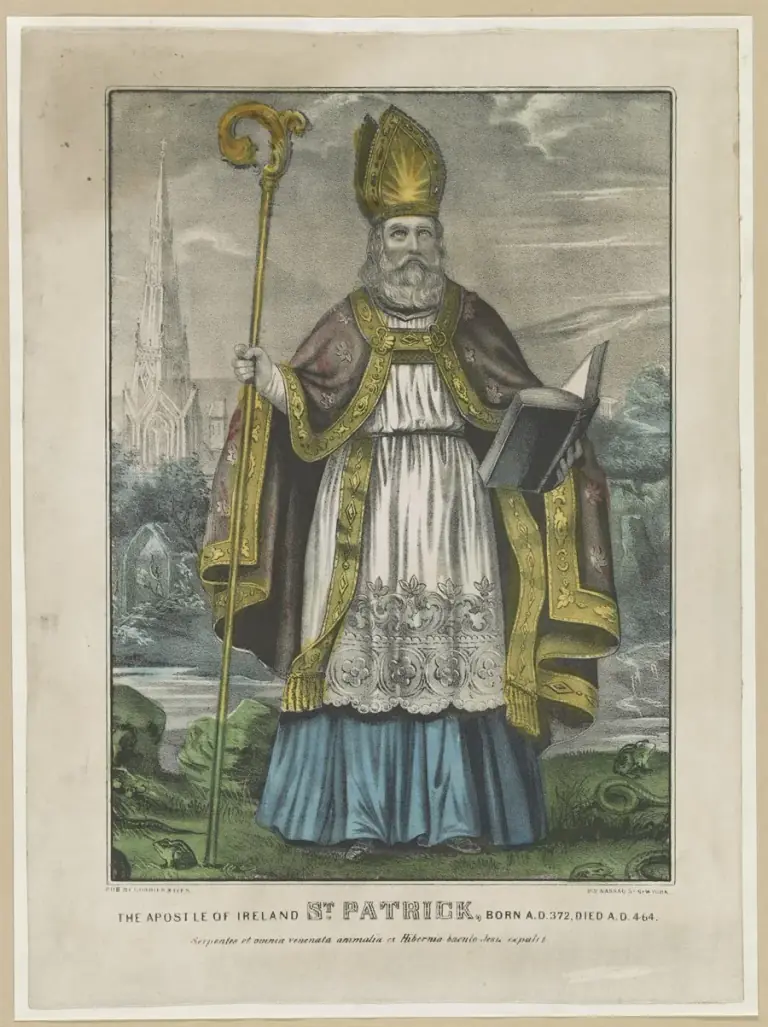
- Born
- Britain; the 1913 Catholic Encyclopedia gives 387 at Kilpatrick, Franciscan Media a cautious c. 415 12
- Died
- March 17, 493, at Saul, near Downpatrick, Ireland 1
- Taken as a slave
- At sixteen, and held six years herding in Ireland 1
- Wrote
- The Confessio, accepted by modern scholars as genuinely his 1
Saint Patrick was kidnapped by slavers at sixteen and spent six years herding animals for a man who owned him. He escaped, got home, and then went back - as a bishop, to the people who had enslaved him. Everything else about him, including the snakes and the shamrock, is decoration on that one fact.
Six years a slave
Patrick was born in Britain - the 1913 Catholic Encyclopedia says at Kilpatrick near Dumbarton in 387, while Franciscan Media gives a more cautious c. 415. 12 At the age of sixteen he was "carried off into captivity by Irish marauders and was sold as a slave" to a chieftain named Milchu, and spent six years herding flocks. 1
He was a teenager, alone, in a country he did not know, belonging to somebody. The faith he had grown up around and largely ignored became, in those years, the only thing he had.
Escape, and going back
He escaped and made his way home. He then trained for years - at Saint Martin's monastery at Tours, at the island sanctuary of Lerins, and under Saint Germain at Auxerre - and received episcopal consecration before returning. 1
The return is the part worth stopping on. Having got out of Ireland, he went back to it, deliberately, as a bishop, to preach to the people whose countrymen had stolen him. He landed around 433. 1
The fire at Slane
The best-known episode of his mission is the Paschal fire he kindled at Slane on Easter Eve in 433, in defiance of the druidical assembly gathered at Tara, where no fire was to be lit before the king's. 1 It is the founding scene of Irish Christianity, and it was an act of open provocation.
He died on 17 March 493 at Saul, near Downpatrick, though the 1913 article notes that some sources give 460 or 461. 1
The Confessio
Patrick wrote his own account of his life, the Confessio, and modern scholars accept it as genuinely his. 1 That is rare: a fifth-century saint who left a first-person document. Anyone who wants Patrick rather than the legend can simply read what he wrote.
The snakes and the shamrock, it is worth saying, are not in it, and are not in either source cited here.
What is Saint Patrick the patron saint of?
Saint Patrick's feast day
Praying with Saint Patrick
Patrick's faith did not come from the Christian household he grew up in. It came from six years of slavery, alone, herding animals for a man who owned him. 1 If the deepest thing in your life arrived through the worst part of it, he understands that arithmetic.
Then he went back. Trained, consecrated a bishop, and returned to the country whose raiders had stolen him at sixteen. 1 Forgiveness in Patrick is not a feeling he worked his way around to. It is a boat he got on.
He lit the Paschal fire at Slane on Easter Eve knowing perfectly well whose fire was supposed to be lit first. 1 There are moments when discretion stops being a virtue, and he picked one deliberately.
He wrote his own account, the Confessio, and scholars accept it as genuinely his. 1 Very few saints of that era can be read in their own words, so you can meet him directly instead of through what has been made of him since.
Saint Patrick, pray for us.
Sources
Saints to turn to next
Others in this collection who are turned to for some of the same things.
- Saint CyprianBirth unknown - September 14, 258CourageConversionSuffering and illness
- Saint EustaceMartyred at Rome, in 118 by tradition; other accounts give 140 or 188ConversionCourageSuffering and illness
- Saint Gregory the Illuminatorc. 257 - c. 337 (both dates uncertain)ConversionSuffering and illnessCourage
- Saint John Paul IIMay 18, 1920 - April 2, 2005CourageSuffering and illnessConversion