Saint Eustace
Martyred at Rome, in 118 by tradition; other accounts give 140 or 188
- Patron saint of
- Hunters and the city of Madrid, and invoked in difficult situations, according to the Catholic Encyclopedia 1; Catholic Culture adds family troubles and protection against fire, and lists firefighters and trappers among others 34
- Also called
- Placidus before his baptism; Eustachius; more properly Eustathius, according to Catholic Culture 124
- Died
- In 118 under Hadrian 1; around 140 2; 188, in Catholic Culture's note from the Roman Martyrology 3
- Family
- His wife Theopista and their sons, Agapius and Theopistus, martyred with him 1
- Emblems
- A crucifix, a stag, an oven 1
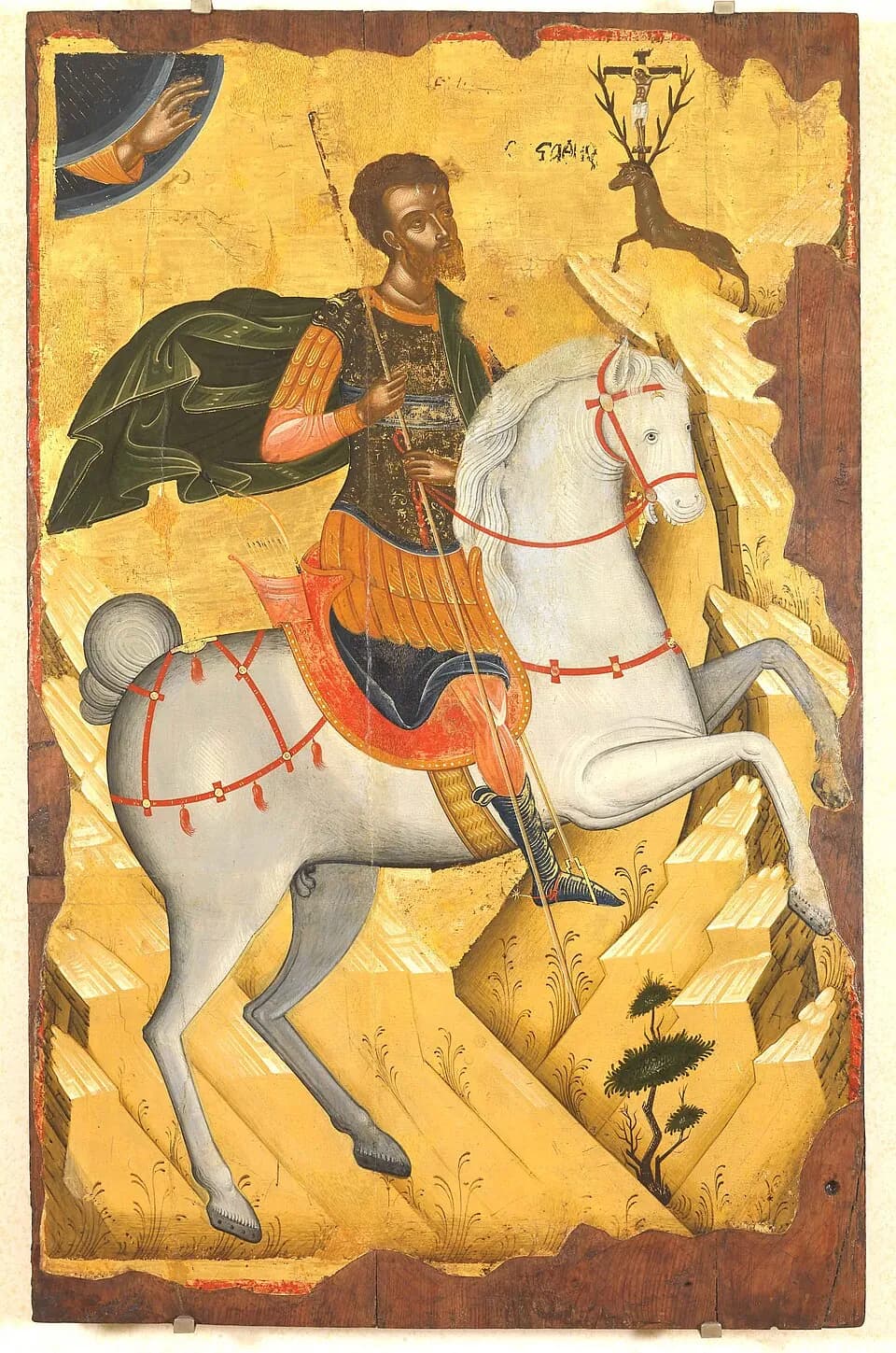
Saint Eustace is the Roman general who, the legend says, was out hunting when a stag turned toward him with a crucifix between its antlers, and who was later put to death with his wife and two sons inside a heated bronze bull. 13 The 1909 Catholic Encyclopedia tells all of this as legend and calls his Acts "certainly fabulous," but it also says his veneration "is very old in both the Greek and Latin Churches." 1 He is one of the Fourteen Holy Helpers and, with Saint Hubert, a patron of hunters. 15
The general and the stag
In the legend his name before baptism was Placidus, and he was a general under the emperor Trajan, still a pagan. 1 Catholic Culture's page for his day, excerpting James Bentley's A Calendar of Saints, calls it "the charming legend of Saint Eustace," and begins it on a hunt: Placidus was chasing a noble stag that suddenly turned and came toward him, and between its antlers he saw a crucifix. 3 Tradition places the vision at Guadagnolo, between Tivoli and Palestrina, not far from Rome. 1
The sources do not agree on what the voice said. In Francis Mershman's Catholic Encyclopedia article it told him that he was to suffer much for Christ's sake. 1 Vatican News has the voice reveal itself as Christ. 2 Bentley says only that it called him by name, and adds a line of his own: "The hunter himself had been caught." 3
Baptism, a scattered family, and the bronze bull
Placidus was baptized and took the name Eustachius, and his wife and sons were baptized with him. 12 Mershman calls her Tatiana, or Trajana, and says she took the name Theopista; he names the boys Agapius and Theopistus. 1 Bentley gives the sons as Agapetus and Theopestus. 3 He also says that Eustace gave away much of his money after his conversion. 3
Then the family came apart. Mershman says only that "through adverse fortune the family was scattered, but later reunited." 1 Vatican News says they were reunited on the eve of their martyrdom. 2 In Bentley's telling Eustace took up his command again and led the legions to great victories, and it was at the celebrations after one of those victories that the four of them refused to sacrifice to the pagan gods. 3
For that they were killed together. Mershman says they "suffered death in a heated brazen bull." 1 Bentley puts the bull in the Colosseum and calls it a bizarre way to die. 3 The Fourteen Holy Helpers page on Catholic Culture says the same thing more simply: he and his family were burned together inside a bronze bull. 4
What the sources make of the story
Mershman does not hedge. "The Acts are certainly fabulous," he writes, and they "recall the similar story in the Clementine Recognitions." 1 He dates them to the seventh century and notes that Saint John Damascene used them. 1 Bentley says the same from another direction: the events are supposed to have happened around 118, but no account of Eustace and his family has been found earlier than the seventh century. 3 Catholic Culture's Fourteen Holy Helpers page begins its entry on him, "Not much is known about St. Eustace." 4
The dates show it. Mershman gives his death under Hadrian in 118. 1 Vatican News gives "around the year 140." 2 Catholic Culture's note from the Roman Martyrology gives 188. 3 Mershman also records that Baronius, in his Annales Ecclesiastici, would identify him with a Placidus whom Josephus mentions as a general under Titus. 1 None of the sources settles any of this, and this page does not try.
The same vision of a stag with a crucifix between its antlers is told of Saint Hubert of Liège, who lived some six hundred years later. 35
A very old veneration
Whatever the Acts are worth, the devotion to him is old. 1 The church of Sant'Eustachio in Rome, which Mershman describes as the title of a cardinal-deacon, existed by 827 according to the Liber Pontificalis, and perhaps as early as the time of Gregory the Great, who died in 604. 1 It claims to hold his relics, and some are said to be at Saint-Denis and at Saint-Eustache in Paris. 1 Catholic Culture's Roman Martyrology note says his cult was introduced at Rome in the early Middle Ages. 3
Bentley calls him one of the most popular saints of the Middle Ages, celebrated in prose and poetry, in art, and in popular devotion. 3 Mershman lists his emblems as a crucifix, a stag and an oven. 1 In the Greek icon on this page he rides a white horse in Roman armor and looks up at the stag on the rock, the crucified Christ standing between its antlers.
He was also counted among the Fourteen Holy Helpers. 14 Jennifer Gregory Miller, writing for Catholic Culture, describes them as saints invoked together because they "have been efficacious in assisting in trials and sufferings." 4 Each kept a separate feast of his or her own, they were often represented together, and devotion to them often began in a monastery that held their relics. 4 All of them were martyrs except Saint Giles, and she says they came to be invoked as a group mainly because of the Black Death of 1346 to 1349. 4 Her list puts Eustace among them, alongside George, Christopher, Barbara, Blaise and the rest. 4
What is Saint Eustace the patron saint of?
Hunters, above all. Mershman calls him patron of hunters and of the city of Madrid, and says he is invoked in difficult situations. 1 Bentley and Miller both name him patron of hunters, and Miller adds that he is patron "in all kinds of difficulties" and invoked in family troubles. 34 Philip Kosloski, writing for Aleteia, says that Eustace and Hubert both became patrons of hunters, Hubert better known in northern Europe and Eustace in the south. 5
Catholic Culture's page for his day prints a longer list: protection against fire, against torture, difficult situations, fire prevention, firefighters, hunters and huntsmen, torture victims, family troubles and trappers, several towns in Italy, and Madrid. 3 Miller's page also says he is invoked against fire, "temporal and eternal." 4 Neither page gives a source for the individual entries.
Catholic Culture's page adds that his story is close to Hubert's, and that which of the two hunters pray to has depended on where they live. 3 Kosloski ends the same way: both saints are still invoked by hunters, that they may have a safe and prosperous hunt. 5
Saint Eustace's feast day
His feast is September 20. 1235 Mershman gives that as the date in the West, and adds that the Eastern Churches keep him on November 2. 1 Kosloski notes that the feasts of Eustace and Hubert fall around the usual deer-hunting season in various countries. 5
September 20 is also the memorial of Saints Andrew Kim Taegon, Paul Chong Hasang and their companions, the Korean Martyrs, and both Vatican News and Catholic Culture put them first that day. 23 Vatican News lists Eustace after them, and Catholic Culture lists him as a commemoration from the Roman Martyrology. 23 Miller notes that the Fourteen Holy Helpers were once honored together on August 8, until that common feast was dropped in the 1969 reform of the Roman calendar. 4
Praying with Saint Eustace
Almost nothing in his story can be checked, and the Catholic Encyclopedia says so plainly. 1 What can be checked is that people in Rome, Paris, Madrid and across the Greek East kept his memory for well over a thousand years, built churches in his name, and gave him the stag and the crucifix as his emblems. 13
The legend puts his conversion in the middle of an ordinary day, on a hunt, and Aleteia describes him as a man who loved to hunt. 35 In Mershman's version the voice did not promise him anything easy. It told him he would suffer much for Christ, and the rest of the story is that suffering: his family lost, then found, then killed together with him. 12
In both versions of the ending the refusal comes at a moment of success. 13 Mershman says the family would not sacrifice to the idols after a victory, and Bentley places the refusal at the celebrations that followed victories Eustace himself had won. 13 A general who had kept his command after his baptism was asked, at the height of it, to give thanks to gods he no longer worshiped, and the legend has him say no with his wife and sons beside him. 13
The family is what sets his story apart from Hubert's, which has the same stag. 5 Eustace was baptized with his wife and sons, separated from them, reunited with them, and died beside them. 12 Miller's page records that people with family troubles have prayed to him. 4
Saint Eustace, pray for us.
Sources
- 1.Francis Mershman, "Sts. Eustachius and Companions," The Catholic Encyclopedia, Vol. 5 (New York: Robert Appleton Company, 1909).
- 2."St. Eustachius," Saint of the Day, September 20, Vatican News.
- 3."St. Eustace and His Companions," Liturgical Year, September 20, Catholic Culture, excerpting James Bentley, A Calendar of Saints.
- 4.Jennifer Gregory Miller, "Fourteen Holy Helpers," Liturgical Year activities, Catholic Culture.
- 5.Philip Kosloski, "Why St. Eustace and St. Hubert are patron saints of hunters," Aleteia, September 20, 2021.
Saints to turn to next
Others in this collection who are turned to for some of the same things.
- Saint CyprianBirth unknown - September 14, 258CourageConversionSuffering and illness
- Saint Gianna Beretta MollaOctober 4, 1922 - April 28, 1962Marriage and familyCourageSuffering and illness
- Saint John Paul IIMay 18, 1920 - April 2, 2005CourageSuffering and illnessConversion
- Saint Josephine Bakhitac. 1869 - February 8, 1947Suffering and illnessConversionCourage